KIEP: "This Year's Global Growth Rate to Fall Short of Pre-Pandemic Average...Prolonged High Oil Price Phase"
Global Growth Rate Maintained at 3.0% This Year
Driven by Upward Revisions for the US and China
The Korea Institute for International Economic Policy (KIEP), a government-affiliated research institute, has projected the global economic growth rate for this year at 3.0%. This represents a 0.4 percentage point decrease from last year and is considerably lower than the pre-pandemic 10-year average of 3.7%. Despite growth drivers such as increased investment in artificial intelligence (AI), it is anticipated that rising energy prices due to the US-Iran war and ongoing tariff uncertainties originating from the United States will collectively suppress global economic growth.
In its revised report on the "2026 Global Economic Outlook" released on May 12, KIEP stated, "While the United States is expected to maintain solid growth, Europe and Japan are likely to continue experiencing sluggish growth trends." The 3.0% growth rate presented in this report is consistent with the previous forecast (3.0%) released in November last year.
KIEP explained, "The decision to maintain the growth outlook despite the Middle East war variable reflects upward adjustments in the growth forecasts for major economies such as the United States and China, which had previously been set conservatively." KIEP also noted, "A 3.0% growth rate indicates that the global economy remains in a slowdown phase."
The institute analyzed that the prolonged Middle East energy shock, persistent trade uncertainties even after rulings on mutual tariffs, increased fiscal burdens in major economies, and instability in government bond markets will all serve as independent downward factors for growth. The global economic growth rate for next year is also expected to remain at around 3.1%, and the energy shock from the Middle East is not expected to subside within this year.

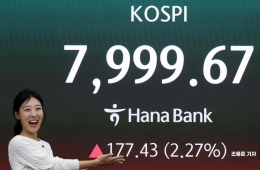
On the 2nd, the domestic stock market started to rise for two consecutive days amid expectations that the US-Iran war would soon end, but it is falling more than 2% after the speech by U.S. President Donald Trump. The live broadcast of President Trump's speech is being shown in the dealing room of Hana Bank headquarters in Jung-gu, Seoul. April 2, 2026. Photo by Jo Yongjun
View original imageSolid Growth in the US...Europe and Japan Lag Behind
KIEP's decision to maintain its outlook was driven by upward revisions in the growth rates for the United States and China. Despite the burden of higher energy costs and tariff uncertainties stemming from the war with Iran, the United States is expected to achieve 2.0% growth, supported by robust AI investment. This 2.0% growth rate is 0.4 percentage points higher than the previous projection.
In Europe, Germany—the region's largest economy—is expected to post a growth rate of 0.9% as recovery remains limited due to sluggish manufacturing performance, despite increased fiscal spending. Japan is forecast to register only 0.7% growth, constrained by deteriorating terms of trade and weakening external demand.
As for China, which has significant global economic influence, despite sluggish real estate and slow domestic demand recovery, the country is expected to grow by 4.5% owing to increased investment in strategic sectors such as AI and robotics, as well as an active fiscal expansion stance.

Gradual Reduction in Dollar Strength...Progressive Stabilization of the Won
The dollar is expected to face upward pressure in the first half of this year due to higher-than-expected inflation and the possibility that US interest rates will remain unchanged; however, the strength of the dollar is forecast to gradually diminish in the second half and into next year as expectations for interest rate cuts increase.
KIEP stated, "Rising oil prices originating from the Middle East, the resulting increase in inflation, and heightened demand for safe assets are all factors that will strengthen the dollar. However, easing geopolitical tensions and expectations for interest rate normalization will act as downward factors for the currency."
The won-dollar exchange rate is expected to remain highly volatile due to external uncertainties, but is forecast to gradually stabilize in the second half of the year and into the next year.
Factors contributing to upward pressure on the exchange rate include a stronger dollar due to heightened global risk aversion and rising international oil prices caused by geopolitical risks in the Middle East and other regions. On the other hand, potential downward pressure on the won could arise if domestic economic growth slows, if there is a greater outflow of foreign securities capital, or if the recovery in the semiconductor sector weakens.
Factors cited as contributing to downward pressure on the exchange rate include a weakening dollar as expectations for US interest rate cuts grow, an improved current account balance driven by a recovery in semiconductor exports, renewed inflows of foreign securities capital, and stabilization of domestic financial markets.
KIEP did not provide specific exchange rate forecasts. However, major international investment banks are forecasting that the won-dollar exchange rate will fall to around 1,480 won in the second quarter, 1,461 won in the third quarter, and 1,450 won in the fourth quarter, suggesting that the won is likely to appreciate moderately toward the end of the year.

International Oil Prices to Remain High at 85 Dollars per Barrel
Regarding international oil prices, KIEP expects the current phase of high prices, which exceeds pre-war levels, to be maintained. However, next year, with the continuation of the ceasefire, normalization of maritime transport, and gradual easing of supply constraints, oil prices are projected to remain above pre-war levels but decrease compared to this year.
KIEP noted, "With extreme oil price volatility inherent in the current Middle East situation, whether the US-Iran military conflict is resolved will be a key factor determining the direction of oil prices. While increased production from non-OPEC+ countries will exert some downward pressure, the process of rebuilding strategic oil reserves that were released to stabilize the market is expected to generate large-scale buying demand through next year, raising the possibility that high oil prices will persist over the long term."
KIEP projected this year's average international oil price at 85.4 dollars per barrel of West Texas Intermediate (WTI). This is lower than the US Energy Information Administration (EIA) forecast of 87.41 dollars but higher than the International Monetary Fund (IMF) estimate of 82.22 dollars.
Hot Picks Today
!["Those Who Hesitated at 3,000 Still Haven't Bought" 7 Trillion-Won Asset Manager Says "Opportunities Remain" [Investment Strategies of the Wealthy] ⑦](https://cwcontent.asiae.co.kr/asiaresize/93/2026050715101553735_1778134216.jpg) "Those Who Hesitated at 3,000 Still Haven't Bought" 7 Trillion-Won Asset Manager Says "Opportunities Remain" [Investment Strategies of the Wealthy] ⑦
"Those Who Hesitated at 3,000 Still Haven't Bought" 7 Trillion-Won Asset Manager Says "Opportunities Remain" [Investment Strategies of the Wealthy] ⑦
- "Why Are My Child's Grades Like This?" Surge in Overprotected, Isolated, and Reclusive University Students [University Students in Crisis] ⑧
- "Not Just Olive Young"... Word-of-Mouth Drives Foreigners to Pharmacies, Spending Surges 156%
- "Don't Come to Work from Tomorrow": Two Million Face Unemployment Crisis...Iran Shaken by War Shock
- "SK hynix Could Reach 2.8 Million Won; Why Securities Firms Are Confident That the Main Chapter of AI Has Not Even Begun Yet [Click eStock]"

In its outlook released on this day, KIEP also published the results of a survey of 49 experts from academia, government, and private research institutes. When asked about the impact of the US-Iran war on US consumer prices this year, respondents expected it would raise the monthly average by more than 0.2 percentage points but less than 0.3 percentage points compared to the same period last year. As for the international oil price (WTI) forecast by the end of this year following the US-Iran war, respondents expected it to exceed 90 dollars per barrel and possibly reach up to 100 dollars. The median value for the US base interest rate was projected to be in the range of 3.25% to 3.50%. For the most important tasks that major governments should pursue over the next two to three years to support the global economy, 53% of experts pointed to "strengthening international cooperation to manage geopolitical risks and resolve major disputes."
© The Asia Business Daily(www.asiae.co.kr). All rights reserved.