"S&P 500's Best and Worst Days Hinge on Trump's Remarks"
Some Point Out, "Because Passive Funds Have Become Mainstream"
Remarks by U.S. President Donald Trump have emerged as a key driver of volatility in the U.S. stock market, according to recent analyses.

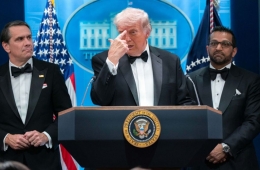
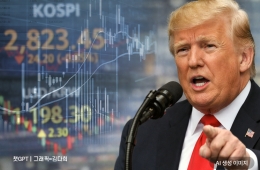
On April 25 (local time), Bloomberg cited an analysis by market research firm Fundstrat Research, which found that since President Trump's inauguration, the five best and five worst trading days for the Standard & Poor's (S&P) 500 index were all determined by his remarks or his posts on the social networking service Truth Social. According to the analysis, there has been no precedent since the Ronald Reagan administration in 1981 of an individual so frequently influencing market fluctuations.
Typically, factors such as the Federal Reserve’s interest rate decisions and corporate earnings influence the market. However, it is now pointed out that President Trump himself plays a pivotal role. Wall Street has clearly begun to focus on the president’s statements.
This trend was particularly evident during the Iran war situation. Recently, the S&P 500 index experienced its sharpest 'V-shaped' decline and surge since 2020. On March 30, the index fell by 9% from its previous peak, nearing a technical correction, but rebounded within just 11 trading days to reach an all-time high.
For example, on March 20, when President Trump stated that he did not want a ceasefire with Iran, the S&P 500 index fell by 1.5%. However, on March 31, when he announced that "negotiations with Iran are progressing smoothly and the end of the war is imminent," the index jumped 2.9%, reaching its highest point since May and continuing its upward trend.
The largest single-day rise for the S&P 500 index during President Trump’s second term occurred on April 9 last year, when he temporarily suspended tariff hikes, causing a 9.5% surge. The index also rose by 3.3% on May 12, when the U.S.-China trade truce agreement was announced. Conversely, on April 3 last year, when President Trump imposed sweeping tariffs, the index declined by 4.8%. The following day, news of China’s retaliatory tariffs led to an additional 6% drop.
Not only the stock market but also commodity prices exhibited increased volatility, and oil prices fluctuated sharply, reaching levels seen at the onset of the COVID-19 pandemic.

Hardika Singh, an economic strategist at Fundstrat, remarked, "He has the market on a leash," adding, "It is unprecedented for a president to wield such control over the fate of the stock market."
However, some argue that this analysis amounts to a 'statistical illusion.' There are also claims that as passive funds tracking the index have become mainstream, variables such as presidential statements have become more sensitive overall in influencing the market.
Hot Picks Today
!["Overseas Travel Is Out, Let's Earn Daily Wages with Short-Term Jobs"... Rising Living Costs Drive Japanese Seniors to Part-Time Work [Sunday Japan Culture]](https://cwcontent.asiae.co.kr/asiaresize/93/2026042215265936333_1776839219.png) "Overseas Travel Is Out, Let's Earn Daily Wages...
"Overseas Travel Is Out, Let's Earn Daily Wages...
- A Single Card Worth 24 Billion Won... "Over 3,000% Higher Returns Than the Stock...
- Donghun Han and Minshik Park Meet for the First Time in Busan Buk-gu Gap... Seni...
- "I Just Wore My Dad's Coat"... Diagnosed with Malignant Lung Cancer Decades Late...
- No Work, No Inheritance for the Eldest... 30 Billion KRW in Shares Gifted to Sec...
Meanwhile, on April 24, expectations for a second ceasefire negotiation between the U.S. and Iran fueled a rally in technology stocks, with both the S&P 500 index and the Nasdaq index reaching all-time highs.
© The Asia Business Daily(www.asiae.co.kr). All rights reserved.