Special Deduction: Abolishing Ownership and Unifying by Residency?... A Look at Past Revisions
Lee: "Reduction in Deduction for Non-Residential Holding Period, Increase for Residential Holding Period"
When Introduced in 1988: Up to 30% Deduction for Over 10 Years of Ownership
Kim Jinpyo's 2008 Revision: Increased Maximum Deduction to 80%
Koh Yongjin's 2020 Revision: Eased to 10 Years Ownership + 10 Years Residence
President Lee Jae-myung's announcement on April 24 regarding concrete directions for the restructuring of the special deduction for long-term ownership in capital gains tax (so-called "jangteukgongje") is interpreted as a direct rebuttal to recent political attacks from the opposition, who have labeled the move as a "tax bomb" and "asset seizure."
Previously, President Lee had dismissed the opposition's criticism as "blatant false agitation," and on this day, he doubled down. Although he appears to be seeking public opinion by posting on social media, the conclusion seems to be set toward revising the special deduction. The only issues left to resolve are the specific scope, the deduction rate, the timing, and the grace period.
In a post on X that day, President Lee stated, "It would be appropriate to reduce the deduction for non-residential holding periods and instead increase the deduction for residential holding periods." This is the first time he has indicated that the deduction rate based on the period of residence could be increased, going beyond his previous comments about reducing or eliminating the deduction rate based on the total holding period.

President Lee Jae-myung is speaking at the Korea-Vietnam Business Forum held at a hotel in Hanoi, Vietnam, on the 23rd (local time). Photo by Yonhap News Agency
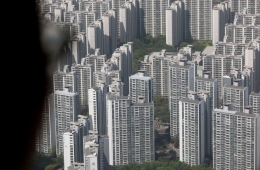
View original imageCurrently, capital gains tax on housing applies to the portion of the actual transaction amount exceeding 1.2 billion won. If a homeowner has resided in the property for more than two years or has owned it for more than three years, a certain percentage is deducted. The deduction rate based on the period of residence ranges from 8% to 40%, and the deduction for ownership ranges from 12% to 40%. If the homeowner has lived in the property for more than 10 years while owning it, up to 80% can be deducted.
If President Lee implements the changes he has discussed so far, it would be possible to introduce a grace period of about six months to one year, during which the deduction rate for the ownership period would be gradually reduced, while the deduction rate for the period of residence would be increased. If deduction rates are cut, controversy over a tax increase is inevitable; however, since the formula would be adjusted for balance, resistance is expected to be relatively muted.
As the president and the opposition leadership face off directly over the special deduction's restructuring, there is renewed interest in how the system has changed since its introduction. Whenever controversy arose regarding multiple homeowners or non-residential single homeowners, President Lee has consistently argued that it is not the groups benefiting from the system that are to blame, but rather that the problem lies in the way the system was designed.

In the party strategy meeting held at the National Assembly on the 21st, Song Eon-seok, floor leader of the People Power Party, criticized the government's and ruling party's moves to abolish the special deduction for long-term housing ownership. Using a drawing tool, he compared the taxes on the apartment in Bundang, Seongnam, Gyeonggi Province, owned by President Lee Jae-myung. Photo by Yonhap News Agency
View original imageIn conclusion, both the ruling and opposition parties have been equally active in expanding the benefits of long-term holding deductions. The special deduction was first introduced in 1988. At that time, under government leadership, a system was established that allowed a 10% deduction on capital gains for those who held property for five to ten years and a 30% deduction for those who held it for over ten years.
Later, when housing prices skyrocketed during the Roh Moo-hyun administration, there were calls to protect real demand buyers. With a bill sponsored by Park Jongkeun, then-chair of the National Assembly's finance committee from the opposition Grand National Party, the deduction rate was raised to 45% for homeowners who had owned a single property for more than 15 years.
After a change in administration, the new government set a policy to reduce capital gains tax for long-term single-homeowners. Kim Jinpyo, then a member of the Democratic United Party, the predecessor of the current Democratic Party, introduced and passed a revision to the income tax law in 2008 that raised the deduction rate to 80% for properties held for over 20 years.
The current system, which increases the deduction rate by four percentage points every year after three years of ownership, up to a maximum of 80%, originates from this revision. Subsequently, a bill sponsored by Koh Yongjin of the Democratic Party in 2020 added a requirement of at least two years of residence and changed the rule to allow a 10-year ownership plus 10-year residence combination.

Civil society has consistently pointed out that the deduction rates of the special deduction are excessively high compared to other tax systems. Despite being a tax on unearned income, the system allows a deduction for the high-end housing threshold of 1.2 billion won, and on top of that, permits an additional maximum deduction of up to 80%, which, they argue, has created an environment where society is inevitably obsessed with real estate.
Hot Picks Today
 After Firing 1,000 $3.6 Million Missiles, U.S. ...
- "We Can't Hold Out Any Longer": Airlines Reduce Seats, Cut Routes, and Face Bank...
- Believing in a 'Blue House Administrator' Business Card... Lost 600 Million Won ...
- "Grandma, This Isn't Made by AI, Right?"... Thought It Was Old-Fashioned, But No...
- "Stabbing Pain" Should Not Be Ignored... This Disease Linked to Obesity Injectio...
The Citizens' Coalition for Economic Justice released a study last month on the reality of the special deduction, stating, "An enormous deduction rate that is never applied to earned income is being applied to unearned real estate gains, which inevitably makes our society a republic of real estate. The special deduction should be the first item to be fundamentally reviewed in the process of establishing tax justice in real estate."
© The Asia Business Daily(www.asiae.co.kr). All rights reserved.