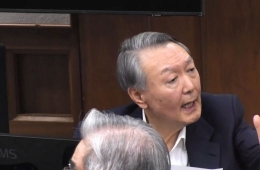
Jung Won-oh: "Under Mayor Oh, Seoul's Growth Rate Declined... Aiming for G2 Leap to Surpass New York and Tokyo"
"Mayor Oh Se-hoon Failed in Spatial Planning, Industrial Ecosystem, and Management Philosophy"
Aiming for "Asia's Number One Economic and Cultural City"
Three Pillars: Five City Centers, Youth Startup Innovation Clusters, and Special Zones
Jung Wonoh, the Democratic Party of Korea's candidate for Seoul mayor, stated on the 23rd, "Since the COVID-19 pandemic, during Mayor Oh Sehoon's tenure, Seoul's growth rate has lagged behind that of the whole nation. Seoul is dragging down the national average," expressing his ambition to transform Seoul into a global G2 city.

On the afternoon of the 23rd, Jung Wonoh, the Democratic Party of Korea's candidate for Seoul mayor, held the 'G2 Seoul Vision Declaration Ceremony' at the National Assembly Members' Office Building and presented the specific action plan "1·2·3·4 Strategy" for Seoul's leap to G2. Jung Wonoh's campaign team
View original imageOn this afternoon, Candidate Jung held the "G2 Seoul Vision Declaration Ceremony" at the National Assembly Members' Office Building and presented the specific action plan, the "1·2·3·4 Strategy," for Seoul's leap to G2. The "1·2·3·4 Strategy" stands for: ▲ No. 1 city in Asia for economy and culture ▲ Creation of 2 additional city centers ▲ 3 major youth startup clusters ▲ 4 special zone pipelines.
He declared, "By 2030, we will enter the top three in the Global Power City Index (GPCI) and make Seoul the No. 1 Asian city in economy and culture, surpassing Tokyo," adding, "The competition of the 21st century is not between nations but between cities, and Seoul's rival is New York."
"Mayor Oh Sehoon Failed in Space, Industrial Ecosystem, and Management Philosophy"
Candidate Jung said, "Urban development in Seoul has been stagnant for 14 years," and argued, "Mayor Oh has failed in all three areas: spatial planning, industrial ecosystem, and management philosophy." Regarding spatial planning, he explained, "Even though industry, housing, and commuting already operate at the metropolitan area level, the administration tried to solve Seoul’s problems strictly within Seoul’s boundaries," adding, "They failed to consider the millions of commuters in the metropolitan area."
As for the failure in the industrial ecosystem, he criticized, "They focused only on keeping corporate headquarters, letting research, production, logistics, and talent flow out to the outskirts," and, "They failed to foster new industries such as artificial intelligence (AI) and finance, befitting a megacity like Seoul." Regarding Mayor Oh’s management philosophy, he pointed out, "Ultra-high-density development continued centered around the existing downtown, but there was no consideration for what and how to fill those spaces," adding, "A focus on skyscrapers, asset sales, and short-term development does not build a city’s competitiveness."
The Four Goals of G2 Seoul: No. 1 in Asia, Five City Centers, Youth Startups, and Special Zones
The G2 Seoul vision declared by Candidate Jung is built on three pillars—space, talent, and industry—that support the goal of making Seoul Asia’s top city in economy and culture. He asserted that the entire Greater Seoul Area should be united as a single economic zone, the K-Arena cluster and MICE platforms should be advanced, and stay-type cultural hubs in areas like Seongsu, Jamsil, and Hongdae should be expanded. He also pledged to cultivate two new innovation city centers—Sinchon-Hongdae and Cheongnyangni-Wangsimni—as future-oriented city centers, in addition to the existing three (Central Seoul, Yeouido-Yeongdeungpo, Gangnam).

Candidate Won Oh Jung's 'G2 Seoul, Strategies 1, 2, 3, and 4'. Won Oh Jung's Campaign Team
View original imageThe plan envisions Sinchon as a content hub, Cheongnyangni as a center for bio and innovation, and Gwanak-gu as a youth base focused on deep-tech startups. Seoul City will provide startup salaries and grants at these three major hubs.
The northwest and Sinchon area will form a "content industry belt" through high-density mixed-use development around Sinchon. Through connections with the Sangam Digital Media City (DMC), a K-content hub and creator growth ladder will be established. The northeast and Cheongnyangni area will function as an "innovation belt," with Cheongnyangni Station’s mixed-use development, linkage with Hongneung, and a university R&D cluster comprising five major universities to foster Cheongnyangni as a bio-startup hub. The southern Gwanak area will serve as a "startup belt," strengthening the Gwanak S-Valley, a tripartite cooperation between Seoul City, Gwanak-gu, and Seoul National University, and focusing on the Gwanak Venture Town startup ecosystem.
Four Special Zone Pipelines Centered on Yongsan

On the afternoon of the 23rd, Jeong Wono, the Democratic Party of Korea's candidate for Seoul mayor, held the 'G2 Seoul Vision Declaration Ceremony' at the National Assembly Members' Office Building and presented the specific execution plan for Seoul's leap to G2, the '1·2·3·4 Strategy.' Jeong Wono's campaign team
View original imageCandidate Jung plans to designate Hongneung, Yangjae, Guro-Gasan, and Yongsan as four special zone pipelines. Hongneung, Yangjae, and Yongsan will be designated as special zones, while Guro will be promoted through a Seoul City ordinance.
In particular, Candidate Jung announced that among the four special zones, Yongsan would be developed as the "global gateway" for Seoul’s leap to G2. In his vision for Seoul, Yongsan will fulfill four functions: ▲ a platform for business transformation ▲ an urban demonstration platform ▲ a global gateway ▲ support for attracting investment and developing sales channels.
He emphasized, "For foreign companies to come to Korea, issues regarding taxes, visas, and free remittance must be resolved," adding, "The solution is for the government to designate these as special zones. I will work closely with the government to achieve this."
Hot Picks Today
 The Quoted 800,000 Won, the Bill Was 5 Million....
- "How Do Six People Sleep in a 44㎡ Apartment?" Subscription Point System Controv...
- They Say They'd Rather Go to Japan Than Travel Domestically... But a 'Surprising...
- "I Felt Suffocated": College Students Packing Their Bags and Escaping the Secula...
- "Never Hike Alone as a Woman" "Even Two Are at Risk"... Growing Fear of Crime on...
In conclusion, Candidate Jung stated, "To make Seoul a G2 city, we will focus on AI, bio, culture, and R&D as new growth engines," adding, "By directly connecting Seoul with the global community, we will drive regional development, promote economic growth, and enhance competitiveness."
© The Asia Business Daily(www.asiae.co.kr). All rights reserved.
![The 'Epic' 1,500 Trillion Won Bill... In the End, the Poor Pay the Price [Data Pick]](https://cwcontent.asiae.co.kr/asiaresize/307/2026042310001637425_1776906017.jpg)