"How Do Six People Sleep in a 44㎡ Apartment?" Subscription Point System Controversy Sparked by Gangnam 'Lottery Subscription'
Otiere Banpo Cut-Off at 74 Points... Highest Scores Only for Five-Member Families
With "Number of Dependents" Inflation, Three- and Four-Member Families Left Behind
Even Perfect Scores Not Enough to Win in Popular Areas Like Gangnam
#. Office worker Park (48) and his wife recently canceled their subscription savings account, which they had maintained for nearly 20 years. Since Park previously owned a small apartment in Gyeonggi Province, he is not eligible for the "first-time homebuyer special supply" program, and, having no children, realized that winning an apartment lottery for a popular property in Seoul under the points system would be virtually impossible. Instead, Park changed his home-buying strategy to purchasing a villa in a redevelopment area in Seoul, planning to wait for a cooperative member sale.
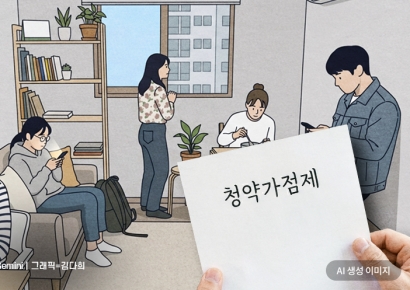
Controversy is growing over the policy limitations of the "subscription points system" amid a series of recent subscription outcomes for small apartments in the Gangnam area. The number of dependents has become the decisive variable for winning small apartments—typically with only two or three rooms—especially in the Gangnam area.

◆A six-member household living in a 44㎡ apartment?= Calls for reform of the subscription system are growing after it was revealed that the cutoff score for a 44㎡ unit at "Otierbanpo" in Jamwon-dong, Seocho-gu, recently reached 74 points, with the highest score being 79 points.
A score of 74 points is achievable only for a five-member household, and 79 points requires a six-member household. If a six-person family resides in a 44㎡ apartment, the living space per person is just 7.3㎡. This is almost the same as the minimum 7㎡ per person required for a gosiwon (single-room occupancy) under Seoul city regulations. Moreover, this calculation includes the total living space, such as bedrooms, kitchen, and bathroom.

The Banpo Raemian Trinity, which was offered for sale in November last year, is a prime example. This apartment complex, supplied only in mid-to-small unit sizes (59–84㎡), had cutoff scores in the 70s for all seven types. For a four-person household, no matter how long they've been without a home, winning was out of reach.
Other recently supplied complexes in the Gangnam area—such as "Yeoksam Central Xi," "Otierbanpo," and "Arc Road Seocho"—showed similar results. The lowest cutoff score was 69, which is the maximum possible for a four-person household. Notably, for the 59㎡ C-type at Arc Road Seocho, the winner was an applicant with a perfect score of 84 points under the points system.
Experts point out that the mismatch between household size and housing area stems from the current system, in which the number of dependents has a far greater impact on the outcome than the length of time without a home or the duration of subscription savings account membership.
◆Household members with separate income still count as "dependents"= Those counted as "dependents" include immediate family members of the account holder and their spouse. The issue is that income is not considered—only whether they are registered on the same household register. While there are residency requirements (at least three years for ascendants and at least one year for descendants over 30), in reality, the system is based on cohabitation, not actual dependency.
Already, more than half of the private housing supply is allocated for special supply categories. Critics argue that granting further advantages in general supply simply due to large household size excessively excludes those who have maintained a long period of no homeownership after subscribing to the savings account.
Currently, the special supply ratios for private housing units of 85㎡ or less are: newlyweds 23%, first-time homebuyers 9%, multi-child families 10%, and households supporting elderly parents 3%. For example, in the recent Lacla Chaseide Pine development in Noryangjin-dong, Dongjak-gu, Seoul, 189 out of 369 units—more than half—were set aside for special supply.
◆Does household size outweigh years without a home or account membership?= The high points given for dependents are also controversial.

Under the points system, the maximum scores for each category are: years without a home (32 points), subscription account membership period (17 points), and number of dependents (35 points). For years without a home, 2 points are awarded per year, so 15 years yields the maximum 32 points. For account membership, 1 point is awarded per year, so a full score of 17 points is reached after 15 years. For dependents, the base score is 5 points, with an additional 5 points per dependent. With six dependents (i.e., a seven-person household), the maximum of 35 points is awarded.
This means that gaining just one more dependent adds as many points as nearly two years of account membership or homeownership-free period. While two additional years in those categories add 6 points, just one more dependent adds 5 points.
As a result, a three-person household (two dependents) cannot score more than 64 points, no matter how long they have been without a home. Even four-person households cannot exceed 69 points. On the other hand, with the maximum 35 points for dependents, a person with ten years of no homeownership and account membership can reach 69 points.
◆The points system disrupts the "first-come, first-served" principle= Critics also argue that the points system conflicts with the "first-come, first-served" principle that was consistently maintained before its introduction.
Although the subscription system was introduced in the 1970s, the importance of the subscription savings account became prominent with the first phase of new towns in the Seoul metropolitan area in the late 1980s. At that time, in the first-phase new towns, priority for winning apartments was given based on the order of account sign-up, with a lottery held among those who qualified within a certain supply ratio.
Since then, the system has evolved with market conditions, but the basic framework—giving higher priority to those with longer periods of no homeownership and account membership—was maintained.

However, since the introduction of the points system in 2007, the "number of dependents" has become the decisive factor. Indeed, looking at the results for private apartments in the Gangnam area since the fourth quarter of last year, the key determinant in most cases has been the number of dependents.
The higher bar for entry has also led to a decline in subscription account holders. According to Korea Real Estate Board's "Subscription Home," as of the end of last month, the number of subscribers to all types of subscription accounts (comprehensive, regular, installment, and deposit) was 26,051,929, down by 261,064 from 26,312,993 at the end of October last year.
This decline was most noticeable in the Seoul metropolitan area. In Seoul, the number dropped from 6,425,413 to 6,359,013 during the same period. In Incheon and Gyeonggi Province, it fell from 8,727,128 to 8,633,226.

◆No word from the Ministry of Land, Infrastructure and Transport on reforms= Amid a series of sham address registrations to boost the number of dependents, the government required submission of National Health Insurance care benefit records starting in the second half of 2024. This was to verify actual residency by checking frequently visited hospitals or pharmacies.
According to the housing supply regulations, those who win through the points system or as special suppliers for supporting elderly parents must submit care benefit records for themselves, their spouses' parents, or descendants over 30 years old.
After the controversy over fraudulent subscription applications involving Minister of Planning and Budget nominee Lee Hyehoon earlier this year, the Ministry of Land, Infrastructure and Transport said it was reviewing reform measures, but more than three months later, there has been no further action.
Hot Picks Today
 "How Do Six People Sleep in a 44㎡ Apartment?" ...
- Despite Claims That “Korea Is a Price-Gouging Heaven, I'd Rather Go to Japan”....
- "If You Have This at Home, Remove It Immediately"... 'This Item' Is as Harmful a...
- "Why Are They Doing This?" Bizarre 'Streetlight Challenge' Involving Leg-Wrappin...
- "You Can Only Have This in Korea": Which National Museum Cafe Menu Is Captivatin...
The ministry was initially expected to announce measures to curb fraudulent subscription applications in late February, but postponed them citing the need for coordination with related agencies. A ministry official stated, "At this time, we cannot specify any concrete plans or timeline for revising the subscription system."
© The Asia Business Daily(www.asiae.co.kr). All rights reserved.
![The 'Epic' 1,500 Trillion Won Bill... In the End, the Poor Pay the Price [Data Pick]](https://cwcontent.asiae.co.kr/asiaresize/307/2026042310001637425_1776906017.jpg)