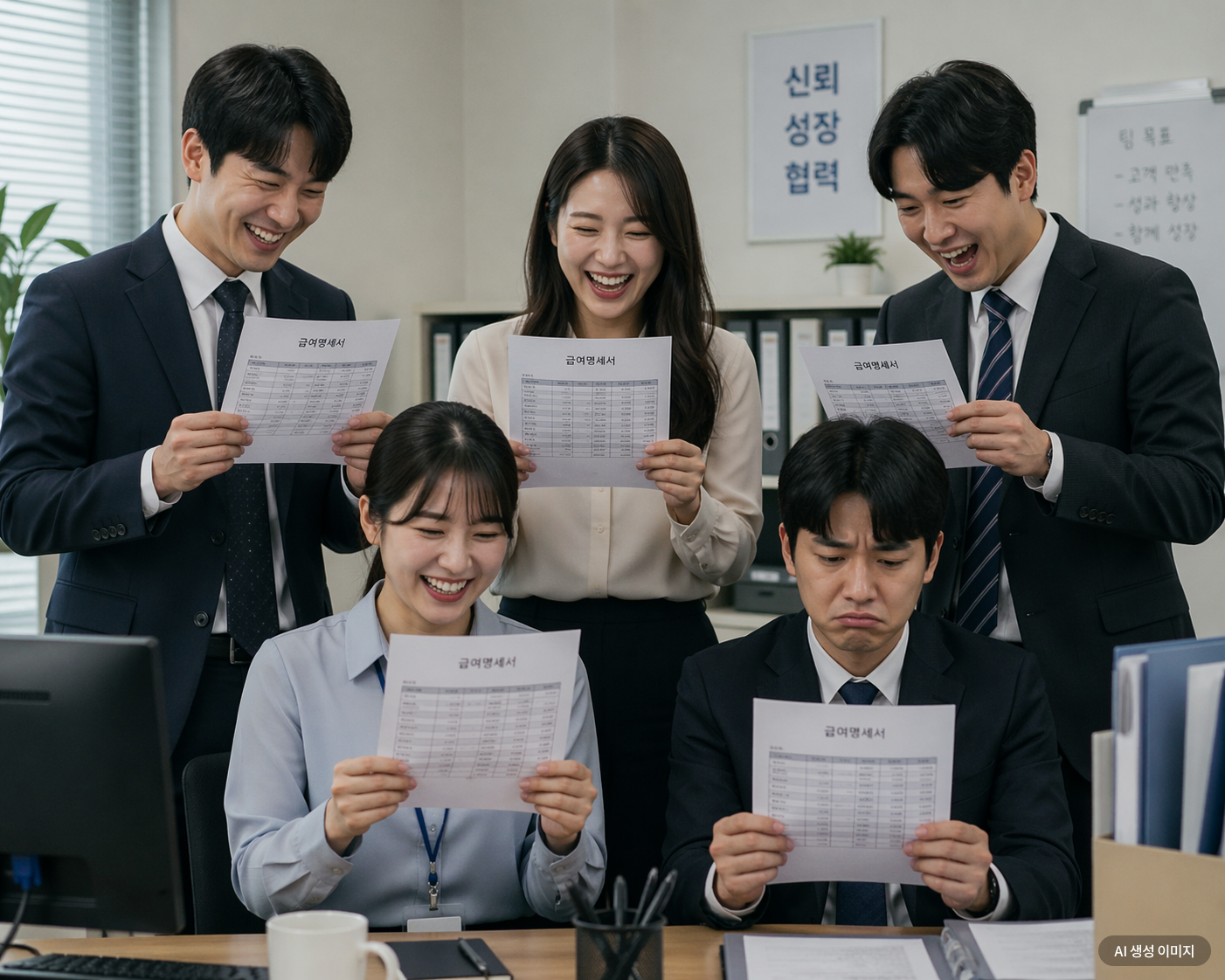
It has been found that one out of every five wage workers in South Korea still earns less than 2 million won per month. As the number of high-income earners with monthly wages of 5 million won or more increases, polarization according to wage levels continues.
According to the "2025 Second Half Regional Employment Survey: Characteristics of Workers by Industry and Occupation" released by the Ministry of Data and Statistics on April 23, the number of wage workers in the second half of last year was tallied at 22.488 million, an increase of 311,000 compared to the previous year.

By wage level, the largest group earned between 2 million and 3 million won per month (30.0%), followed by those earning 3 million to 4 million won (22.3%), 5 million won or more (16.5%), 4 million to 5 million won (11.5%), 1 million to 2 million won (10.0%), and less than 1 million won (9.8%). In other words, 19.8% of wage workers-one in five-earn less than 2 million won per month.
Amid rising nominal wages due to inflation and increases in the minimum wage, the "polarization at both ends" of the employment market has intensified. The proportions of those earning 5 million won or more (up 1.1 percentage points) and those earning less than 1 million won (up 0.2 percentage points) both increased, while the proportions of those earning 2 million to 3 million won (down 1.6 percentage points) and those earning 1 million to 2 million won (down 0.5 percentage points) decreased. An official from the Ministry of Data and Statistics explained, "The increase in low-wage workers appears to be due to the government's senior employment programs and the rise in jobs related to non-residential welfare facility operations. However, more than 50% of wage workers now earn at least 3 million won per month."

In fact, most jobs are still concentrated in low-wage sectors such as simple sales, cleaning, and care services. When subdividing the characteristics of workers by occupation in the second half of last year, store sales workers increased by 38,000 from the previous year to a total of 1.545 million (5.3%), making this the largest occupational group.
The number of cleaning-related workers rose by 52,000 to 1.301 million (4.5%), while caregivers and nursing assistants increased by 48,000 to 497,000 (1.7%).

Among all industries, "non-residential welfare facility operations" showed the largest increase in employment. This industry includes businesses that operate daycare centers, childcare facilities, social welfare centers, and home-visit welfare services.
This sector recorded 1.77 million workers, up 177,000 (0.6 percentage points) from the previous year, and for the first time since statistics were compiled in 2013, it ranked first by sub-industry both in the first and second halves of the year, surpassing the previous leader, "restaurant businesses," which now employs 1.692 million.

The trend of welfare and care work becoming primary sources of employment for women and older adults has continued. Among workers aged 50 or older, 1.358 million (9.8%) are employed in non-residential welfare facility operations, making it the top job for seniors. Among female workers, employment in this sector increased by 147,000, absorbing most of the total increase of 171,000 female workers.
In contrast, traditional industries such as "crop cultivation" (down 109,000), "building construction" (down 65,000), and "interior and finishing construction" (down 33,000) are rapidly losing jobs.
-

Reporter Lee Dongwoo dwlee@asiae.co.kr
-
Edit Bae Byoungmin wuhaha@asiae.co.kr
© The Asia Business Daily(www.asiae.co.kr). All rights reserved.




![[Why&Next] Korea Focuses on 'Search', China on 'Action'Why Shopping AI Assistants Differ](https://cwcontent.asiae.co.kr/asiaresize/304/2026042210401035836_1776822010.png)
![[PolPolNews] Lee's Approval Rating Hits Post-Inauguration High Again... Democratic Party 48%, People Power Party 20%](https://cwcontent.asiae.co.kr/asiaresize/304/2026042321495438510_1776948594.jpg)