MOEF: "Full Impact of Middle East War in Q2... GDP Adjustment Inevitable"
The government stated that, despite Korea's economy experiencing a surprise growth in the first quarter of this year thanks to the semiconductor boom and the effects of government policies, an adjustment in the second quarter will be inevitable as the impact of the Middle East war is fully reflected.

On the 20th, when the KOSPI surpassed the 5700 mark for the first time in history, an employee was monitoring the stock market and exchange rates in the dealing room at the Woori Bank headquarters in Seoul. On that day, the KOSPI opened at 5696.89, up 19.64 points (0.35%) from the previous day. Semiconductor stocks, including Samsung Electronics, remained slightly weak. 2026.2.20 Photo by Jo Yongjun
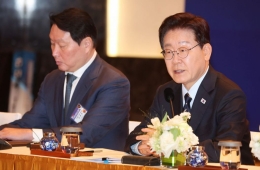
View original imageOn April 23, Yoo Byunghee, Director General for Economic Policy at the Ministry of Economy and Finance, said at a background briefing on first-quarter GDP, "In the second quarter, the base effect from the significant growth in the first quarter and the full impact of the Middle East war will overlap, making an adjustment inevitable compared to the previous quarter."
He added, "Given the high external uncertainties, such as the unfolding situation of the Middle East war, the annual growth outlook needs to be monitored further." Previously, Deputy Prime Minister and Minister of Economy and Finance Koo Yooncheol had stated, "It is possible to achieve 2.0% economic growth this year, and we expect even more."
On this day, the Bank of Korea announced that the real GDP growth rate (preliminary figure) for the first quarter grew by 1.7% compared to the previous quarter. This far exceeds the Bank’s forecast of 0.9% announced in February. It is the highest level in five years and six months since the third quarter of 2020 (2.2%).
The Ministry of Economy and Finance explained that the strong growth in the first quarter was due to the boom in IT sectors such as semiconductors, the effects of government policies implemented since the current administration took office, and the rapid response to the Middle East war. Despite the outbreak of the Middle East war at the end of February, the growth trend, which had been expanding since the second half of last year, continued to strengthen.
In particular, although the domestic market—which was showing signs of recovery—faced negative impacts from the Middle East war, the government’s swift response, including the implementation of price ceiling policies, was instrumental in minimizing the effects of the conflict.
When asked whether a supplementary budget was necessary despite the high first-quarter growth, Director Yoo replied, "While the effects of the Middle East war were not significant in the first quarter, they are expected to appear from the second quarter, so I believe a supplementary budget is necessary."
He further explained, "If you look at first-quarter growth by sector, all sectors grew evenly," and added, "It is also notable that the contribution from the private sector was high."
Hot Picks Today
 Chilling Timing "Did They Know Again?"... $640 ...
- Trump: "Iran in a Crazy Situation... Orders to Fire on Mine-Laying Vessels in th...
- "I Spent Money in a Truly Meaningful Way"... How an SK hynix Employee Donated 10...
- "If You Have This at Home, Remove It Immediately"... 'This Item' Is as Harmful a...
- Foreign Vessels Once Swept Up the Seas Every Season... Now Face Fines of Up to 1...
The government plans to make every effort to minimize the economic impact of the Middle East war by executing 85% of the 10.5 trillion won in projects designated for prompt implementation under the supplementary budget within the first half of the year.
© The Asia Business Daily(www.asiae.co.kr). All rights reserved.