Trump Ultimately Extends Ceasefire... Second Round of Talks Remain Uncertain
Divisions Noted Between Iranian Hardliners
Iran Confirms Non-Participation in Talks, Criticizes U.S. Stance
Uncertainty Remains Over Second Round of Talks

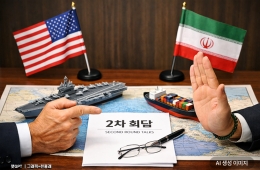
On April 21 (local time), U.S. President Donald Trump announced that the ceasefire period with Iran would be extended. The ceasefire was dramatically prolonged just one day before its scheduled end, but the possibility of holding a second round of talks remains uncertain. Iran is withholding participation in the negotiations, expressing deep distrust of the U.S. strategy that simultaneously employs diplomatic solutions and military pressure. Unless either the United States or Iran makes concessions, the stalemate between the two sides is likely to continue.
That day, President Trump stated on the social networking service Truth Social, "Based on the fact that the Iranian government is deeply divided, Pakistan’s Chief of Army Staff Asim Munir and Prime Minister Shehbaz Sharif requested that we hold off on any attack against Iran."
Previously, after Iran reopened the Strait of Hormuz to commercial vessels, state-run media representing Iranian hardliners and the military launched a wave of criticism, raising questions about possible divisions within the Iranian leadership.
President Trump explained, "We received a request to hold off on any attack against Iran until Iranian leaders are able to present a unified proposal," adding, "I will extend the ceasefire until they have resolved their internal differences."

The extension of the ceasefire between the United States and Iran was made public after U.S. Vice President JD Vance’s trip to Pakistan was postponed. The New York Times (NYT), citing government officials, reported that Vice President Vance’s planned visit to Pakistan was delayed because Iran had not yet decided whether to participate in the second round of talks. Instead, Bloomberg reported that Vice President Vance held a meeting at the White House in the afternoon regarding negotiations with Iran.
Until that morning, President Trump had maintained an optimistic outlook on a second round of talks with Iran. In a phone interview with CNBC, he said regarding Iran, "They have no other choice" and added, "In the end, we will reach a great agreement."
During this process, Pakistan, serving as the intermediary, tried to persuade the United States to lift the naval counter-blockade against Iran as a gesture of confidence before the second round of talks at the White House, but failed, according to the Wall Street Journal (WSJ). When Iran refused to participate in the talks due to its hardline stance, President Trump ultimately decided to extend the ceasefire.
Iran Confirms Final Decision Not to Attend Talks...Criticizes U.S. Attitude

Although the ceasefire period has been extended, uncertainty around the second round of talks persists. Iran is withholding its participation, citing issues with the U.S. attitude. Tasnim News Agency reported that Iran had conveyed its final decision not to participate in the second round of ceasefire talks, scheduled for the afternoon of the 22nd, to the United States through intermediary Pakistan.
Tasnim stated, "During the first negotiations held in Islamabad, the U.S. made excessive demands beyond the initially agreed framework, leading the talks to a deadlock," and criticized the U.S. for "trying to compensate for its failures on the battlefield at the negotiating table."
The agency further explained, "For these reasons, Iran judges that participating in negotiations under the current circumstances would be a waste of time, and that the United States is obstructing a proper agreement, so Iran will not participate in talks with the U.S."
Distrust toward the United States appears to have been accumulating since the ceasefire agreement was first reached. Tasnim News Agency cited the Israel-Lebanon ceasefire negotiations and the counter-blockade in the Strait of Hormuz as reasons for refusing to participate in talks with the U.S. It argued that the U.S. failed to compel Israel to immediately implement a ceasefire with Lebanon, making the initial negotiation process difficult.
Iran has also continued to express dissatisfaction with the recent U.S. seizure of Iranian merchant ships and other maritime blockades. On this day, Iranian Foreign Minister Abbas Araghchi wrote on X (formerly Twitter), "The blockade of Iranian ports is an act of war and a violation of the ceasefire agreement," adding, "Iran knows how to protect its own interests and resist threats."
There are observations that the biggest obstacle to a lasting peace agreement is the lack of trust. The New York Times (NYT) reported that Iranian government officials, who have always been wary of the U.S., especially consider President Trump a betrayer.
Hot Picks Today
![Even With a 900 Million Won Deposit and 2.5 Million Won Monthly Living Expenses, Residents Say "It's Good to Be Taken Care Of"... Inside a Luxury Silver Town [Opening Silver Housing]](https://cwcontent.asiae.co.kr/asiaresize/93/2026042010015932171_1776646918.gif) Even With a 900 Million Won Deposit and 2.5 Mil...
Even With a 900 Million Won Deposit and 2.5 Mil...
- "Over 20 Times More Than Overseas": 104.5 Million Tons of Rare Mineral Discovere...
- [New York Stock Market] Iran Remains Silent Ahead of Ceasefire Expiration... All...
- "When the Middle East War Ends, This Stock Will Lead"... Target Price Raised 71%...
- "Please Launch It in Korea!" After All the Hype... This Coffee Finally Arrives i...
Karim Sadjadpour, a senior fellow at the Carnegie Endowment for International Peace, pointed out, "The level of trust between the United States and Iran has always been very low, but now it has completely disappeared," adding, "Iran believes that, as President Trump has done twice in the past, the U.S. could attack at any time, even during negotiations, and the White House will never believe that Iran has abandoned its ambition for nuclear weapons, even if it agrees to a compromise."
© The Asia Business Daily(www.asiae.co.kr). All rights reserved.