Iran War Drives Up Producer Prices to Highest in Four Years... "Stimulating Consumer Price Increase"
PPI Rises 1.6% in March from Previous Month
Highest Rate in Over Four Years Since April 2022
Middle East War Drives International Oil Prices Higher
Coal and Petroleum Products Surge 31.9%
Highest Increase Since 57.7% in Decembe
Last month, the producer price index jumped by 1.6% compared to the previous month. This is the highest rate of increase in over four years since April 2022. As international oil prices surged due to the aftermath of the Middle East war, coal and petroleum products soared by 31.9%. This is the highest increase since December 1997, when it reached 57.7%. With the producer price index rising for seven consecutive months and showing a significant spike in March, analysts believe this will stimulate a rise in consumer prices.

"Direct Impact from Iran War" — Coal and Petroleum Products Surge 31.9%
According to the "March 2026 Producer Price Index (Preliminary)" released by the Bank of Korea on the 22nd, the producer price index for March stood at 125.24 (2020=100), up 1.6% from the previous month. This is the first time since April 2022 (1.6%) that the producer price index has risen by as much as 1.6% from the previous month in over four years. The producer price index has increased for seven consecutive months since September last year. Compared to the same month of the previous year, it jumped by 4.1%.
The producer price index is a statistic that measures changes in the prices of goods and services supplied by producers to the market, and depending on the item, it is reflected in the consumer price index with a time lag of about one to three months. Lee Moonhee, Head of the Price Statistics Team at the Economic Statistics Department 1 of the Bank of Korea, explained, "The producer price index for March rose by 1.6% from the previous month, mainly due to increases in coal and petroleum products and chemical products."
By item, industrial goods rose significantly by 3.5%. Among these, coal and petroleum products surged by 31.9% compared to the previous month. This is the highest rate of increase since December 1997, when it reached 57.7%. Chemical products also increased by 6.7%. In contrast, prices of agricultural, forestry, and fishery products fell by 3.3% from the previous month, as agricultural products dropped by 5.0% and livestock products by 1.6%. Electricity, gas, water, and waste management also fell by 0.1% from the previous month, as industrial city gas declined by 3.0%. In the services sector, restaurant and accommodation services rose by 0.1%, but transportation services fell by 0.2%, resulting in no change from the previous month.
Among detailed items, computer memory devices rose sharply by 101.4%, naphtha by 68.0%, ethylene by 60.5%, and xylene (also called paraxylene) by 33.5%.

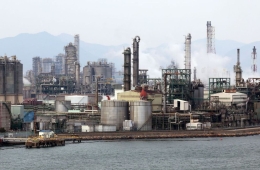
Steam is rising from a petrochemical complex in Yeosu City, Jeollanam-do. Photo by Yonhap News Agency
View original imageProducer Price Index Rises for Seventh Month, Stimulating Consumer Prices
Analysts say it is still difficult to predict the trend in the producer price index for this month. The international oil price, which was the main factor in the sharp rise of the producer price index in March, has averaged lower so far this month compared to the previous month. However, Lee pointed out, "The impact of raw material prices that had risen before March is expected to gradually expand, and this will act as upward pressure on the producer price index." Uncertainty remains high due to negotiations between the United States and Iran, making it difficult to predict future trends. Lee added, "If the situation calms down in the short term, the extent and duration of the impact from rising raw material prices will also be shortened, but it is difficult to make predictions at this time."
With the producer price index having risen for seven consecutive months and showing a significant spike in March, it is expected to exert upward pressure on consumer prices. Lee further explained, "The time lag between the producer price index and its impact on the consumer price index varies greatly depending on the item. Some items move almost in tandem, while others have a lag of three to four months." He added, "The extent and timing of how changes in the prices of raw materials and intermediate goods affect consumer prices also depend on current business conditions, market competition, and government policies. As uncertainty is high, it is necessary to monitor the trend closely."
Hot Picks Today
!["When the Middle East War Ends, This Stock Will Lead"... Target Price Raised 71% [Click e-Stock]](https://cwcontent.asiae.co.kr/asiaresize/93/2026042115550834734_1776754507.jpg) "When the Middle East War Ends, This Stock Will...
"When the Middle East War Ends, This Stock Will...
- "Is the Starting Salary Really 4 Million Won?"... Surprise as Navy Salary and Sa...
- Why SK Hynix Was Rejected While Samsung Electronics Was Approved: The Reason for...
- "Please Launch It in Korea!" After All the Hype... This Coffee Finally Arrives i...
- Even With a 900 Million Won Deposit and 2.5 Million Won Monthly Living Expenses,...
Meanwhile, the domestic supply price index, which measures price changes of goods and services supplied domestically (including domestic shipments and imports), rose by 2.3% from the previous month. The increase was led mainly by intermediate goods (2.8%) and raw materials (5.1%). Compared to the same month of the previous year, it rose by 3.7%. Based on total output, which includes exports in addition to domestic shipments, the total output price index, which measures price changes of goods and services, rose by 4.7% from the previous month, mainly due to industrial goods (7.9%). Compared to the same month of the previous year, it jumped by 9.0%.
© The Asia Business Daily(www.asiae.co.kr). All rights reserved.