Lee Chang-yong to Continue Public Commentary After Retirement: "Speaking Out Is My Style, Will Engage in Economic Analysis" (Comprehensive)
"My philosophy is that clarity is best... It's not a world where you get recognized by staying quietly in the background"
Communication with Overseas Institutions Right After Martial Law: "This Is Why I Took on the Role"
Freeze Dilemma? I Disagree... 'Keeping Rates Unchanged' Is Also a Major Decision
"Shin Hyunsong Is an Outstanding Nominee... I Hope Things Move Forward Smoothly"
Lee Chang-yong, Governor of the Bank of Korea, announced that even after his retirement, he will continue to deliver public messages about domestic and international economic conditions through economic commentary and analysis. This approach contrasts with previous Bank of Korea governors, who typically refrained from making public statements after leaving office. Regarding Shin Hyun-song, the governor nominee, Lee emphasized, "He is much more outstanding than I am," and added, "We now have a highly capable person, so I hope things will proceed smoothly and quickly."

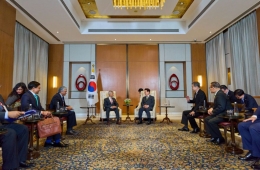
Lee Chang-yong, Governor of the Bank of Korea, is delivering his farewell speech at the farewell ceremony held on the 20th at the Bank of Korea Annex in Jung-gu, Seoul. Photo by Yonhap News Agency, Joint Coverage
View original imageWill Continue to Deliver Public Messages After Retirement: "I Will Stay in Korea for Some Time and Comment on the Economy"
After the farewell ceremony held at the Bank of Korea in Jung-gu, Seoul on the 20th, Lee visited the press room to answer questions about his future plans. He stated, "There is a three-year employment restriction. I will remain in Korea for the time being, engaging in economic commentary and consulting work."
On his intention to continue offering public commentary post-retirement, he said, "My philosophy is that it is better to speak clearly," and added, "Not every central bank governor needs to do this, but it's my style." He emphasized, "I believe it's right to communicate. People have different evaluations, but I don't think the world will recognize you if you just stay quietly in the background. Even during my tenure, if I believed something was right, I spoke up, and if there were misunderstandings, I thought it was important to clearly show—using data and other means—how my views differed." He acknowledged that this could attract criticism for causing market shocks, but said he was willing to accept any resulting criticism. Regarding some reports about him becoming a YouTuber, Lee clarified, "It was a joke that ended up in the newspaper as if it were serious," and added, "Which medium I use for economic commentary will depend on the nature of the message I want to deliver."
When asked for advice or requests for Shin Hyun-song, the Bank of Korea governor nominee, Lee responded, "He is much more outstanding than I am," and added, "During the past four years, he provided advice on many aspects of the policies I implemented, and in fact, I was the one who benefited from his help." He continued, "Every Bank of Korea governor has their own approach. I am sure he will do well, given his own vision. It would be inappropriate for me to offer advice. Now that we have someone so capable, I hope everything will move forward smoothly and quickly," he added.
When asked to grade his own tenure, Lee said, "Rather than grades, I am satisfied that, over four years, I made policy decisions with the country's best interests in mind, within my abilities and limitations. Over time, there will be various evaluations." He explained, "Some will say the policy was good, while others may accuse me of overreaching. Since monetary policy affects people differently—some benefit, some lose—there will always be a range of assessments. This is the fate of a central bank governor."

Lee Chang-yong, Governor of the Bank of Korea, is receiving a bouquet at the farewell ceremony held on the 20th at the Bank of Korea Annex in Jung-gu, Seoul. Photo by Yonhap News Agency, Joint Coverage
View original imageCommunication with Overseas Institutions Right After Martial Law: "This Is Why I Took on the Role"
Lee cited communication with overseas institutions immediately after the declaration of martial law as the most rewarding moment of his four-year term, as it helped ease concerns about the Korean market. He reflected that his extensive international experience and relationships helped dispel much of the overseas anxiety about the Korean economy, and it made him think, "This is why I took on this responsibility." He said, "Right after martial law was declared, I received an overwhelming number of calls from abroad." Drawing on his past experiences, he emphasized to them that "Korea's politics and economy are separate, and there is no need for concern," which proved effective.
Conversely, he cited the misunderstandings caused by his comments about 'Seohak Ants' (Korean retail investors investing in foreign stocks) as a regretful moment. However, Lee added, "At the end of last year, there was a focus on the significant increase in domestic retail investment overseas, which helped push for reforms such as the National Pension Service's new framework. Although the criticism was personally uncomfortable, I think it is fortunate that it led to improvements in the system."
Regarding the most challenging moment in setting the base interest rate, Lee said, "There was never a situation where it was difficult to reach a decision because of major disagreements with Monetary Policy Board members. The real challenge came after those decisions—especially in the middle of 2024, when people questioned, 'Why aren't you lowering rates?' At that time, the surge in real estate prices was threatening financial stability, so although I explained that the decision to hold rates steady took a comprehensive view beyond just inflation, there was a lot of debate afterward." He further noted, "Recently, there have been concerns that the Korea-U.S. interest rate gap is too wide, leading to a weaker won and related issues. Since both arguments exist, I believe we have managed to find a good middle ground."
On the issue of excessive concentration of assets in real estate, Lee said, "In our country, the real estate problem is something we must solve, no matter what. It is a part of policy that must be addressed through persistent and long-term efforts."

Bank of Korea Governor Lee Chang-yong receives the Bank of Korea plaque at the farewell ceremony held on the 20th at the Bank of Korea annex in Jung-gu, Seoul. Photo by Yonhap News Agency, Joint Coverage
View original imageIs the Bank of Korea Facing a Freeze Dilemma? "I Disagree... Keeping Rates Unchanged Is Also a Major Decision"
Regarding the introduction of the dot plot and forward guidance system during his term, Lee explained, "Forward guidance is not always right—other advanced economies abandoned it because of its drawbacks, but we barely used it, so adopting it even a little was an improvement. The six-month forward guidance and the dot plot, where each Monetary Policy Board member selects three points, have been highly praised overseas as 'excellent ideas.' In fact, they could even be exported." He added, "The purpose of introducing these systems was to improve communication, but they are conditional. If people continue to judge them as merely incorrect forecasts, disregarding the conditionality, we won't be able to continue. Whether the system takes root depends on how well the market accepts its conditional nature."
Responding to some claims that the Bank of Korea is stuck in a dilemma—unable to raise or lower rates due to high exchange rates and financial imbalances amid economic stagnation—Lee stressed, "I do not agree." He stated, "Leaving rates unchanged is also a significant decision. Having the courage not to raise rates when you shouldn't is important. The (external) situation, like the Middle East conflict, changes daily, so it is necessary to watch the direction for some time. Afterward, we must determine whether inflationary pressures will intensify or economic conditions will deteriorate."
Hot Picks Today
 Goldman Sachs Raises Forecast to 220%: "KOSPI H...
- Popcorn Container Craze at Theaters Sparks Sell-Out Frenzy, Emerges as New Reven...
- Samsung SDI to Supply Batteries to Mercedes-Benz Electric Vehicles for the First...
- "It Turns Out They Were After My Account" Shocked Reactions... "We're Watching Y...
- "Moms Touch Unruly Woman" Video Spreads... Assaulted Employee and Smashed Regist...
As for what he learned from attending the G20 Finance Ministers and Central Bank Governors Meeting and the IMF-World Bank Group Spring Meetings just before his retirement, Lee cited three points: the Middle East conflict has had a particularly severe impact on Asian countries; in the future, if manufacturing and other sectors cannot secure oil supplies, problems will go beyond inflation to threaten actual production; and 'cybersecurity' has emerged as a global priority. In particular, he noted there were many references to the Mythos model by Anthropic, which is recognized for its expert-level vulnerability detection capabilities. Lee said, "There are 40 U.S. institutions with access to the Claude Mythos preview, but none from Europe or elsewhere. Since hacking will target the weakest link, how to resolve issues with other connected countries, how to exchange information, and how to regulate artificial intelligence (AI) have become global challenges."
© The Asia Business Daily(www.asiae.co.kr). All rights reserved.



!["They Said It Was 'Delicious' Milk... Is the 'List of Fake Milk Products in Korea' for Real? [Matjal X-File]"](https://cwcontent.asiae.co.kr/asiaresize/307/2023072413274517286_1690172865.jpg)