"Retirement Ceremony to Be Held in Sejong"... Firm Commitment to Presidential Office Relocation Leaves Sejong Government Officials Torn Between Hope and Concern [Gwanja-in]
Greater Work Efficiency and Hopes for Real Estate Recovery
Concerns Remain Over a 'Half-Completed Administrative Capital'
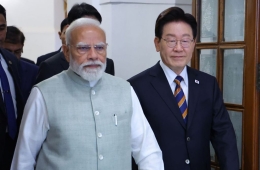
The government has reiterated that "President Lee Jaemyung has once again expressed his determination to hold his retirement ceremony in Sejong," signaling a strong commitment to the swift construction of the presidential office. This has stirred up excitement among government officials in Sejong. It has only been three months since the Agency for Construction of the Happy City presented its roadmap in a work report in January, and now the timeline for moving into the presidential office has been firmly set for "August 2029." With Sejong City experiencing ups and downs for 20 years since the agency's establishment in 2006, there is growing anticipation that the city is finally standing at the threshold of becoming a "complete administrative capital."

Aerial photo centered on the planned site of the national symbolic zone where the presidential office and Sejong National Assembly will be established. Agency for Construction of the Happy City.
View original imageThe greatest expectation cited by government officials in Sejong is improved work efficiency. Currently, senior officials at the bureau and division head levels travel between Seoul and Sejong every week to report to the presidential office or for work-related meetings, earning the nicknames "road directors" and "road bureau chiefs." Having witnessed the strong drive of the current administration, public officials are optimistic, saying, "This time, the relocation seems certain, especially with discussions on the special administrative capital bill pending in the National Assembly's Land, Infrastructure and Transport Committee." If the presidential office is relocated to the center of Sejong, key ministerial meetings are also likely to be held there, which could significantly reduce the administrative waste spent on roads and railways.
Underlying the welcome for the office relocation is also the expectation of a recovery in the real estate market. In 2020, when discussions about relocating the administrative capital were underway, Sejong City apartments posted an annual growth rate of 44.92%, ranking first among the 17 cities and provinces. However, as the relocation failed to materialize, annual growth rates turned negative for four consecutive years from 2021 to 2024. Last year, the growth rate was 1.89%, slightly above the national average of 1.05%. A central government official noted, "Apartments that once sold for 1 billion won are now hard to sell even at 700 million won, with some properties losing nearly half their value." According to monthly statistics from the Korea Real Estate Board, apartment prices are down an average of 27% compared to the previous peak in May 2021. For public officials who bought at high prices and have been worried ever since, the push for the relocation and "completion of the administrative capital" is especially welcome.
However, not everything is rosy. Some within the government still voice concerns about Sejong becoming a "half-finished administrative capital." The main reason is that it has not yet been decided whether the Sejong office will fully replace the current presidential office. Lee Guyoun, Senior Secretary for Public Relations and Communication at the presidential office, stated, "While preparations are underway for the president to mainly use the Sejong office, relocating from the current presidential office and reducing its functions would require national consensus." An even bigger issue is "Yeouido." Trips to Yeouido for consultations with political parties are actually more frequent than visits to the presidential office. Since the Sejong National Assembly building will not be completed before 2031 at the earliest, physical inefficiencies are expected to persist for the time being even after the office is relocated. Furthermore, it has not yet been decided whether the Sejong National Assembly will fully replace the Yeouido Assembly building either.
Hot Picks Today
 "With This Certificate, Even Those in Their 60s...
- Popcorn Container Craze at Theaters Sparks Sell-Out Frenzy, Emerges as New Reven...
- "Bear Destroyed My Rolls-Royce"... US Car Owners Who Claimed $200,000 Insurance ...
- Passed Through Just Before Hormuz Re-closure... 1 Million Barrels of Crude Oil H...
- "Quit Office Job to Earn Over 200 Million Won a Year"… Chinese Woman in Her 30s...
The lack of industrial presence is also a dilemma. While the symbolism of being the "administrative capital" puts Sejong in the spotlight, paradoxically, it is less competitive than neighboring Daejeon, Chungnam, and Chungbuk when it comes to attracting businesses or jobs. In a recent report, the Korea Development Institute (KDI) pointed out, "Sejong City faces limitations in creating economic incentives to attract a large influx of people, and the population has stagnated at around 400,000," stressing the need to devise ways to boost real productivity, such as attracting companies. A Sejong public official remarked, "While the relocation of the office is certainly welcome, the city's growth will remain limited unless connectivity with the National Assembly and self-sufficiency functions are also secured."
© The Asia Business Daily(www.asiae.co.kr). All rights reserved.



!["They Said It Was 'Delicious' Milk... Is the 'List of Fake Milk Products in Korea' for Real? [Matjal X-File]"](https://cwcontent.asiae.co.kr/asiaresize/307/2023072413274517286_1690172865.jpg)