KOSPI Also Hit by 'Hormuz Supply Chain Blockade' Shock
Breakdown in U.S.-Iran Talks Leads to Hormuz Strait Blockade
KOSPI Opens Down Over 2% on Supply Chain Shock Concerns
Expectations of a Rebound Amid Inflow of Value Buyers

As the termination negotiations between the United States and Iran collapsed, the KOSPI index opened down 2.08% in early trading on the 13th. The electronic board at the dealing room of Hana Bank in Jung-gu, Seoul, displayed the current status of the domestic stock market. On that day, the won-dollar exchange rate started trading at 1,495.4 won, up 12.9 won from the previous trading day, and West Texas Intermediate (WTI) crude oil in the United States surpassed 100 dollars per barrel. Photo by Jinhyung Kang, April 13, 2026
View original imageAs ceasefire negotiations between the United States and Iran faced difficulties, the Korean stock market declined. Due to concerns about supply chain disruptions caused by a prolonged blockade of the Strait of Hormuz, both the won-dollar exchange rate and international oil prices rose.
KOSPI Opens Down Over 2% on Supply Chain Shock Concerns
On April 13, the KOSPI opened at 5,737.28, down 2.08% compared to the previous trading day, but narrowed its losses, trading at 5,819.14 as of 9:53 a.m., down 0.68%. The KOSDAQ opened at 1,076.85, down 1.53%, but reversed to an increase, trading at 1,097.43, up 0.35%. The won-dollar exchange rate rose 0.51% from the previous trading day to 1,492.29 won.
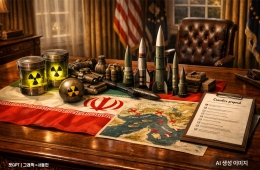
The Korean financial market was negatively impacted as the ceasefire negotiations between the United States and Iran held over the weekend broke down, and the United States announced that it would begin blocking all maritime traffic entering and exiting Iranian ports. U.S. President Donald Trump stated on social media overnight, "We will begin blockade procedures for all vessels passing through the Strait of Hormuz."
With the ceasefire negotiations suspended and the United States blocking the Strait of Hormuz, effectively halting Iranian crude oil exports, West Texas Intermediate (WTI) crude oil in the U.S. soared to around $104 per barrel as of 9:51 a.m., up 8% from the previous trading day.
Suh Sangyoung, a researcher at Mirae Asset Securities, expressed concerns, saying, "If the blockade of the Strait of Hormuz continues, this will destabilize global supply chains and have a negative impact on the economy. This could lead to a slowdown in growth due to reduced corporate investment and weakened consumer spending, as well as a deterioration in risk appetite for assets."
As of 9:57 a.m., foreign investors were net sellers of approximately 300 billion won in the KOSPI market, while institutions sold a net 160 billion won and individuals were net buyers of about 400 billion won. Shares of Samsung Electronics were trading at 202,500 won, down 1.70% from the previous session. Many of the major stocks by market capitalization, including Hyundai Motor (-1.07%), LG Energy Solution (-1.09%), Samsung Biologics (-1.85%), and Doosan Enerbility (-1.70%), were also declining. However, SK hynix, which had opened lower, reversed course and was trading up 1.17% at 1,038,000 won.
Expectations of a Rebound Amid Inflow of Value Buyers
Experts believe that volatility in the stock market is likely to persist for some time as ceasefire negotiations between the United States and Iran remain difficult. However, with the ceasefire period scheduled to last until the 22nd and both countries appearing willing to continue dialogue, some see a market correction as a potential buying opportunity. On this day as well, although the market opened sharply lower, the inflow of value buyers helped reduce losses.
Han Ji-young, a researcher at Kiwoom Securities, explained, "Although Iran reached agreement on some issues, it failed to reach consensus on two or three points. Pakistan, acting as a mediator, also stated it would continue to facilitate dialogue between the two countries. This means the breakdown leaves room for diplomatic compromise, and suggests there is a possibility of progress in negotiations during the ceasefire period scheduled until April 22." Han added, "Although anxiety related to the breakdown of the first round of negotiations is dominant in early Monday trading, investors should avoid prioritizing selling as a response."
Hot Picks Today
 "With This Certificate, Even Those in Their 60s...
- Popcorn Container Craze at Theaters Sparks Sell-Out Frenzy, Emerges as New Reven...
- "Bear Destroyed My Rolls-Royce"... US Car Owners Who Claimed $200,000 Insurance ...
- Passed Through Just Before Hormuz Re-closure... 1 Million Barrels of Crude Oil H...
- "Quit Office Job to Earn Over 200 Million Won a Year"… Chinese Woman in Her 30s...
Some experts emphasize that, regardless of external variables, the fundamentals of the market are strengthening as Korean companies' earnings improve. Lee Kyungmin, a researcher at Daishin Securities, said, "After last week's earnings surprise by Samsung Electronics, the KOSPI's 12-month forward price-to-earnings ratio (PER) has declined further to 7.19 times, indicating even deeper undervaluation. A forward PER below 8 for the KOSPI signals a deep value phase, making this an especially attractive segment."
© The Asia Business Daily(www.asiae.co.kr). All rights reserved.


!["They Said It Was 'Delicious' Milk... Is the 'List of Fake Milk Products in Korea' for Real? [Matjal X-File]"](https://cwcontent.asiae.co.kr/asiaresize/307/2023072413274517286_1690172865.jpg)