[Good Morning Market] Will "Six Thousand" Return? KOSPI Driven by Foreign Investors, War, and Inflation
There are expectations that the KOSPI could once again reach the "six thousand" mark this week. However, analysts note that volatility is likely to continue due to several factors, including the breakdown of the first round of US-Iran negotiations, US inflation indicators, earnings reports from major US financial companies such as Goldman Sachs, and whether foreign investors will continue to be net buyers of the domestic stock market.

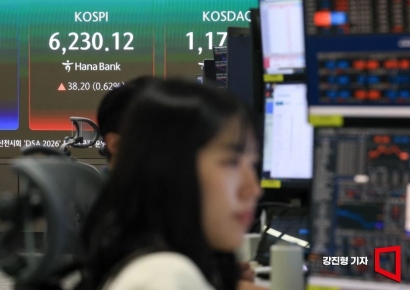
On the 10th, as the US-Iran war entered a two-week ceasefire, the domestic stock market started with nearly a 2% rise. An employee is monitoring the stock market and exchange rates at the dealing room of Hana Bank’s headquarters in Jung-gu, Seoul. On that day, the KOSPI opened at 5,876.12, up 98.11 points (1.70%) from the previous trading day, the KOSDAQ increased by 13.14 points (1.22%) to 1,089.14, and the won/dollar exchange rate started at 1,475.1 won, down 7.4 won. April 10, 2026. Photo by Cho Yongjun
View original imageOn April 13, Kiwoom Securities forecasted that the KOSPI would remain volatile this week, with its projected weekly range set between 5,600 and 6,050 points.
On April 10 (local time), the Dow Jones Industrial Average closed at 47,916.57, down 269.23 points (0.56%) from the previous trading day at the New York Stock Exchange (NYSE). The S&P 500, which focuses on large-cap stocks, dropped 7.77 points (0.11%) to close at 6,816.89. In contrast, the tech-heavy Nasdaq index ended the session up 80.48 points (0.35%) at 22,902.89.
This was interpreted as a result of both relief and anxiety surrounding US inflation data. The headline Consumer Price Index (CPI) for March rose 3.3%, which was higher than February’s 2.4% but lower than expected (3.4%). The core CPI also came in at 2.6%, lower than the consensus forecast of 2.7%. However, consumer inflation expectations for April shocked the market, coming in at 4.8%, which was higher than the expected 4.2%.
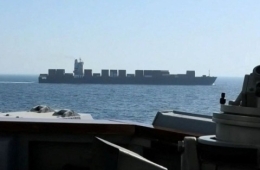
The market is expected to remain exposed to continuous volatility going forward. The extent of this volatility hinges on the progress of US-Iran negotiations. However, the breakdown of the first round of talks, particularly over Iran's nuclear capabilities, has increased market uncertainty. Additionally, US President Donald Trump's announcement of a blockade of the Strait of Hormuz, with the possibility of a dual blockade, has contributed to upward pressure on oil prices, further amplifying market volatility.
While market uncertainty persists, there is no need to prioritize a sell-off response. This is because there is still room for compromise. Pakistan, acting as a mediator, has indicated that it will keep the dialogue between the US and Iran ongoing. This suggests that there is potential for progress during the ceasefire period, which is scheduled to last until April 22.
Earnings from US financial companies also warrant close attention, given concerns over possible defaults in the private credit market. According to foreign media reports, redemption requests in the private credit market amounted to $300 billion in the first quarter of this year, which is about 7% of total private credit assets. The Federal Reserve has also reportedly begun collecting information related to US banks' exposure to private credit.
For the domestic stock market, whether foreign investors continue to be net buyers is of particular importance. Last week, foreign investors were net buyers of KOSPI stocks, purchasing a total of 5 trillion won and reversing to net buying for the first time in eight weeks. Factors such as the "earnings surprise" from Samsung Electronics, increased expectations for KOSPI first-quarter results, and the stabilization of the sharply rising exchange rate contributed to this reversal.
Hot Picks Today
 Goldman Sachs Raises Forecast to 220%: "KOSPI H...
- Popcorn Container Craze at Theaters Sparks Sell-Out Frenzy, Emerges as New Reven...
- [Breaking] Magnitude 7.4 Earthquake Strikes Off Eastern Honshu, Tsunami Warning ...
- "It Turns Out They Were After My Account" Shocked Reactions... "We're Watching Y...
- "Moms Touch Unruly Woman" Video Spreads... Assaulted Employee and Smashed Regist...
Han Jiyoung, a researcher at Kiwoom Securities, said, "The breakdown of the first round of US-Iran negotiations could trigger concerns about foreign capital outflows, but the war risk appears to have peaked. Since the beginning of the year, foreign investors had been net sellers of about 50 trillion won in KOSPI stocks, but the burden of buying, particularly in semiconductors, has lessened. The direction of foreign capital flows is likely to shift toward increasing the weighting of Korean stocks through net buying."
© The Asia Business Daily(www.asiae.co.kr). All rights reserved.


!["They Said It Was 'Delicious' Milk... Is the 'List of Fake Milk Products in Korea' for Real? [Matjal X-File]"](https://cwcontent.asiae.co.kr/asiaresize/307/2023072413274517286_1690172865.jpg)