"Trump Administration Pressures Cuba: 'President Must Step Down to Resolve the Issue'"
NYT Reports: U.S. Pressures Cuba for Regime Change
"Castro Family Spared... Measures Aim to Force Compliance"
Trump: "Will Intervene in Cuba in Some Form"
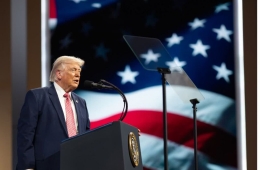
There have been reports that the Donald Trump administration in the United States pressured Cuba, which is experiencing an energy crisis, by stating, "the president must step down to resolve the issue."

The Donald Trump administration reportedly pressured Cuba, which is experiencing an energy crisis, by stating, "The president must step down to solve the problem." Photo by EPA Yonhap News
View original imageAccording to Yonhap News, on the 16th (local time), The New York Times (NYT) reported, citing multiple sources familiar with the discussions between the United States and Cuba, that "the Trump administration made the resignation of Cuban President Miguel Diaz-Canel a condition for progress in negotiations."
The Trump administration reportedly insisted that no agreement could be reached with Cuba as long as President Diaz-Canel remained in power. It also demanded the removal of certain high-ranking officials who uphold the ideology of Fidel Castro, who led the socialist revolution, as well as the release of political prisoners. However, it was reported that the administration did not demand any action regarding the Castro family, who still wield significant influence in Cuba.
The NYT analyzed, "Such demands are measures that remove symbolic figures while leaving the communist regime in place, which aligns with the Trump administration’s foreign policy stance of forcing compliance from regimes rather than pursuing regime change." Previously, the United States ousted Venezuelan President Nicolas Maduro, but nominated former Vice President Delcy Rodriguez as interim president and called for improved relations with the United States.
The report also pointed out, "While ousting the Cuban president would serve as a symbolic demonstration to the world that 'the United States toppled a leftist regime leader,' it would be difficult to persuade Cuban exiles in the United States and Cuban-American lawmakers who seek a complete political transformation."

On the 16th (local time), street vendors are chatting in Havana, the capital of Cuba, where a blackout occurred. Photo by AP Yonhap News
View original imageMeanwhile, with the aim of controlling the Western Hemisphere, President Trump has intensified pressure on Cuba, making it the next target after ousting Maduro in Venezuela. The United States has blocked the export of Venezuelan oil to Cuba and pressured countries like Mexico to halt oil transactions, causing Cuba to experience an unprecedented energy crisis. On this day, Cuba's national power system was completely disconnected.
Hot Picks Today
!["Stock Set to Double: This Company Smiles Every Time a Data Center Is Built [Click e-Stock]"](https://cwcontent.asiae.co.kr/asiaresize/93/2026050416112750184_1777878687.jpg) "Stock Set to Double: This Company Smiles Every...
"Stock Set to Double: This Company Smiles Every...
- "Is Yours Just Gathering Dust at Home? Millennials & Gen Z Rediscover Digicams O...
- "SK hynix GDRs Trade at a Premium...Global Demand Set to Surge"[Click e-Stock]
- "High-Net-Worth Investors Managing 10 Trillion Won: 'Gangnam Wealthy Also Feel F...
- “She Shouted, ‘The Rope Isn’t Tied!’... Chinese Woman Falls from 168m Cliff ...
The Cuban government reportedly began talks with the United States on the 13th to resolve the crisis. However, President Trump stated, "I believe I will have the honor of occupying Cuba. It would be a great honor," and asserted, "(I think I can do) whatever I want regarding Cuba. They have become very weak." When asked about the meaning of his 'occupation' remark, he answered, "I will intervene in some form."
© The Asia Business Daily(www.asiae.co.kr). All rights reserved.