[Why&Next] After the Lockout Shock... Will Golden Blue Lose Its Whisky Crown?
Domestic Whisky Brand Golden Blue Faces Slumping Performance
Impact of Metropolitan Sales Outlets Lockout
The domestic whiskey market is poised for a seismic shift. GoldenBlue, which holds the top spot in market share, is now at risk of losing its throne amid years of deteriorating performance. While the whiskey boom in Korea has subsided since the COVID-19 pandemic, leading the market into an adjustment phase, there is pointed criticism that GoldenBlue, now led by the second-generation owner, is losing its dominance due to a lack of effective leadership.
According to the Financial Supervisory Service's electronic disclosure system as of March 5, GoldenBlue's cumulative sales through the third quarter of last year stood at 8.39 billion won, marking an 18.67% decline from 10.98 billion won during the same period a year earlier. Prior to COVID-19, GoldenBlue maintained annual sales in the 160 billion won range, but this figure plummeted to the 120 billion won level in 2020. However, as the whiskey craze—centered on Millennials & Gen Z—spread, sales surged to 217.5 billion won in 2022. Yet, from the following year, sales began to slide, and it is estimated that last year's revenue shrank to around 150 billion won.
Profitability also deteriorated rapidly. Operating profit, which reached 50 billion won in 2022, turned into an operating loss by the third quarter of last year, with cumulative profit remaining at just 2.5 billion won. During this period, GoldenBlue recorded a net loss of 1.1 billion won, as it wrote off loans extended to subsidiaries such as GoldenBlue International as bad debt.
![[Why&Next] After the Lockout Shock... Will Golden Blue Lose Its Whisky Crown?](http://www.asiae.co.kr/news/img_view.htm?img=2026030608175563918_1772752675.jpg)
The Whiskey Craze Cools Off... Diageo Holds Its Ground
During this period, GoldenBlue's competitors also experienced sluggish sales, though not to the same extent. Diageo Korea, the importer of "Johnnie Walker," recorded annual sales of 160.6 billion won for the 2025 fiscal year (July 1, 2024 – June 30, 2025), a slight decrease of 1.1% from 162.4 billion won the previous year. This has led to speculation that Diageo may have overtaken GoldenBlue in annual sales.
Pernod Ricard Korea, the importer of "Ballantine's" and a company with a June fiscal year-end, saw its sales shrink by over 30%, from 175.1 billion won to 120.7 billion won during the same period. However, this is still above the pre-COVID-19 2019 level of 103.7 billion won. Windsor Global, which was spun off from Diageo Korea and sold in 2022, also saw its sales gradually decline to 100.6 billion won last year, down from 110 billion won in 2023.
![[Why&Next] After the Lockout Shock... Will Golden Blue Lose Its Whisky Crown?](http://www.asiae.co.kr/news/img_view.htm?img=2026030416260061601_1772609161.jpg)
The domestic whiskey market shrank sharply in 2020 when the COVID-19 pandemic hit. However, the market rebounded and expanded after home drinking trends took hold during the social distancing era. Nevertheless, following the COVID-19 endemic, household consumption weakened due to rising interest rates, the restaurant industry froze in the aftermath of the emergency martial law at the end of 2024, and a "sober life" trend—drinking less, especially among younger consumers—has become established. As a result, the whiskey market as a whole is contracting.
However, the wide variation in sales declines among whiskey makers indicates that each company's management strategy played a decisive role in defending—or failing to defend—its performance.
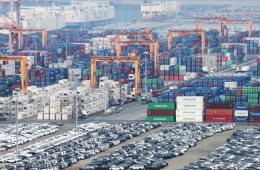
According to the Korea Customs Service's import and export trade statistics, whiskey imports last year amounted to USD 226.85 million (about 320 billion won), down 9.0% from the previous year. Over the same period, import volume dropped 17.7%, from 27,440 tons to 22,582 tons. The sharper drop in import volume compared to import value suggests that consumption of lower-priced products has decreased more significantly. This explains why Diageo, which focuses on importing and selling premium whiskeys, was able to weather the downturn relatively well.
![[Why&Next] After the Lockout Shock... Will Golden Blue Lose Its Whisky Crown?](http://www.asiae.co.kr/news/img_view.htm?img=2026010608520479781_1767657124.jpg)
Impact of the Japanese Whiskey Invasion and Labor-Management Conflicts
In contrast, GoldenBlue's major products—GoldenBlue Quartz (750ml) and GoldenBlue Sapphirus (450ml)—are sold in the 30,000 won range, while GoldenBlue Diamond (450ml) is priced around 50,000 won. GoldenBlue Quartz was launched in October 2024 to tap into the shift in whiskey consumption channels from entertainment bars to homes, driven by the growing home and solo drinking trend. However, this was not enough to defend last year's performance.
This was compounded by the strong performance of Japanese whiskeys, which are considered good value for money, in the Korean market. Recently, the popularity of highballs, particularly among younger consumers, has fueled rapid growth in Japanese whiskeys such as "Kakubin." In fact, Beam Suntory Korea, the importer and distributor of Kakubin, saw its sales double from 39.7 billion won in 2022 (when it began disclosing audit reports) to 79.6 billion won the following year. Sales in 2024 exceeded 100 billion won, up 27% from the previous year.
![[Why&Next] After the Lockout Shock... Will Golden Blue Lose Its Whisky Crown?](http://www.asiae.co.kr/news/img_view.htm?img=2026030612460364737_1772768763.jpg)
Additionally, GoldenBlue’s suspension of sales operations in the Seoul metropolitan area due to labor-management conflicts has been cited as another factor dragging down the company’s performance. Labor and management clashed over wage increases, leading to a union strike that began in April 2024 and has continued for over a year. In response, management conducted a lockout at four sales offices in the Seoul metropolitan area in May last year, which was lifted in September ahead of the National Assembly audit. The conflict continues, with the GoldenBlue labor union filing criminal complaints against management for wage arrears and unfair labor practices.
GoldenBlue was originally established as the fermented liquor producer "Chun Nyeon Yak Sok" in 2003. It became part of Suseok Millennium in 2009 and then launched the first low-alcohol whiskey brand in Korea. Chairman Yongsu Park acquired the company in 2011 and changed its name to GoldenBlue. From the time of the acquisition, Park’s son-in-law, former CEO Dongwook Kim, led the company until 2022, when he stepped down for health reasons and Chairman Park took over direct management, triggering the onset of labor-management conflict.

In 2024, Vice Chairwoman Soyoung Park, the second daughter of Chairman Park, became co-CEO, continuing the father-daughter management structure. Last year, she received Chairman Park’s entire 18.45% stake as a gift and became the sole largest shareholder. Yet, in the first year of inheriting the family business, GoldenBlue’s top position in the Korean whiskey market has also become precarious.
Hot Picks Today
 No Bacteria Detected in Arisu After 24 Hours of Repeated Drinking from a Tumbler
- "My Wife Is Missing"... Woman in Her 50s Still Unaccounted for Nearly a Month After Climbing Bukhansan Mountain
- "Available Only in Korea": Pokémon Card Prices Surge 2,532% Due to Rarity, Becoming Investment Assets
- High-Net-Worth Investors Increase Stock Holdings: "Samsung and SK hynix Are Basic, Now Searching for the Next Opportunity" [Investment Strategies of the Wealthy] ⑧
- Police Officer Cycling on Day Off Rescues Woman Attempting to Jump from Hangju Bridge
Currently, GoldenBlue’s shares are held by Vice Chairwoman Soyoung Park (40.81%), as well as Chairman Park’s eldest daughter and wife, who own 22.40% and 18.45%, respectively. The remaining 15.59% is distributed among 1,529 minority shareholders. GoldenBlue stock has been traded on the over-the-counter market K-OTC since 2014. After Chairman Park gifted his stake, the company conducted a free capital reduction, consolidating every five common shares into one, and announced in a disclosure that this was “to secure reserves through the free capital reduction as part of a medium- to long-term shareholder return policy.”
© The Asia Business Daily(www.asiae.co.kr). All rights reserved.