
More Than Half of All Basic Council Districts Confirmed as Two-Member Districts
Despite efforts to expand multi-member districts in basic councils, more than half of all districts for the June 3 local elections have been finalized as two-member districts.
On May 14, The Asia Business Daily analyzed the 'Ordinances on the Delimitation of Basic Council Districts' and the 'Delimitation Committee Proposals for Basic Council Districts' from 15 metropolitan municipalities (excluding Sejong and Jeju, which do not have basic councils), provided by Assemblywoman Lim Mi-ae of the Democratic Party of Korea. The analysis revealed that 51.2% of all basic council districts have been designated as two-member districts. This is an improvement of 1.4 percentage points compared to the 52.6% recorded in the local elections four years ago. Last month, the National Assembly's Special Committee on Political Reform decided to implement additional multi-member districts in 27 constituencies through an amendment to the Public Official Election Act, which also included the total number of basic council members. As a result, the proportion of two-member districts has decreased.

On the 14th, election commission officials inspected the voting station supply sets for the June 3 local elections at the Daegu Metropolitan City Election Commission in Seo-gu, Daegu. Photo by Yonhap News Agency
원본보기 아이콘Delimitation Committee Drafted District Proposals, but Metropolitan Councils Made Arbitrary Adjustments
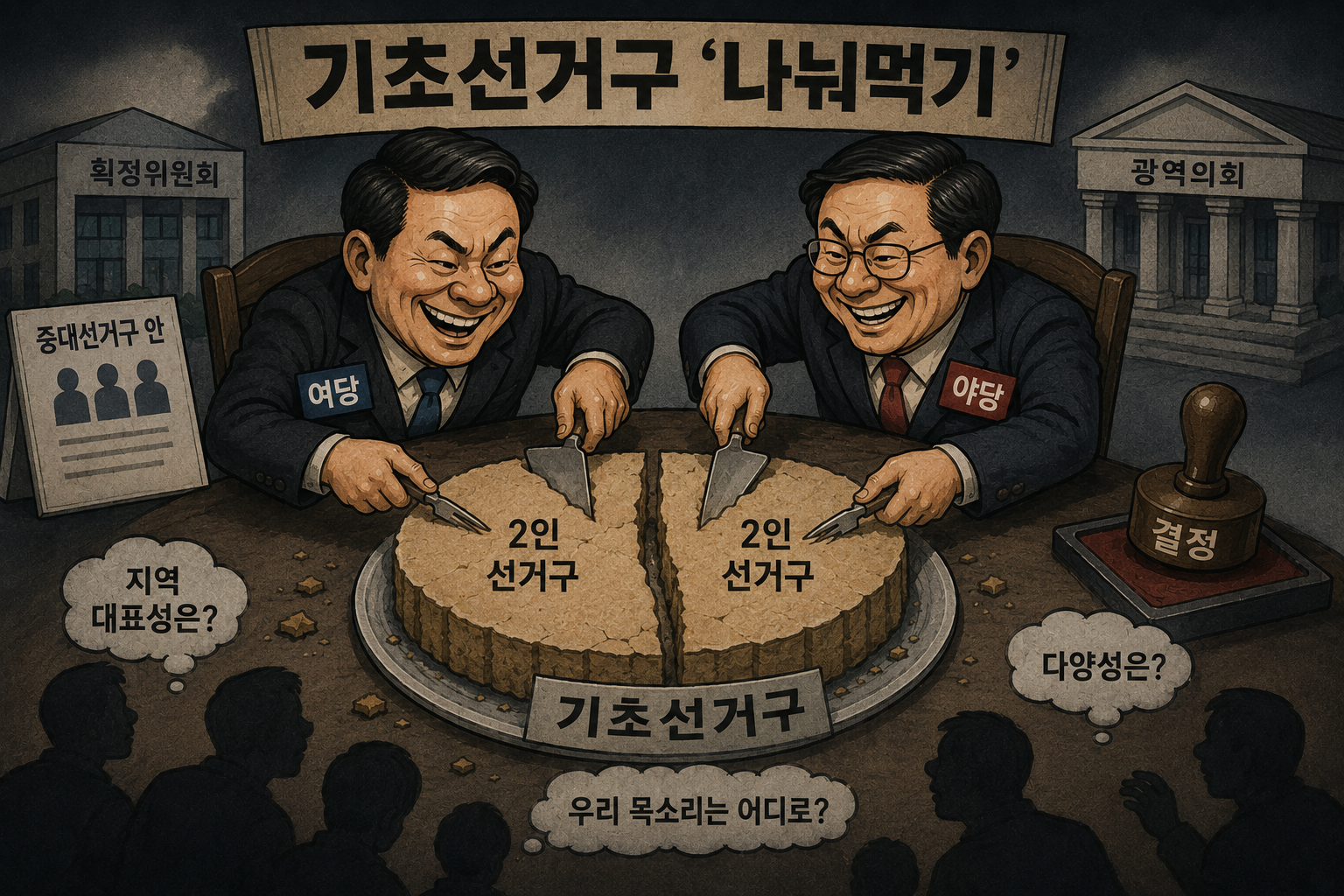
Currently, the basic council districts are drafted by a delimitation committee composed of experts, based on the total number of basic council seats determined by the National Assembly. These proposals are then submitted to the metropolitan council, where they are finalized through ordinances. However, the metropolitan councils can arbitrarily adjust the districts. According to an analysis of the differences between the committee's proposals and the actual ordinances, a significant number of blatant "splitting" cases were found. In an effort to protect vested interests, multi-member districts were divided into two-member districts out of concern that small parties and independent candidates might win seats.
For example, in Daegu, the delimitation committee's proposal was significantly revised during the process of amending the city council ordinance. There were many instances where large multi-member districts, which would have elected four or more members, were split into two-member districts.

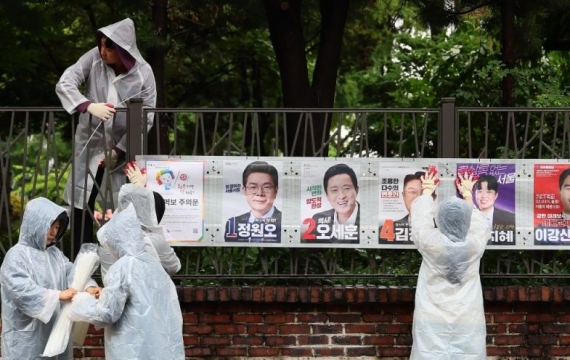
On the 14th, the candidate registration acceptance day for the 9th nationwide local elections, candidates and campaign representatives are registering as candidates at the Seoul Metropolitan Election Commission in Jongno-gu, Seoul. Photo by Yonhap News Agency
원본보기 아이콘Pohang: From 10 to 12 Districts, Three-Member Districts Turned into Two-Member Districts
In the case of Pohang, the committee's draft set the number of districts at 10, but after review by the council, this increased to 12. Many of the three-member districts in the original proposal were split into two-member districts. In Gangwon Province, the M district in Gangneung, originally a three-member district in the committee's proposal, was split into two separate two-member districts. In Gyeongnam Province, the Goseong-gun district was increased from three to four, resulting in two more two-member districts.
In Seoul, the delimitation committee initially proposed merging the five districts in Seodaemun-gu into four, thereby eliminating two-member districts. However, after review by the city council, the original five-district structure was retained, and the two two-member districts remained unchanged.
Assemblyman Lim criticized, "Multi-member districts allow opportunities for small parties and others to enter, but when these are split into two-member districts, in areas where a single party has more than 50% support, candidates from other parties lose any realistic chance of winning."
!['WHO Declares International Public Health Emergency' Why the Untreatable 'Variant Ebola' Is More Deadly Than COVID-19 [Reading Science]](https://cwcontent.asiae.co.kr/asiaresize/323/2026052110164072055_1779326201.png)
!["Please Help Us": How Much Do Those Bowing 90 Degrees These Days Actually Earn? [Data Pick]](https://cwcontent.asiae.co.kr/asiaresize/323/2026052010120870131_1779239528.png)