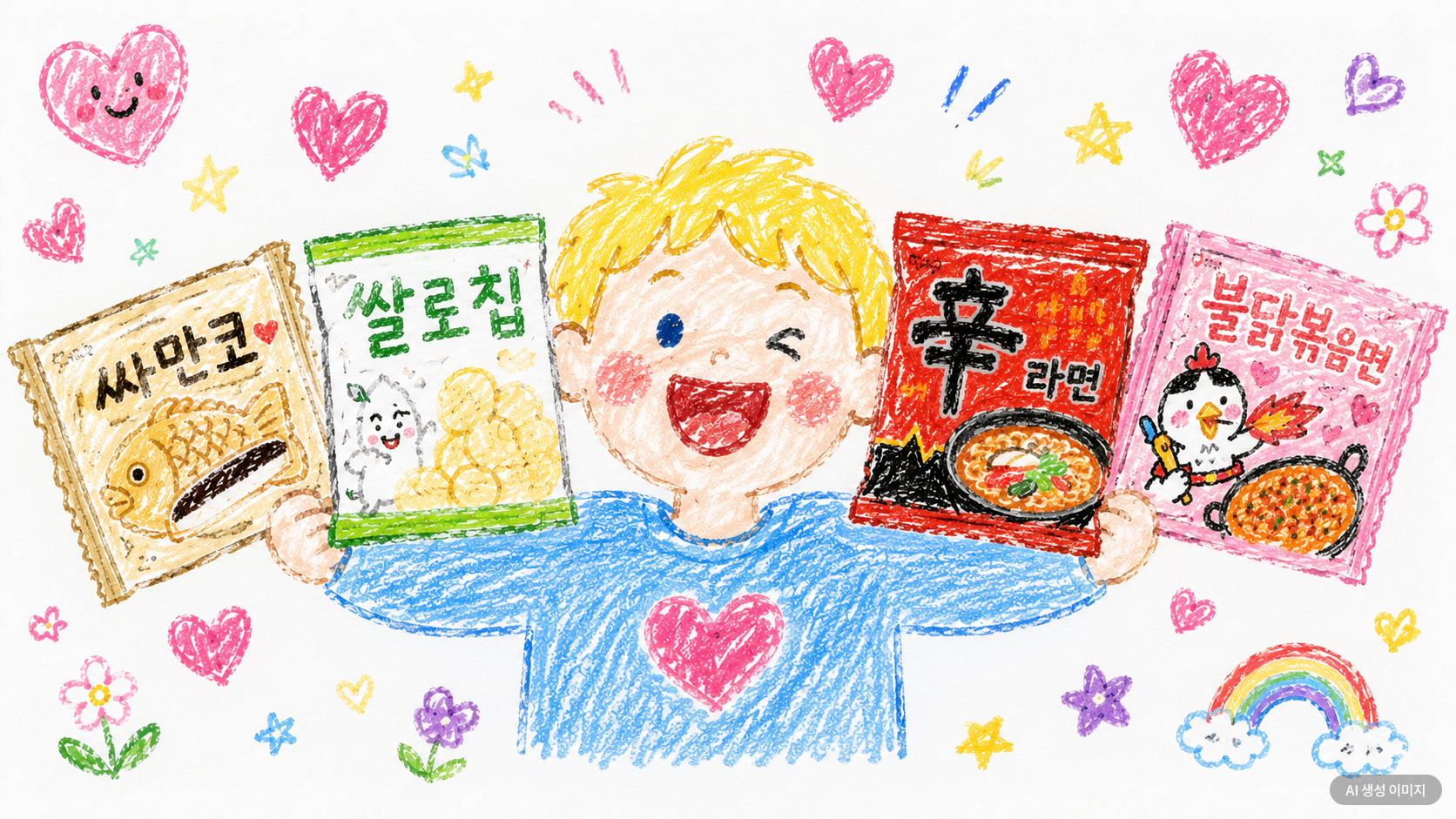
#At the end of last year, Costco in the United States requested Binggrae to include the Hangul "Samanco" on the "Samanco Club Pack" packaging. The reason was that, as the preference for Korean products among local consumers grew, packaging with Korean writing reinforced the image of "authentic K-food." In response, Binggrae redesigned the package by adding a Hangul logo to its previously English-focused design.
Korean-Style Design and Hangul Themselves Are Popular
"Made in Korea" is now regarded as a guarantee of quality in the global market. While companies previously focused on English and local languages for accessibility, Korean-style design and Hangul itself have recently emerged as competitive advantages for products.
According to the food industry on May 9, Lotte Wellfood is leveraging Hangul and K-culture in overseas markets. The premium ice cream "Krunch Bar," introduced to the Indian market this year, achieved sales of 60 million rupees (about 1 billion won) within just three months. Developed based on Korea's "Pig Bar," the product succeeded despite being priced at 60 rupees, two to three times higher than standard ice bars in the local market.
Lotte Wellfood highlighted that the ice cream is "from Korea" throughout its marketing campaign. Campaign videos released on social media featured K-pop idol-style dancing, finger heart gestures, and Korean phrases such as "Annyeong" ("Hello") and "Masisseo" ("Delicious"). Observers noted that this strategy encourages consumers to experience both the product and K-culture together.
'Made in Korea' Is the Mainstream


In Pakistan, products featuring Hangul brand names have also appeared. Last year, Lotte Wellfood launched "Sallo Chip," Pakistan's first rice snack, and displayed "Sallo" and "Sallo Chip" in Hangul prominently on the front of the package. The back of the package included a brand introduction, emphasizing that it is a Korean snack brand. This strategy aims to convey a distinctly Korean identity more intuitively to local consumers.
Last year in Kazakhstan, Lotte Wellfood launched the sugar-free dessert brand "Zero" and applied the Hangul "Zero" directly to the package. This was to highlight its image as a "popular Korean sugar-free dessert brand."
In Southeast Asian markets, Hangul is used as an element to create a premium image. The packaging of the infant formula brand "Nubone," sold by Lotte Wellfood in Vietnam, includes Korean phrases such as "For Our Child" and "Proper Growth Project" alongside the Taegeukgi (Korean national flag). This leverages the strong trust in Korean-made baby food products.

CJ CheilJedang has also inserted Korean language on the packaging of Bibigo dumplings and kimchi products manufactured at its Vietnamese production base for sale in Thailand. According to reports, products labeled in Korean are perceived as premium in the Thai market. Local companies are also utilizing Korean as a marketing element. Thai food companies have been launching products that feature Korean text or Korean-style designs on their packages. For instance, even products such as "OK Mama" and "Singha" seaweed snacks have been released with Korean writing on the packaging.
Nongshim continues its Hangul packaging strategy in the Japanese market. The "Tumba" product, launched last year in Japan, uses its name in Hangul. Nongshim has already used Hangul packaging for its "Neoguri" product in Japan, and since its initial entry into the Japanese market, "Shin Ramyun" has also featured "ramyun" written in Hangul. Hangul is also present on the packaging of banana kick products sold in Japan.
Samyang Foods is likewise strengthening the use of "KOREA" on its Buldak Bokkeum Myeon packaging to directly communicate its brand identity as "Korea's Spicy Flavor." A representative from Samyang Foods explained, "In local markets, products that emphasize their Korean identity show positive effects in terms of brand awareness and consumer response," adding, "It also increases product credibility when negotiating with local distribution channels."
Requests from Local Distributors for Hangul Labeling Are Constantly Increasing
The food industry expects that K-food marketing utilizing Hangul will continue to expand. With the Korean Wave (Hallyu) driven by K-culture spreading, more consumers are seeking out Korean food itself, and Hangul has now become a signature design element symbolizing K-food.
An industry insider noted, "Following the K-culture boom, overseas consumers have increasingly come to regard products with Korean writing as 'genuine Korean products.' In the past, companies tried to minimize Hangul on export products, but now there is growing sentiment that Hangul is essential to evoke a true K-food feel." The source added, "Requests from local distributors for Hangul labeling are steadily increasing. We have entered an era where Hangul itself is becoming a core brand asset of K-food."
!["Please Help Us": How Much Do Those Bowing 90 Degrees These Days Actually Earn? [Data Pick]](https://cwcontent.asiae.co.kr/asiaresize/323/2026052010120870131_1779239528.png)