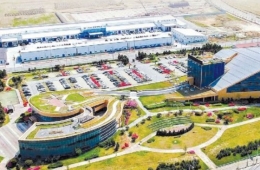
Intel CEO Warns of Memory Shortage Until 2028 Amid Soaring Prices
First-quarter DRAM average price
Revised up 95% quarter-on-quarter
Server DRAM also in short supply
As the global shortage of memory chips continues, Intel Chief Executive Officer (CEO) Ripbu Tan of the U.S. foundry (semiconductor contract manufacturing) company said that "the shortage of computer memory chips is highly likely to persist for at least two more years."

CEO Tan said this on the 3rd (local time) at a Cisco Systems conference, stating, "There is no sign that the shortage in supply is easing. I heard from two major key players in the memory sector that there is no indication that the shortage will ease before 2028."
As artificial intelligence (AI) infrastructure expands, demand for memory chips is exploding. According to market research firm TrendForce, as of the first quarter of this year, the projected quarter-on-quarter (QoQ) increase in the average price of DRAM was revised up to 90–95% as of the 3rd. Previously, it had been around 55–60%. NAND flash was revised up from 33–38% to 55–60%. As personal computer (PC) shipments in the fourth quarter of last year exceeded expectations, demand for PC DRAM increased and prices rose. Most major PC original equipment manufacturers (OEMs) are currently experiencing memory inventory shortages.
Server DRAM, considered a high value-added product, is also in short supply. Major cloud service providers (CSPs) and server OEMs in North America and China have been signing annual long-term DRAM contracts since the beginning of this month, and they expect first-quarter server DRAM prices this year to rise by about 90% from the previous quarter. This would mark the highest quarterly increase on record. The first-quarter contract price of low-power DRAM used in smartphones is also expected to surge 90% quarter-on-quarter, which would be the steepest rise ever.
As memory manufacturers focus on DRAM production, NAND supply is decreasing and prices are trending upward. The price of enterprise solid-state drives (eSSDs), a representative NAND product, is expected to rise by 53–58% in the first quarter. Overall NAND product prices are projected to climb by 55–60%.
Due to this price surge, the supply of memory needed for computers and smartphones is tightening. Bloomberg reported that Intel, the largest PC processor manufacturer, may raise its prices because of the memory supply shortage. It analyzed that if the prices of PCs equipped with Intel processors increase, consumer purchasing sentiment could weaken.
CEO Tan predicted that Nvidia, the frontrunner in the AI processor market, will further fuel memory demand with its latest Rubin platform and next-generation products. He said, "AI will absorb an enormous amount of memory."
Hot Picks Today
 Goldman Sachs Raises Forecast to 220%: "KOSPI H...
- Popcorn Container Craze at Theaters Sparks Sell-Out Frenzy, Emerges as New Reven...
- [Breaking] Magnitude 7.4 Earthquake Strikes Off Eastern Honshu, Tsunami Warning ...
- "It Turns Out They Were After My Account" Shocked Reactions... "We're Watching Y...
- "Moms Touch Unruly Woman" Video Spreads... Assaulted Employee and Smashed Regist...
The global memory market is currently dominated by Samsung Electronics, SK Hynix, and Micron Technology. Analysts say memory manufacturers are likely to significantly expand their gains from rising memory prices this year, following last year. The annual operating profits of Samsung Electronics and SK Hynix this year are both highly likely to far exceed 100 trillion won. SK Hynix improved memory profitability in the fourth quarter of last year and recorded an operating margin of 58%. This surpassed the operating margin of Taiwan's TSMC (54%).
© The Asia Business Daily(www.asiae.co.kr). All rights reserved.


!["They Said It Was 'Delicious' Milk... Is the 'List of Fake Milk Products in Korea' for Real? [Matjal X-File]"](https://cwcontent.asiae.co.kr/asiaresize/307/2023072413274517286_1690172865.jpg)