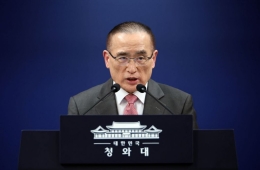
Resigned Resident Doctors Must Speak with One Voice to Engage in Dialogue with the Government
Interview with Chankyu Kim, Former Wonkwang University Hospital Resident Who Criticized KIRA's "Lack of Communication"
"There is a need to unify the communication channel for resident doctors. Now that a new emergency response committee, which is willing to engage in dialogue, has been formed, I intend to support it from within going forward."
Chankyu Kim, a resident doctor who resigned from Wonkwang University Hospital, made these remarks in an interview with Asia Economy on June 30, welcoming the launch of the new Emergency Response Committee of the Korean Intern Resident Association (KIRA). He emphasized that, amid the prolonged conflict between the medical community and the government, the voices of resident doctors?which had been divided by training hospital, region, and medical specialty?must be unified in order to negotiate with the government and political circles.

Chankyu Kim, a resident doctor who resigned from Wonkwang University Hospital, gave an interview to Asia Economy on the 30th of last month at a location in Yongsan-gu, Seoul. Photo by Taewon Choi
View original imageKim had previously publicly pointed out the lack of internal and external communication by the former KIRA emergency committee led by Dan Park. On June 19, together with 30 other resigned resident doctors, he criticized the KIRA leadership by stating, "KIRA's communication structure is not much different from that of the Yoon Suk Yeol administration," and called on the leadership to establish a channel for resigned residents to express their opinions. After reaching a consensus in a group chat with around 200 resigned residents that KIRA should engage in dialogue with the government, they conveyed this view to the Seoul Medical Association.
Kim explained, "After the launch of the new government, there was a consensus that communication with the government should take place before the start of the second half of the year’s training in September, which naturally brought resigned residents together," and added, "As a result, at the newly convened KIRA general assembly, a regional council was established as a channel for resident doctors to express their opinions."
He also began activities to promote voluntary changes in the medical field, rather than government-led medical reform. In March of this year, he joined as a founding member of the Korean Medical Policy School, where he is studying Korean medical policy anew with senior and junior doctors and colleagues, seeking practical alternatives.
Based on the ideas and research generated there, he also met with politicians from both ruling and opposition parties to convey the opinions of resident doctors. On June 22, he held a meeting with Yongtae Kim, the emergency committee chair of the People Power Party, asking for bipartisan cooperation to resolve the medical-government conflict. Two days later, on June 24, he met with Jumin Park, chair of the National Assembly Health and Welfare Committee from the Democratic Party, and Youngho Kim, chair of the Education Committee, to propose a governance (decision-making system) structure for resolving the medical crisis and to explain specific methods for achieving this.
In the meantime, the previous hardline leadership of KIRA stepped down, and the new emergency committee chair, Sungjon Han, was elected, creating an environment where resident doctors could sit at the negotiating table with the government to discuss returning to their training posts. On her first day commuting to work, Eunkyung Jung, who was nominated as the first Minister of Health and Welfare in the Lee Jaemyung administration, stated, "I will review the opinions of resident doctors and carefully consider ways for their return." In response, KIRA said, "We are ready to engage in open discussions to create a sustainable medical environment for everyone."
Hot Picks Today
 Even with High Oil Price Relief Payment, Additional 300,000 Won Per Person to Be Provided... Applications Open from the 18th in This Region
- "Invested 95% in Hynix and Reached 10 Billion Won"... Japanese Investor's Proof Post Goes Viral
- "Why Is the Korean Stock Market Surging?"... Even Italy Is Astonished by the KOSPI Rally
- "You Don't Need to Go to the Gym": The Best Exercises for Lowering Hypertension
- "That Thing Wakes Up Every Night" ... Suspicious Object Covers Rural Village
He stressed that, now that the environment has been established, it is necessary for resident doctors to speak with one voice. Kim said, "To resolve the conflict between the medical community and the government, and ultimately to persuade the public, resident doctors must speak with one voice," and added, "I hope the new emergency committee will gather members' opinions through democratic procedures and engage in constructive dialogue with the government and National Assembly to facilitate the return of resident doctors."
© The Asia Business Daily(www.asiae.co.kr). All rights reserved.