The Blueprint for Industrial AI Expansion Emerges... "Overcoming Industrial Structural Changes Due to Population Decline with AI"
Announcement of the Top 10 Tasks for Expanding Industrial AI
at the 3rd Public-Private AI Industry Policy Committee Meeting
The government has unveiled a blueprint to expand industrial artificial intelligence (AI). The plan aims to overcome changes in industrial structure, such as population decline and intensified technological competition, through AI, and to create success cases and discover new industries using AI in various fields including manufacturing, energy, and data.
The Ministry of Trade, Industry and Energy and AI Industry Policy Committee, composed of related industry experts, announced the "Top 10 Tasks for Expanding Industrial AI" at the 3rd meeting held on the 22nd at Lotte Hotel in Seoul.
Co-chairman and Minister of Trade, Industry and Energy Ahn Deok-geun emphasized at the meeting, "To accomplish the urgent task of spreading 'industrial AI' by integrating AI into industrial policy, the Ministry of Trade, Industry and Energy has been focusing on expanding industrial AI as a new axis of industrial policy since last year. It is important to create success cases first to overcome domestic and international challenges such as population decline, technological catch-up by latecomer countries, and oversupply, and to create new businesses and new industries."

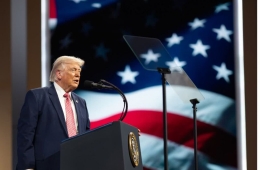
Minister Andeok Geun of the Ministry of Trade, Industry and Energy is delivering a greeting at the 3rd AI Industry Policy Committee meeting held on the 22nd at the Sapphire Ballroom of Lotte Hotel Sogong-dong, Seoul. Photo by Ministry of Trade, Industry and Energy
View original imageThe 10 tasks presented this time are subdivided into three major areas (success models, essential elements, infrastructure) and include ▲leading projects ▲AI agents and physical AI ▲industrial AI computing infrastructure ▲industrial data ▲AI semiconductors ▲AI talent ▲power infrastructure ▲industrial AI capital ▲AI ecosystem ▲industrial AI systems.
Looking at the main contents, first, the number of leading projects in autonomous manufacturing is planned to reach 60 by the end of this year on a cumulative basis and 200 by 2027. New manufacturing support leading projects in R&D, design, distribution, energy, supply chain, and safety will be promoted to spread AI throughout the industry. There is also a plan to build an inventory database of experiences during the application process such as AI success cases and to hold AI challenge competitions to create creative AI utilization cases.
Regarding industrial AI computing infrastructure, it was decided to build enterprise-level industrial AI computing infrastructure by industry and region in connection with and parallel to the National AI Computing Center. AI computing centers will be established in major regions (non-capital areas) reflecting corporate demand, and AI model demonstration infrastructure such as research equipment and testing/certification facilities will be built.
To improve the current difficulty in data exchange between companies due to concerns about trade secret leaks and lack of data standardization, a plan was also announced to establish an "industrial data bank" system.
Additionally, to secure semiconductor technology, support will be provided for the development of semiconductors that perform AI inference with high performance and power efficiency. Investments will be made in on-device AI semiconductor development projects embedded in products such as automobiles and robots, and foundational technologies essential for AI semiconductor manufacturing, such as commercialization design technology and next-generation packaging technology, will also be developed.
Furthermore, a power supply plan reflecting AI power demand will be established, and an AI-friendly power system will be built, including the creation of dedicated AI data center complexes. A tentative industrial AI fund will also be established to support high-risk corporate investments.

At the meeting, the four subcommittees of the AI Industry Policy Committee?Technology Trends, Future Industry, Standards, and Policy Recommendations?each presented various opinions for AI expansion.
The Technology Trends subcommittee suggested that, since there is a large gap in AI foundation model technology, which is a core technology necessary for AI application in industry, compared to the U.S. and China, it is necessary to derive and promote the domestic level and future development directions centered on 12 key tasks such as market forecasting, supply chain and purchasing efficiency, and research and development.
The Future Industry subcommittee emphasized the expected effects of AI integration in automobiles, shipbuilding, steel, and other sectors and stressed the need for policy support to achieve this. The Standards subcommittee proposed pursuing AI reliability assurance and international standardization cooperation measures.
The Policy Recommendations subcommittee proposed establishing an "AI Transition Promotion Fund," introducing an "AI Innovation Growth Initiative," fostering talent including one million practical professionals, and building an R&D center to respond to AI regulations to expand AI utilization.
Hot Picks Today
!["Stock Set to Double: This Company Smiles Every Time a Data Center Is Built [Click e-Stock]"](https://cwcontent.asiae.co.kr/asiaresize/93/2026050416112750184_1777878687.jpg) "Stock Set to Double: This Company Smiles Every...
"Stock Set to Double: This Company Smiles Every...
- "Is Yours Just Gathering Dust at Home? Millennials & Gen Z Rediscover Digicams O...
- Chicago Fed President: "Rate Hikes Needed If Productivity Expectations Overheat"
- "High-Net-Worth Investors Managing 10 Trillion Won: 'Gangnam Wealthy Also Feel F...
- “She Shouted, ‘The Rope Isn’t Tied!’... Chinese Woman Falls from 168m Cliff ...
Co-chairman Yoon Ui-jun, president of the Korean Academy of Engineering, stated, "We will actively contribute to concretizing policy tasks and producing tangible results."
© The Asia Business Daily(www.asiae.co.kr). All rights reserved.