[Asia Report] Manila's Political Drama: The War Between the Marcos and Duterte Clans
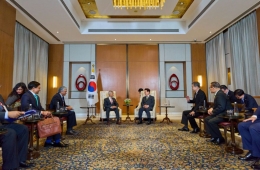
Bongbong Marcos and Sara Duterte
Clash on Every Issue Since Taking Office
Impeachment Motion Filed Against Vice President Last Month
Two Million Rally Nationwide in Opposition to Impeachment
![[Asia Report] Manila's Political Drama: The War Between the Marcos and Duterte Clans](http://www.asiae.co.kr/news/img_view.htm?img=2024062711120731528_1719454327.jpg)
The Philippines is considered one of the countries with the highest geopolitical importance and advantages alongside Taiwan during Trump’s second term. This is because the Philippines must serve as a strategic counterbalance to China’s influence in the broader Indo-Pacific region, including the contentious South China Sea.
For this, the approach to the ‘alliance’ with Trump and President Bongbong Marcos Jr. (hereafter Bongbong) is crucial. Both were born into wealthy families and exhibit a pragmatic attitude that values ‘deals,’ and Bongbong’s pro-American stance is widely expected to strengthen U.S.-Philippine relations.
◆ Vice President Impeachment Crisis = The Bongbong administration, inaugurated in 2022, already seems mired in domestic political conflict. This is largely due to the escalating conflict with Vice President Sara Duterte (hereafter Sara), which began in earnest over a year ago. Since an impeachment complaint against the vice president was filed last December, it is widely assessed that the two have crossed the point of no return. Naturally, the public is also unsettled.
On the 13th, when the Philippine Congress resumed, a grand event unfolded in Manila, the capital. Over one million religious followers held a peace rally at the Quirino Grandstand in Rizal Park, where the Philippine president took the oath of office. Nationwide, about two million people participated in this massive rally across eight regions. These attendees were supporters of the anti-impeachment movement for Vice President Sara Duterte, repeatedly reciting prayers and shedding tears for politicians, creating a remarkable scene. The event proceeded so calmly that it was described as a religious ceremony, with participants appealing to the president and the Senate, saying, “What we support is not conflict, blame, or selfishness, but reconciliation.”
This rally was organized by the influential Philippine Christian group Iglesia ni Cristo (INC), and it is expected to have significant repercussions. Religious organizations such as the Catholic Church and Christian groups wield overwhelming influence in the Philippines. Voters affiliated with religious groups tend to vote as a bloc and act as powerful interest groups. Although the INC faction leading this rally accounts for only 2-3% of the total population, their cohesive voting behavior has made them a significant force in elections. Naturally, the ruling party’s influence may decline in the upcoming by-elections in May, while Sara could rapidly emerge as a presidential candidate, putting pressure on Bongbong.
Political conflict in the Philippines is not an unfamiliar topic. However, the early split and hostile turn between the presidential and vice-presidential duo who won in 2022, Bongbong and Sara, is shocking. First, they share more similarities than differences. The Marcos family, known for dictatorship, represents the northern Philippines, while the Duterte family represents the southern Mindanao faction. The Philippines has a political culture of alliances among powerful families, often criticized as “dividing the spoils.”
Experts point out that the main cause of tension is the greater political ambitions of the two factions. The key issue is that Sara is a potential future presidential candidate. Sara Duterte, who harbors ambitions for the 2028 presidential election, has openly declared her aspirations. In contrast, President Bongbong focuses on unifying his family’s legacy and balancing the power among political clans in the Philippines, making it difficult for the two to find a compromise.
Since taking office, the president and vice president have clashed over senior government appointments and policy priorities. Sara, who serves as vice president and education secretary, has naturally gone beyond a ceremonial vice presidency to serious disagreements with Bongbong’s administration officials. As discord continued, Bongbong and the ruling party resorted to the impeachment card against the vice president at the end of last year. The impeachment charges are quite shocking: ‘threats to kill the president and the House Speaker,’ ‘ill-gotten wealth,’ and ‘involvement in large-scale corruption and other serious crimes.’
The philosophical and foreign policy differences between the two families have also played a role. The Marcos family has traditionally been close to the pro-American elite. Bongbong’s father Marcos went into political exile in Hawaii, and Bongbong himself was mostly educated in the United States. Conversely, the Duterte family is more closely connected to the indigenous elite in the Philippines. While not necessarily pro-China, they seem less inclined to participate in Western-style reform programs.
◆ Why Support Sara? = The religious sector’s ‘anti-Sara impeachment’ movement, which began in earnest on the 13th, can also be understood against this backdrop. Religious institutions in the Philippines exert political influence to protect church privileges in legal and institutional protections, land disputes, and tax issues. The Duterte family’s traditionally favorable policies toward indigenous religions have also contributed to this.
Some analyses suggest that while Bongbong is a past power, Sara represents future power, prompting early alignment. The Philippine president cannot serve consecutive terms, and as long as Sara avoids impeachment by the Senate, she can run in the 2028 presidential election. Considering Sara’s nationwide high profile and support from the religious sector, future rallies are likely to expand further.
Hot Picks Today
 Goldman Sachs Raises Forecast to 220%: "KOSPI H...
- Popcorn Container Craze at Theaters Sparks Sell-Out Frenzy, Emerges as New Reven...
- [Breaking] Magnitude 7.4 Earthquake Strikes Off Eastern Honshu, Tsunami Warning ...
- "It Turns Out They Were After My Account" Shocked Reactions... "We're Watching Y...
- "Moms Touch Unruly Woman" Video Spreads... Assaulted Employee and Smashed Regist...
The Philippines is considered a typical country trapped in the middle-income trap. Although it adopted democracy and a market economy early on, it has failed to overcome the evils of ‘oligarchy’ dominated by large landowning families. From the perspective of land capital, an agricultural economy is more advantageous than a manufacturing-based economy, so national policies have inevitably gone in circles.
The previous Duterte administration also poured most of the national budget into ‘infrastructure’ innovation but failed to link policies to the manufacturing industry, resulting in no clear economic growth. Although President Bongbong and Vice President Sara were elected on the platform of “economic reform,” they still emphasize agriculture as the core sector for development, showing limitations. Despite the sharp confrontations between the two families, it is likely that there is little substantive difference in content.
Jung Ho-jae, Secretary-General of Asia Vision Forum
© The Asia Business Daily(www.asiae.co.kr). All rights reserved.



!["They Said It Was 'Delicious' Milk... Is the 'List of Fake Milk Products in Korea' for Real? [Matjal X-File]"](https://cwcontent.asiae.co.kr/asiaresize/307/2023072413274517286_1690172865.jpg)