Vice Minister Park Minsu: "Although Medical Reform Discussions Are Difficult, We Will Strive to Ensure No Setbacks"
Medical Group Action Discussed at Central Disaster and Safety Countermeasures Headquarters Meeting: "Will Advance When Situation Stabilizes"
"Consulting Medical Community on Resident Return Plan"
Amid concerns that the government's medical reform may lose momentum following the emergency martial law situation, the government emphasized that it will "make every effort to ensure smooth progress."

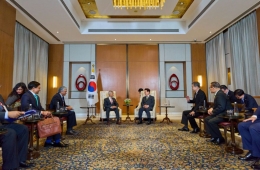
On the 12th, Park Min-su, the 2nd Vice Minister of the Ministry of Health and Welfare, stated in his opening remarks at the Central Disaster and Safety Countermeasures Headquarters (CDSCH) meeting regarding the doctors' collective action, "Although discussions on medical reform plans have faced difficulties due to recent challenging circumstances, we will advance the discussions as soon as the situation stabilizes."
Earlier, medical organizations such as the Korean Hospital Association, which participated in the Special Committee on Medical Reform (SCMR), protested against the martial law proclamation's phrase "punishment of medical personnel such as residents who have not returned," leading to their withdrawal from the committee. As a result, it remains uncertain whether the "2nd phase medical reform implementation plan," including improvements to non-reimbursable services and indemnity insurance initially scheduled for release this month, will be announced. The application rate for first-year resident recruitment, which closed on the 9th, was also low.
Vice Minister Park expressed regret, saying, "It is unfortunate that many residents who left training hospitals in the first half of this year have not yet returned," and added, "The government will operate the emergency medical system without disruption and will consult openly with the medical community on various measures to facilitate the return of residents."
On the same day, the CDSCH also reviewed the overall emergency medical system in preparation for the increase in patients during the winter season. According to the CDSCH, as of the previous day, 410 out of 414 emergency rooms nationwide are operating 24 hours a day, and there are 5,948 emergency room beds, which is about 98% of the normal level before the medical crisis.
With a decrease in mild and non-emergency patients visiting emergency rooms, overcrowding has slightly eased. Based on the first week of this month, the total number of patients visiting emergency rooms was 13,940, about 78% of the usual level, and mild and non-emergency patients numbered 5,484, approximately 66% of the usual level. The number of emergency medicine specialists at regional and local emergency medical centers was 1,611 as of the 9th, an increase of about 100 from 1,508 in December last year.
When checking whether patients admitted to emergency rooms could receive follow-up treatments such as hospitalization and surgery in a timely manner, as of the first week of this month, 101 out of 181 emergency medical centers capable of treating severe and emergency diseases were operational, a slight decrease compared to 109 centers during normal times.
Vice Minister Park said, "Overall, there are some difficulties in operating the emergency medical system, but it is being maintained relatively stably," and added, "The government will continue to communicate with the field and make ongoing improvements to ensure the emergency medical system remains stable."
Hot Picks Today
 Goldman Sachs Raises Forecast to 220%: "KOSPI H...
- Popcorn Container Craze at Theaters Sparks Sell-Out Frenzy, Emerges as New Reven...
- "Soaking in the Ganges Will Heal You" Tragedy as 13-Year-Old Boy Dies After 12 H...
- "It Turns Out They Were After My Account" Shocked Reactions... "We're Watching Y...
- "Moms Touch Unruly Woman" Video Spreads... Assaulted Employee and Smashed Regist...
The government plans to designate 10 additional emergency medical base regional centers this month, increasing the total from 14, to strengthen treatment for severe and emergency patients. From this month until February next year, incentives will be provided to regional emergency centers and others in recognition of their contributions to maintaining the emergency medical system, including patient acceptance and providing backup treatment. Additionally, more than 100 fever clinics for mild patients such as those with COVID-19 and around 200 COVID-19 cooperative hospitals will be reactivated to alleviate emergency room overcrowding.
© The Asia Business Daily(www.asiae.co.kr). All rights reserved.



!["They Said It Was 'Delicious' Milk... Is the 'List of Fake Milk Products in Korea' for Real? [Matjal X-File]"](https://cwcontent.asiae.co.kr/asiaresize/307/2023072413274517286_1690172865.jpg)