[How to Reform Inheritance Tax] ② Lower the Top Tax Rate for Large Corporations and Eliminate Surcharge on Major Shareholders
Despite Rising Prices and Housing Costs,
Inheritance Tax System Remains Unchanged for 24 Years
Five-Tier Tax Rate Structure Needs Reduction
![[How to Reform Inheritance Tax] ② Lower the Top Tax Rate for Large Corporations and Eliminate Surcharge on Major Shareholders](http://www.asiae.co.kr/news/img_view.htm?img=2024021415081363382_1707890893.png)
There is a growing opinion that to substantially ease the inheritance burden on businesses, the inheritance tax system?which has remained unchanged for 24 years despite rising prices and housing costs?needs a complete overhaul. The long-neglected inheritance tax reform has negatively impacted not only the middle class's burden but also the enhancement of corporate value. Experts point out the need to not only transition to an inheritance acquisition tax for rationalizing the taxation system but also to entirely reset the inheritance tax rates and brackets and consider abolishing the surcharge premium system.
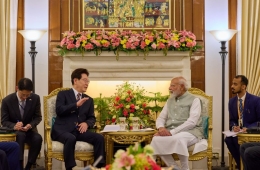
On the 17th of last month, President Yoon Suk-yeol hinted at the possibility of inheritance tax reform during a public discussion held at the Korea Exchange in Yeouido, stating, “There needs to be public consensus that inheritance tax is an excessive surcharge tax.” Since then, concerns about the excessive inheritance system have been raised continuously. According to a report titled ‘Suggestions for Smooth Business Succession of Export Companies’ published by the Korea International Trade Association in December last year, 42.2% of companies considered selling or closing their businesses instead of succession due to tax issues and other problems.
![[How to Reform Inheritance Tax] ② Lower the Top Tax Rate for Large Corporations and Eliminate Surcharge on Major Shareholders](http://www.asiae.co.kr/news/img_view.htm?img=2024021411151563052_1707876916.jpg)
Inheritance Tax System Unchanged for 24 Years... "Not Reflecting Inflation Is Virtually a Tax Increase"
Experts agree that fundamentally ‘normalizing the taxation system’ is necessary to alleviate the increased inheritance tax burden on businesses and the middle class. Since the highest inheritance tax rate was raised from 45% to 50% (60% for major shareholders) in 2000 and the taxable bracket lowered from ‘over 5 billion KRW’ to ‘over 3 billion KRW,’ there have been no significant changes for about 24 years. Currently, the inheritance tax rates are divided into five tiers: ▲10% for up to 100 million KRW ▲20% for over 100 million KRW up to 500 million KRW ▲30% for over 500 million KRW up to 1 billion KRW ▲40% for over 1 billion KRW up to 3 billion KRW ▲50% for over 3 billion KRW.
Professor Kang Sung-hoon of Hanyang University’s Department of Policy Studies stated, “Not reflecting annual inflation is effectively a tax increase,” and argued, “As the number of people paying inheritance tax increases every year, at least the tax rates or taxable standards should be adjusted to reflect the inflation rate.” According to a study by Professor Park Sung-wook of Kyung Hee University’s Department of Accounting and Taxation titled ‘Improvement Measures on Inheritance Tax Rates and Personal Deductions,’ the 3 billion KRW bracket for the highest tax rate in 2000 is estimated to be worth 4.86 billion KRW in 2021 value. This diminishes the meaning of inheritance tax as a tax on ultra-high net worth individuals. According to the National Assembly Budget Office, only 2.24% of all decedents paid inheritance tax in 2018, but this ratio rose to 4.52% in 2022. Professor Park diagnosed that the current five-tier tax rate structure should be reduced to four tiers and the highest tax rate should be eased from the current 50% to 40%.
There is a prevailing opinion that adjusting tax brackets alone is insufficient to solve the excessively large inheritance burden on conglomerates such as Samsung. Major shareholders of large corporations fall into the highest taxable bracket and thus are unaffected by bracket adjustments. It is known that the inheritance tax payable by Samsung’s largest shareholder amounts to about 12 trillion KRW. Even if tens of billions of KRW are reduced, it is difficult to ease the inheritance burden. Therefore, there is a claim that the surcharge system for major shareholders should be abolished to reduce the tax burden.
The major shareholder surcharge tax means that when inheriting shares of the major shareholder, an additional 20% of the valuation of those shares is imposed as a ‘management premium.’ This system imposes a surcharge tax by valuing shares that can influence decision-making in major listed companies at a higher value. For example, if shares valued at 100 million KRW are subject to inheritance, they are assessed as having 20% more value than their actual worth.
"Abolish Major Shareholder Surcharge Tax for Conglomerates" vs. "Surcharge Valuation Is Inevitable for High-Value Shares"
Professor Park Hoon of the Department of Taxation at the University of Seoul criticized the rationality of the 20% surcharge rate. He said, “Depending on the company, the management premium could be 130 million KRW or 140 million KRW, not just 120 million KRW with a 20% premium,” and added, “However, Korea applies this uniformly and mechanically (20% surcharge) in a formal manner, so changes are needed.” He further stated, “Small and medium-sized enterprises have already abolished the surcharge tax, so the system should also be reviewed for non-listed large corporations.” In the United States, there is no surcharge valuation rule when evaluating inherited shares. The fair market value principle is applied. Evaluations are conducted according to each company’s circumstances, considering their different characteristics. A tax law expert who requested anonymity said, “Unlike Korea, the U.S. courts appraise stock values case by case as if conducting an appraisal.”
Related Articles
![[How to Reform Inheritance Tax] ① Unfair Burden Increases with More Siblings Must Be Improved](https://cwcontent.asiae.co.kr/asiaresize/37/2024021313592561846_1707800366.png) [How to Reform Inheritance Tax] ① Unfair Burden Increases with More Siblings Must Be Improved
[How to Reform Inheritance Tax] ① Unfair Burden Increases with More Siblings Must Be Improved
However, there is also a counterargument that surcharge valuation is inevitable because controlling shares of large corporations have high socio-economic value. Professor Yoon Ji-hyun of Seoul National University Law School stated, “While the evaluation method cannot be considered absolutely correct, it is technically unavoidable for taxation legislation.” Professor Yoon argued, “Controlling shares with management rights in chaebol companies are assets with significant socio-economic value, so surcharge valuation is necessary.” Since there is a management premium where controlling shares are purchased at prices higher than market value when traded in the market, it is reasonable to apply a surcharge to the highest inheritance and gift tax rates based on the legal principle that the value of inherited property should be assessed at market price.
© The Asia Business Daily(www.asiae.co.kr). All rights reserved.



!["They Said It Was 'Delicious' Milk... Is the 'List of Fake Milk Products in Korea' for Real? [Matjal X-File]"](https://cwcontent.asiae.co.kr/asiaresize/307/2023072413274517286_1690172865.jpg)