EBS and Entrance Exam Industry: "Korean Language Harder Than Last Year's CSAT... No Killer Questions but Discriminative Power Secured" [2024 CSAT]
EBS "Questions from Public Education Curriculum"
"Securing Differentiation through Inferential and Critical Thinking"
Entrance Exam Industry Also Says "Likely Insufficient Time"
The Korean language section of the 2024 College Scholastic Ability Test (CSAT) was analyzed by EBS and the admissions industry as being somewhat more difficult than last year’s CSAT and this September’s mock exam. It was explained that the test was designed with high discriminative power even within the scope of public education by employing methods such as intricately applying concepts from the passages to the answer choices.
At the "2024 CSAT Korean Language Section Question Trend Analysis Briefing" held on the 16th at the Government Complex Sejong, Yoon Hye-jung, a teacher from Deoksu High School and a member of the EBS on-site teacher group who analyzed the first session Korean language questions, stated, "Although so-called 'killer questions' were excluded, the existing trend of creating a test that can be prepared for through the public education curriculum was maintained, which is expected to prevent confusion among test takers."
She also said, "A variety of difficulty levels appeared in the elective subjects of Speech and Writing, and Language and Media, securing discriminative power."
For the Korean language section, the EBS linkage rate was identified as 51.1%. Teacher Yoon said, "Following the test direction of maintaining the EBS linkage rate and linkage method while increasing the perceived linkage, it is expected that the perceived linkage felt by test takers in reading and literature will be generally high. Students who have faithfully completed public education and studied the EBS CSAT textbooks should be able to solve the questions sufficiently."
![[Image source=Yonhap News]](http://www.asiae.co.kr/news/img_view.htm?img=2023111612480955347_1700106488.jpg)
Among the questions, numbers 10 (Reading, Science and Technology), 15 (Reading, Integrated Humanities Theme), 27 (Literature, Genre Complex), 40 (Speech and Writing), and 39 (Language and Media) were considered highly discriminative questions.
Teacher Yoon said, "In the case of question 10, the topic of 'outliers and missing values' may be unfamiliar. However, it is at a level that can be sufficiently studied within the school curriculum’s Korean reading subject and is linked to an EBS passage." She added, "The concept is explained in the passage, and characteristics, human concepts, principles, and methods are well explained. Even without special professional background knowledge, the passage allows understanding of the overall argument."
When asked whether there were attractive answer choices like in the September mock exam, she replied, "Rather than attractive answer choices, these are questions that secure discriminative power. They are not questions where one can mechanically find the correct answer through simple practice, but questions that students who deeply understand literary passages and have factual, inferential, and critical thinking skills can solve, thus securing discriminative power."
Regarding the specific methods used to secure discriminative power, she analyzed, "The answer choices were carefully and intricately constructed to ask whether the test taker properly understands the explanations in the questions and can apply various inferential and critical thinking skills and other concrete examples." She also noted that there was no difference in question types compared to the September mock exam.

On the 16th, the day of the 2024 College Scholastic Ability Test, a test taker is waiting for the exam to start at Ewha Girls' Foreign Language High School in Jung-gu, Seoul. Photo by Joint Press Corps
View original imageThe admissions industry’s analysis was similar. It was evaluated that the test was more difficult compared to the September mock exam and last year’s CSAT, with many discriminative questions included.
Lim Seong-ho, CEO of Jongro Academy, analyzed, "Both the Korean common subjects (Reading, Literature) and elective subjects (Language and Media, Speech and Writing) were more difficult than the September mock exam and last year’s CSAT. Although EBS was linked, it is presumed that it was practically difficult to find the correct answers, and overall, the time was likely more insufficient than in the September mock exam."
Kim Byung-jin, director of the Etoos Education Evaluation Research Institute, said, "Considering the large imbalance in standard scores between Korean and Mathematics in the 2023 CSAT, it seems that the difficulty of Korean was somewhat increased in the 2024 CSAT to secure discriminative power. This is a trend similar to the September mock exam, and the final perceived difficulty will be determined by students’ analysis and learning level of the September mock exam."
The Korean language teaching staff of Megastudy Education also evaluated, "There were no truly ultra-high difficulty questions, and the test seemed to be designed not to deviate significantly from the September mock exam. However, much thought was put into the question types and answer choices to create discriminative questions, and there are many attractive incorrect answer choices."
Related Articles
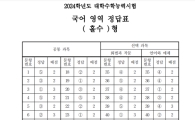 Announcement of 2024 CSAT Korean Language Section Answers and Answer Sheets (Odd and Even Versions)
Highly discriminative questions mentioned included numbers 15, 16 (Reading, Eastern Philosophy), 27, 31 (Literature, Modern Novels), 37, 36 (Language and Media, Grammar), 40, 43 (Speech and Writing, Writing), and 45 (Speech and Writing, Writing).
© The Asia Business Daily(www.asiae.co.kr). All rights reserved.







