How to Reform LH Former Officials and Improve Public Housing?..."Must Focus on Core Functions"
Experts Emphasize Need for LH Organizational Restructuring
Won Hee-ryong: "Turn Crisis into Opportunity for Public Housing Innovation"
"Prioritize Former Officials' Issues... Be Cautious with Function Improvements"
Experts have suggested that some functions of the Korea Land and Housing Corporation (LH) should be transferred to local governments and the private sector in relation to LH's overexpansion and the revolving door issue, which were triggered by the collapse accident in the underground parking lot of a public sale apartment in Geomdan, Incheon.
In response, the government plans to prioritize resolving the revolving door issue and handle the adjustment of functions cautiously. It also emphasized that it will turn this incident into an opportunity for innovation, including improving the quality of public housing.

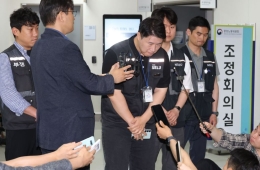
Won Hee-ryong, Minister of Land, Infrastructure and Transport, is speaking at the 'Public Housing Innovation Expert Meeting' held at the Government Seoul Office Building on the afternoon of the 10th. / Photo by Noh Kyung-jo
View original imageOn the afternoon of the 10th, Won Hee-ryong, Minister of Land, Infrastructure and Transport, stated at the 'Public Housing Innovation Expert Meeting' held at the Government Seoul Office, "LH must break its vested interest cartel and respond to the era's and the public's demand for public housing innovation."
He added, "The income levels and expectations of the public have risen," and said, "By combining good building materials, design, and various necessary living services, public housing will secure quality equal to or exceeding that of private housing."
From 2008 to 2022, a total of 1.24 million households of public housing were completed over 15 years. Among them, LH supplied 890,000 households, accounting for about 72.3% of the total. However, residents' discomfort due to defects caused by low quality has persisted.
In particular, 40% of defect reports originate from government-supplied materials, and negative perceptions of LH housing remain. Problems such as the revolving door and poor systems are widespread in the construction process, including ordering, bidding, design, and supervision.
At the meeting, members of the Public Housing Innovation Subcommittee of the Housing Supply Innovation Committee unanimously pointed to LH's organizational overexpansion as the root cause and agreed that it should be reorganized to focus on core functions.
Shim Kyo-eon, President of the Korea Research Institute for Human Settlements, said, "If housing construction is boldly handed over to the private sector and infrastructure, land acquisition, and development are kept as core functions, the speed of housing supply can increase and quality can improve."
Chun Hyun-sook, adjunct professor of architecture at Korea University, also said, "Housing welfare-related tasks should be handled directly by the government centered on local governments, not LH," and added, "Considering each party's strengths, the public should develop and provide land, while design and construction should be expanded in the private sector." She further emphasized, "In a situation where housing supply contraction is a concern, it is important that a form of 'governance' that complements this by the public sector operates."
Lee Yong-man, professor of real estate at Hansung University, mentioned ways to strengthen LH's original functions. He said, "To prevent moral hazard caused by information asymmetry, LH's internal control system needs to be strengthened to the level of financial institutions," and added, "Personnel should be redeployed where necessary, and if needed, LH Land and Housing University should train and supply the required workforce."
There were also opinions that budget and rent should be sufficiently considered during LH's structural reform, as this is directly linked to improving the quality and brand of public housing and housing welfare.
Kim Deok-rye, head of housing policy at the Korea Research Institute for Housing and Urban Affairs, suggested, "Can public housing funded by public money be compared equally with high-quality private apartments?" and said, "Basic considerations are needed, such as who bears the cost when supplying high-quality public housing at low rents." She added, "To improve quality, performance indicators focused on quantity should be improved."
Heo Yoon-kyung, research fellow at the Korea Construction Industry Research Institute, said, "In a situation where the housing budget is insufficient, LH has supplied rental housing using funds generated from sales and land development," and added, "When it is difficult to inject more funds, if development profits are reduced, housing welfare and budget issues must be considered together with LH's problems."
Hot Picks Today
 "Stocks Are Not Taxed, but Annual Crypto Gains Over 2.5 Million Won to Be Taxed Next Year... Investors Push Back"
- Second Round of Post-Adjustment Talks at Samsung Electronics Ultimately Fails... Central Labor Relations Commission: "Labor Accepted, Management Reserved Decision"
- "Not Jealous of Winning the Lottery"... Entire Village Stunned as 200 Million Won Jackpot of Wild Ginseng Cluster Discovered at Jirisan
- Bull Market End Signal? Securities Firm Warns: "Sell SK hynix 'At This Moment'"
- "Even With a 90 Million Won Salary and Bonuses, It Doesn’t Feel Like Much"... A Latecomer Rookie Who Beat 70 to 1 Odds [Scientists Are Disappearing] ③
Meanwhile, concerns were raised about the rise in sale prices and rents when public housing quality is improved. In response, Minister Won said, "A sudden jump in sale prices does not align with market functions, but increases in line with inflation or economic growth rates are considered normal," and added, "There can be various forms of private sector participation in public housing. We will evaluate performance and consumer responses to find a balance where the market functions and the public can accept it."
© The Asia Business Daily(www.asiae.co.kr). All rights reserved.