"The Right to Give Birth Must Be Guaranteed Regardless of Marital Status"
Jang Hye-young, Justice Party Lawmaker, Hosts 'Support for Single Mothers by Choice Act' Forum
Promoting Maternal and Child Health Act for Assisted Reproductive Technology Support for Single Women
Public discourse surrounding the amendment to the Maternal and Child Health Act (Non-Marital Childbirth Support Act), which includes support for assisted reproductive technology for unmarried women, is gaining momentum. The bill is one of the three family composition rights laws (Life Partner Act, Marriage Equality Act, Non-Marital Childbirth Support Act) promoted by the Justice Party.
Jang Hye-young, a Justice Party lawmaker who introduced the bill, stated at the forum titled "Pregnancy, Childbirth, and Family Composition Rights of Unmarried Women" held at the National Assembly Members' Office Building on the 28th, "The right to give birth and raise children should be guaranteed not only to married couples composed of a man and a woman but also to unmarried women and anyone who is not bound by the institution of marriage."
The Non-Marital Childbirth Support Act is based on expanding the support for assisted reproductive technology, which is currently limited to infertile couples, to all women who wish to become pregnant and give birth. Although assisted reproductive technology for unmarried women is not illegal at present, the ethical guidelines of the Korean Society of Obstetrics and Gynecology effectively restrict assisted reproductive technology for unmarried women. The Non-Marital Childbirth Support Act was prepared to guarantee women's self-determination rights regarding pregnancy and childbirth and to legally protect non-marital childbirth.

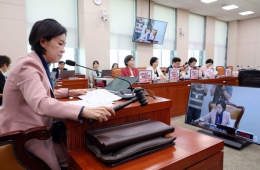
On the 28th, a forum titled "Pregnancy, Childbirth, and Family Composition Rights of Unmarried Women as Seen Through the Unmarried Childbirth Support Act" was held at the National Assembly Members' Office Building. Photo by Joohee Kang kjh818@
View original imageLawmaker Jang pointed out, "As shown by the case of Sayuri, who publicly revealed her non-marital childbirth a few years ago, domestic policy discussions on pregnancy and childbirth for unmarried women are at a very insufficient level," adding, "The government only provides and supports sperm to infertile couples. Unmarried women cannot use public sperm banks, and even if they receive sperm donations, they cannot receive sperm donations due to the assisted reproductive technology ethical guidelines of the Korean Society of Obstetrics and Gynecology."
Kim Dong-sik, senior research fellow at the Korean Women's Development Institute, who presented at the forum, noted, "Statistically, awareness of the respect, protection, and support for the human rights and rights related to non-marital childbirth has significantly increased, but various issues and conflicts surrounding pregnancy have not yet been resolved."
Researcher Kim emphasized the need for discussions on unmarried individuals' access to assisted reproductive technology, the difficulty of financial support for assisted reproductive technology for unmarried individuals, and the necessity of operating public sperm and egg banks to guarantee childbirth for unmarried individuals. He particularly stressed, "The issue of non-marital childbirth should not be viewed from the perspective of population policy or solving low birth rates, but should be discussed within the framework of human rights."
Attorney Ryu Min-hee (Executive Committee member of the Marriage Equality Coalition) said, "The basic principle from the rights perspective is that everyone has the right to choose to become a parent or not, and this should not be discriminated against based on marital status, sexual orientation, or gender identity." However, Attorney Ryu pointed out that sexual minorities, including unmarried women, same-sex couples, and transgender individuals, have been deprived of these rights until now.
Kim Sae-rom, research professor at Seoul National University Graduate School of Public Health, pointed out, "Various laws, including the Maternal and Child Health Act, regulate medical care, but there is a considerable gap between legal guarantees and quality, patient-centered medical care in reality." Currently, unmarried women and sexual minorities can receive assisted reproductive technology if they bear the costs and wish to give birth, but access itself is practically difficult due to the ethical guidelines of the Korean Society of Obstetrics and Gynecology.
Regarding the Maternal and Child Health Act, Professor Kim diagnosed, "The authority over what kind of procedures and relationships to go through in the medical process is generally held by medical institutions. It is also difficult for patients, civil society, or the state to intervene in the medical process."
Hot Picks Today
 "Now Our Salaries Are 10 Million Won a Month" Record High... Semiconductor Boom Drives Performance Bonuses at Major Electronic Component Firms
- Is It Really Like an Illness? "I Can't Wait to Go Again"—Over 1 Million Visited in Q1, Now 'Busanbyeong' Takes Hold [K-Holic]
- "Realizing How Fast Money Disappears: Should You Try Only the Essentials for 5,000 Won? [The Basics of Benefits]"
- "Heading for 2 Million Won": The Company the Securities Industry Says Not to Doubt [Weekend Money]
- Experts Already Watching Closely..."Target Price Set at 970,000 Won" Only Upward Momentum Remains [Weekend Money]
She added, "In Korean society, where forming a family and raising children is becoming a privilege of the upper class, the position of (support for assisted reproductive technology) should be examined within the class and patriarchal structures."
© The Asia Business Daily(www.asiae.co.kr). All rights reserved.