"OPCON Transfer" Wi Seongrak: "Significant Progress in South Korea-U.S. Talks... No Major Gap in Timing"
"Timing will likely be discussed through high-level dialogue representing the leaders"
On USFK strategic flexibility issues such as the Taiwan Strait: "Adjustments can be made through consultations"
Denies speculation of USFK equipment redep
Wi Seong-rak, Director of the National Security Office at the Blue House, stated that discussions regarding the transfer of wartime operational control (OPCON) are progressing with the goal of completing the transfer as soon as possible within the current administration’s term. He also said that talks between South Korea and the United States have made significant progress in this regard. Regarding the operational flexibility of U.S. Forces Korea (USFK) in the region, he commented, "Strategic flexibility is not a new issue, and if we make good use of the framework of agreements and operational finesse between South Korea and the United States, adjustments can be made."

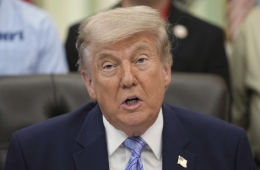
Seong Nak Wi, Director of National Security Office, is speaking at a meeting held by the Korea Newspaper Editors Association at the Press Center in Seoul on May 13, 2026. Photo by Yonhap News
View original imageOn May 17, Wi appeared on KBS's "Sunday Diagnosis Live" and responded to questions regarding current issues in the South Korea-U.S. alliance. He said it is "difficult to specify an exact timeline" for the OPCON transfer, but emphasized, "The government’s externally stated position is to proceed as soon as possible within the term." He went on to explain, "Since operational command authority is a matter related to the military command of the head of state, it can be addressed at the level of dialogue between leaders or high-level representatives. It is both a political and military issue."
He reiterated that discussions on the OPCON transfer have made significant progress. "There is no major gap in the timing currently being discussed between the military authorities of South Korea and the United States," he said, "the difference is not five or ten years but is quite close." Regarding U.S. Forces Korea Commander General Paul LaBrunson’s mention of 2029 as the projected timeline for meeting the conditions for OPCON transfer during a U.S. Congressional hearing, Wi commented, "I understand that the general was testifying about what is important from a military commander’s perspective," and added, "Around the second half of this year, a roadmap will be developed, and the timeline will be proposed based on the Full Operational Capability (FOC) assessment."
He also explained that an increase in the national defense budget is inevitable in conjunction with the OPCON transfer. Wi stated, "One of the two major issues discussed with the United States at the beginning of this administration was the increase in the defense budget," adding, "It was agreed that the direct defense budget would be gradually increased to 3.5% of the gross domestic product (GDP)." He further said, "If we are to take over OPCON and play a greater role in defending the Korean Peninsula ourselves, an increase in the defense budget is naturally required."
On the issue of strategic flexibility for USFK, he reaffirmed the existing framework of agreement between South Korea and the United States. Wi explained, "While USFK is under the command of the U.S. President, its presence in South Korea also subjects it to the influence of Korean sovereignty. It is not something that the United States can do as it wishes, nor can we unilaterally prevent actions." He added, "There are overlapping sovereign elements that require coordination."
Referring to the 2006 agreement on strategic flexibility between South Korea and the United States, he explained, "There is a mutual understanding that while strategic flexibility is respected, it should not result in South Korea’s involvement in unwanted conflicts." He continued, "This principle is also reflected in recent joint fact sheets, meaning that while the United States exercises strategic flexibility, it does so within the scope that respects South Korea’s considerations."
Wi also dismissed concerns that USFK’s role could change in the event of a regional emergency, such as a crisis in the Taiwan Strait. "Even if we consider a scenario involving the Taiwan Strait, I do not believe there would be significant difficulties or concerns," he said, "If we make good use of the current framework of agreements and operational finesse, adjustments can be made." He added, "The first mission of USFK and the South Korea-U.S. Combined Forces is still to counter the threat from North Korea. However, there is some flexibility, and even that flexibility can be adjusted and managed through consultations between South Korea and the United States."
Wi also denied speculation that USFK equipment has been removed from South Korea due to the Middle East crisis. "It is true that there has been some movement of supplies as a result of the situation in the Middle East, and that too is part of strategic flexibility," he said, "but there have been no cases where major equipment of USFK has been moved or diverted during this Middle East situation." When the host mentioned THAAD and Patriot systems, Wi replied, "Nothing has been moved," adding, "There may be some parts or supplies that are not major equipment, but these are being managed and coordinated through mutual consultations."
Wi’s remarks reflect the government’s policy of managing the sensitive alliance issues of OPCON transfer and strategic flexibility simultaneously. The aim is to strengthen the Korean military’s leading defense capability through the OPCON transfer, while controlling the regional operations of USFK based on South Korea-U.S. agreements and South Korea’s security interests.
Hot Picks Today
 "Only Two Per Person" Garbage Bag Crisis Was Just Yesterday... Japan Also Faces Shortage Anxiety
- "Samsung Electronics Employee with 100 Million Won Salary Receiving 600 Million Won Bonus... Estimated Tax Revealed"
- Lived as Family for Over 30 Years... Daughter-in-Law Cast Aside After Husband's Death
- 'Will Demand Finally Decline Due to High Prices?'... "I'll Just Enjoy Nearby Trips" as Japan and China See a Surge
- "Wore It Once, Then This? White Spots All Over 4.15 Million Won Prada Jacket... 'Full Refund Ordered'"
Regarding the overall South Korea-U.S. alliance, Wi assessed, "The relationship remains robust in terms of the overall trajectory. We also have enough potential to manage and address newly emerging issues as they arise." However, regarding the convergence of security, economic, and trade issues, he noted, "We are in an era where security and the economy cannot be separated," and stressed the need for cooperation and coordination between diplomatic and security ministries, the economic ministries, the government, and the private sector.
© The Asia Business Daily(www.asiae.co.kr). All rights reserved.