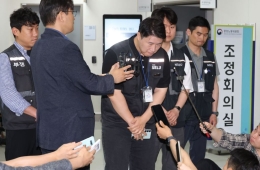
"Hyundai Motor Union Member Verdict" Kim Sang-hwan, Director of the Court Administration Office, "Deep Concern Over Excessive Criticism"
Director Kim: "Difficult to Accept Personal Attacks Unrelated to the Verdict"
Supreme Court: "Not Blocking Damage Claims... Responsibility Differs Among Union Members"
After the Supreme Court ruled that the liability ratio for damages should be different for each union member who participated in an illegal strike, the political sphere and labor and industry sectors have been rife with controversy, prompting the Court Administration Office to step in for damage control.
Inside and outside the legal community, there have been serious personal attacks against Justice No Jeong-hee, who presided over the case, with reactions that the situation has gone too far.

Kim Sang-hwan, Chief of the Court Administration Office. / Photo by Yoon Dong-joo doso7@
View original imageOn the 19th, Kim Sang-hwan, head of the Court Administration Office, issued a statement expressing "deep concern over the excessive criticism directed at the Supreme Court ruling on a specific case and the presiding justice following the announcement of the verdict."
He added, "While it is natural to have various evaluations and criticisms of court rulings, and the court itself must listen carefully, it is unacceptable to hastily assert claims that may cause misunderstandings about the true intent and purpose of the ruling without a precise understanding and careful review of the legal issues raised during the trial and the content of the judgment, or to direct excessive personal attacks unrelated to the ruling against specific judges constituting the bench."
He continued, "This applies not only to the Supreme Court ruling but also to the rulings of the first and second trials. Such wrongful claims can act as undue pressure on the bench that issued the ruling based solely on constitutional and legal interpretations, and furthermore, they can significantly undermine the independence of the judiciary guaranteed by the Constitution and the public’s trust in judicial procedures, so restraint is necessary."
Earlier, on the 15th, the Supreme Court judged that viewing the scope of damages liability equally for the labor union, which decided and led the illegal industrial action, and individual union members could potentially undermine the constitutional rights of workers to organize and take collective action.
The bench stated, "The degree of limitation on the liability of individual union members should be comprehensively determined by considering their status and role within the union, the circumstances and extent of their participation in the industrial action, and the degree of contribution to the damages incurred."
The labor sector interprets the Supreme Court’s judgment as aligning with the intent of the ‘Yellow Envelope Act,’ but the government, ruling party, and business community criticize it, saying it will result in restricting the employer’s sole means of responding to illegal industrial actions through claims for damages.
Hot Picks Today
 "Stocks Are Not Taxed, but Annual Crypto Gains Over 2.5 Million Won to Be Taxed Next Year... Investors Push Back"
- [Breaking] Samsung Labor-Management 'Performance Bonus Negotiations' Fail in Third Mediation... Union Says "General Strike to Proceed as Planned Tomorrow"
- "Not Jealous of Winning the Lottery"... Entire Village Stunned as 200 Million Won Jackpot of Wild Ginseng Cluster Discovered at Jirisan
- Bull Market End Signal? Securities Firm Warns: "Sell SK hynix 'At This Moment'"
- "Even With a 90 Million Won Salary and Bonuses, It Doesn’t Feel Like Much"... A Latecomer Rookie Who Beat 70 to 1 Odds [Scientists Are Disappearing] ③
However, the Supreme Court rebutted, stating that even after the ruling, companies can still prove the total damages and claim compensation from defendants who participated in the illegal industrial action, so claims for damages are not blocked or restricted.
© The Asia Business Daily(www.asiae.co.kr). All rights reserved.