[News Terms] Germany Announces National Security Strategy... China 'De-risking'
"Not 'Decoupling' but 'De-risking' Desired
"Manage Risk Factors Arising from High Dependence"
Mentioned in Joint Declaration of G7 Countries
Germany's mention of "de-risking," meaning reducing risks caused by China, has drawn attention to what this term actually means. The German traffic light coalition government (Social Democrats - red, Free Democrats - yellow, Greens - green) approved its first-ever national security strategy at a cabinet meeting on the 14th (local time).
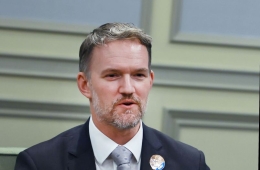
German Chancellor Olaf Scholz said at a joint government press conference in Berlin that day, "For the first time in our country's history, we have created a national security strategy," adding, "It is an unprecedented and important strategy to ensure the safety of our people amid changing surrounding circumstances."
Regarding China, he said, "We want de-risking, not decoupling, from China," and added, "China will continue to grow economically, and its participation in global trade should not be affected, but at the same time, we need to consult on security issues. Maintaining this balance is the challenge."

German Chancellor Olaf Scholz is speaking at a press conference announcing the 'National Security Strategy' held in Berlin on the 14th (local time). Photo by EPA Yonhap News
View original image"De-risking" generally referred to financial institutions limiting transactions in certain sectors for risk management. However, in the 2020s, its meaning expanded to international trade. It is used with the intention of managing or reducing potential risks arising from heavy dependence on a specific country.
The term gained global attention when Ursula von der Leyen, President of the European Union (EU) Commission, used it in a speech on China policy on March 30. She emphasized two reasons behind de-risking: "Europe's interests and the impracticality of decoupling." She added that honest exchanges and diplomacy are important to move beyond black-and-white thinking for de-risking.
After the speech brought de-risking into the international spotlight, Jake Sullivan, U.S. National Security Advisor, said at a Brookings Institution lecture on the 27th of last month, "We support de-risking, not decoupling," and explained, "De-risking fundamentally means securing resilient and efficient supply chains to ensure that no country can coerce dependence."
Hot Picks Today
 "Buy on Black Monday"... Japan's Nomura Forecasts 590,000 for Samsung, 4 Million for SK hynix
- "Plunged During the War, Now Surging Again"... The Real Reason Behind the 6% One-Day Silver Market Rally [Weekend Money]
- "Trump and Netanyahu Hold Talks on Iran War...Possibility of Resuming Military Action"
- Experts Are Already Watching Closely..."Target Stock Price 970,000 Won" Now Only the Uptrend Remains [Weekend Money]
- "That? It's Already Stashed" Nightlife Scene Crosses the Line [ChwiYak Nation] ③
Subsequently, the term appeared in the G7 joint declaration on May 20. The leaders emphasized in the declaration, "Our policy approach is not to harm China or hinder China's economic progress and development," and stressed that they are not pursuing "decoupling" or inward-looking policies with China, but recognize the importance of economic resilience through "de-risking" and diversification.
© The Asia Business Daily(www.asiae.co.kr). All rights reserved.