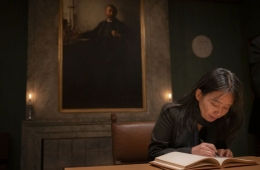
ChatGPT Reporter vs. Human Reporter Writing Contest, "I Felt a Sense of Self-Disgust"
[Essential Intellectual Property]⑫ Relationship Between Patents and AI
AI Patents Rank First Among 4th Industrial Revolution Technologies
KIPO Utilizes AI in Work... Also Faces Administrative Lawsuits
Many AI Creations... Discussions Ongoing on IP Ownership Rights

Double-edged Sword AI... Used in Patents but a 'Headache', Why?
The rapidly advancing artificial intelligence (AI) technology is a hot topic. AI technology is also bringing significant changes to the intellectual property (IP) market. AI brings both benefits and drawbacks. Let's take a look at the changes AI has brought to the patent market.
Companies, without exception, are filing patents utilizing AI technology. According to the patent application statistics in the field of 4th Industrial Revolution technologies released by the Korean Intellectual Property Office (KIPO), last year the number of patent applications in the AI field was the highest at 6,860. Following that were Digital Healthcare (5,591), Autonomous Driving (3,805), Intelligent Robots (1,883), Internet of Things (1,584), and Big Data (1,020).
Since the COVID-19 pandemic, demand for non-face-to-face and digital industries has increased, causing a surge in AI technology patent applications. By year, the numbers were 5,711 in 2019, 7,855 in 2020, 9,117 in 2021, and 6,860 in 2022.
For example, Samsung Electronics filed a patent in January 2018 titled "Device and Method for Recommending Products," which was registered last month. This patent includes technology where AI reads the user's facial expressions and movements to recommend products. Users virtually try on clothes, and AI reads their facial expressions via camera to assess emotions and satisfaction with the clothes, helping with purchase decisions.
![Samsung Electronics' AI Patent 'Device and Method for Recommending Products' [Source=KIPRIS]](http://www.asiae.co.kr/news/img_view.htm?img=2023022307573433402_1677106654.jpg)
Samsung Electronics' AI Patent 'Device and Method for Recommending Products' [Source=KIPRIS]
View original imageThat's not all. AI now creates content such as videos, games, music, and even books. Recently, a book titled <45 Ways to Find the Purpose of Life> written by ChatGPT was published. What would have taken a human months was completed in just seven days, with AI handling proofreading and editing as well.
As AI technology changes the world, the Korean Intellectual Property Office's work methods are gradually evolving. This month, KIPO announced an "Innovation Roadmap for Patent Administration Using AI Technology." The plan is to utilize AI throughout patent administration, including examination and trials. This is a measure considering the limited budget and the difficulty of infinitely increasing patent examiners. They plan to develop AI language models specialized in understanding and processing patent documents in cooperation with private companies. Additionally, they will expand the scope of patent and trademark searches to improve work efficiency.
However, AI is a "double-edged sword" for KIPO. Last year, they were sued administratively by an American scientist (Professor Steven Taylor) who argued that AI should be recognized as an inventor. In response, KIPO formed an internal task force and is collaborating with private law firms. KIPO must submit a response to the Seoul Administrative Court by next month, which will include arguments refuting Professor Taylor's claims.
Whether to recognize AI as an inventor is an issue that must be aligned with the international community. Jwa Seung-kwan, head of the Patent System Division at KIPO, said, "Most countries do not allow patent applications listing AI as an inventor," adding, "International harmony is important regarding intellectual property rights. Even if the system is improved in the future, there is a consensus to align stances."
"There Is a Possibility AI Could Be Recognized as an Inventor"
Currently, legally, artificial intelligence (AI) cannot be an inventor. Most countries stipulate that inventors must be human. This is because, according to the theory of creators, only humans can be inventors. Humans create new ideas based on creativity, knowledge, experience, and intuition, and invent based on these ideas.
However, AI can learn and analyze human knowledge and data to generate new information. When AI plays a role in generating parts of creative works, it can be unclear to whom the intellectual property rights of such creations belong. For example, suppose AI composes music or draws pictures. Questions may arise as to whether these works belong to the AI, the developers who created the AI, or the owners of the data used to generate the works. These issues are being discussed among experts and legal professionals dealing with AI-related legal matters. In the future, more regulations and guidelines may be developed regarding the possibility of AI owning copyrights. As technology advances, discussions may arise about whether AI-generated creations or inventions are legally recognized.
Professor Steven Taylor developed "Creativity Machine" technology to enable AI to generate creative results. He produced several creative works with this technology, some of which were recognized as artworks. There is debate about the extent of human involvement in the creation process and how it affects copyright issues.

AI-generated creations can take various forms, including music, paintings, videos, literature, and games. These creations are generated in diverse forms depending on AI's training data, algorithms, and inputs. A distinguishing feature of AI-generated works is that they are created using machine learning algorithms.
There is a lot of AI-generated music. One of the most famous examples is "AIVA." AIVA stands for "Artificial Intelligence Virtual Artist," a startup headquartered in Luxembourg. AIVA composes classical music by analyzing large amounts of classical music data, understanding the structure and patterns of compositions, and then generating new compositions. Among AIVA's works, the piece "Genesis" is well-known.
AI can also guide you on how to find the purpose of life. First, listen to your inner voice. Challenge yourself with new things and explore your interests and passions. Analyze your values and abilities while participating in social activities such as volunteering. You can also seek help from experts like career counselors. The important thing is to think about the kind of life you want to live and continue trying to find your life's purpose.
A Showdown Between ChatGPT Developed by OpenAI and a Human Reporter Writing Articles
Article ① was written by a human reporter, and Article ② was written by ChatGPT. To conclude, the human reporter was 'knocked out'. In terms of time and efficiency, the reporter was completely KO'd. A digital timer was placed on the desk to precisely measure the time spent on research and writing. The article length was set equally at 7.7 manuscript pages. The reporter took 2 hours and 32 minutes, while ChatGPT completed the article in just 27 minutes. It was disheartening. Another reporter was asked to read both articles and guess which was written by AI. They said my article "seemed AI-written," citing the frequent use of clich?d expressions like "hot topic."
The human reporter's research process was not easy. This was because they did not have accurate information about recognizing AI as an inventor. They called the relevant department at KIPO. The official said, "After discussing with the spokesperson's office, we will inform you 'immediately'." The reporter trusted this firmly. However, the callback from KIPO came 1 hour and 21 minutes later. Would they have called sooner if they knew the reporter was engaged in a showdown with ChatGPT akin to the legendary Lee Sedol vs. AlphaGo match? The reporter regretted the delay. After an 11-minute and 22-second call with a KIPO official, over 30 minutes were spent searching for article sources. They searched KIPO press releases and various patent professional institutions' information. Finding useful and accurate information for readers in the "sea of information" on the internet was not easy. To avoid missing the deadline and scolding from the editor-in-chief, the reporter hurried to write the article.
However, another hurdle arose when discovering Samsung Electronics' case of filing a patent using AI technology. This technology allows users to virtually try on clothes, and AI cameras assess satisfaction based on the user's facial expressions to help select clothes. When the user picks clothes, they go straight into the shopping cart. AI also measures the user's body size to select perfectly fitting clothes. This fresh patent was registered last month after being initially rejected and revised. The reporter thought, "Fashion companies will pay attention," but also worried unnecessarily about the cost burden of building such a system. Being an intuitive (N) type in the MBTI personality, prone to rich imagination, unnecessary thoughts kept piling up.

On the other hand, ChatGPT showed astonishing focus. When asked about over ten questions such as "Can AI be the owner of intellectual property rights?" "AI-created works," and "How to find the purpose of life," it answered each within 30 seconds. Slightly editing the answers to fit the context was not difficult. ChatGPT was especially knowledgeable about overseas information. However, it was annoying that it introduced AIVA as a startup headquartered in Luxembourg. The startup's name is "AIVA Technologies," and the AI composer created by this company is named "AIVA." The reporter thought it would be more accurate to write "AIVA Technologies" initially and then shorten it to "AIVA." But considering that it is common in English-speaking countries to omit "Technologies" after company names, it was not a big issue. Also, when asked about recent yearly AI-related patent application numbers, ChatGPT gave figures different from KIPO's announcement, so the reporter did not include them in the article.
Related Articles
 Chinese Communist Party 'Bans ChatGPT'... Concerns Over Criticism Like "Lifelong Rule"
ChatGPT possessed not only knowledge but also wisdom. When asked directly about the book it wrote on finding the purpose of life, it provided answers containing deep insights about life that world-renowned scholars might share. The reporter listened to "Genesis," a song composed by AIVA, on YouTube. The majestic yet poignant melody almost brought tears. It was of a quality suitable for a movie OST. The reporter thought that content creation for solo creators would become easier by using AI as an assistant. Summarizing the experience of competing with ChatGPT as a professional, the reporter concluded that it is now time to seriously consider whether to utilize AI in one's work or be replaced by AI.
© The Asia Business Daily(www.asiae.co.kr). All rights reserved.