Kim Ki-moon: "The Delivery Price Linkage System Aims to Correct Unfair Trade"... Rebuttal to KDI

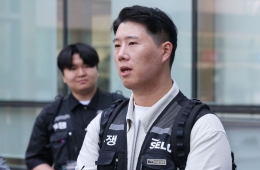
Kim Ki-moon, Chairman of the Korea Federation of Small and Medium Business, is speaking at a press conference held on the 28th at Lotte Hotel Jeju in Seogwipo, Jeju.
View original image[Asia Economy Reporter Donghyun Choi] "The delivery price linkage system aims to correct the unfair trade order where, for example, large corporations make a 15% profit while small and medium enterprises (SMEs) only get 5%. It is difficult to agree with the Korea Development Institute (KDI)'s claim that the linkage system will lead to a transfer of consumer burden."
Kim Gi-moon, Chairman of the Korea Federation of SMEs, said at a press conference held on the 28th at Lotte Hotel Jeju in Seogwipo, Jeju, "The linkage system is not a new issue but one that has been socially verified over the past 14 years." He added, "The linkage system is an issue on which the ruling and opposition parties have agreed as a livelihood bill, so it is regrettable to hear such comments from KDI."
Kim's remarks were a rebuttal to the report titled "Economic Discussion on the Delivery Price Linkage System" released by KDI, a leading national research institute, the day before. KDI warned in the report that if the linkage system is mandated, it would undermine market efficiency and protect the profits of partner companies, but the burden would be passed on to consumers.
However, the People Power Party proposed the "Subcontracting Act Amendment," which centers on the introduction of the linkage system, as the first bill after the new government took office. The Ministry of SMEs and Startups has been conducting a pilot operation of the linkage system since this month and is pushing for its legalization. In this context, Kim expressed some surprise at the report.
Furthermore, Kim proposed four major policy tasks to overcome the complex economic crisis facing the SME sector: ▲ responding to rising raw material prices and supply chain crises ▲ easing financial burdens on SMEs ▲ a major shift in employment and labor policies ▲ creating conditions for innovative growth of SMEs.
According to a survey conducted by the Korea Federation of SMEs from July to the 20th targeting 500 SMEs, 7 out of 10 SMEs (65.0%) perceive the recent economic situation as a 'crisis,' yet 22.5% of them have no specific response plan.
Also, 9 out of 10 SMEs (86.8%) expect the current economic crisis to last at least one year. To respond to the crisis, SMEs were preparing 'cost reduction plans including production and labor costs' (51.7%) or 'new market development' (36.9%), but 22.5% responded that they had 'no particular plan.'
In particular, the burden from the high inflation triggered by soaring raw material prices over the past two years was the greatest. The survey showed that the biggest burden for SMEs was the 'sharp rise in raw material prices' (76.6%), followed by 'increased financial costs (interest)' (13.5%), 'exchange rate rise' (7.1%), and 'worsening labor shortage' (2.8%).
While 8 out of 10 SMEs (72.8%) are purchasing raw materials at higher prices than last year, only 2.5% of SMEs fully reflected the price increase in their delivery prices or sales prices.
The SME sector demanded government policies necessary in the high inflation situation such as 'strengthening support for providing raw material price and supply information' (67.8%), 'strengthening support for raw material purchase financing and guarantees' (35.6%), 'prompt legalization of the delivery price linkage system' (33.2%), and 'discounted release of raw materials stockpiled by the Public Procurement Service' (14.0%).
Hot Picks Today
!["Heading for 2 Million Won": The Company the Securities Industry Says Not to Doubt [Weekend Money]](https://cwcontent.asiae.co.kr/asiaresize/93/2025061015355092669_1749537351.jpg) "Heading for 2 Million Won": The Company the Securities Industry Says Not to Doubt [Weekend Money]
"Heading for 2 Million Won": The Company the Securities Industry Says Not to Doubt [Weekend Money]
- "Anyone Who Visited the Room Salon, Come Forward"… Gangnam Police Station Launches Full Staff Investigation After New Scandal
- "Envious of Korean Daily Life"...Foreign Tourists Line Up in Central Myeongdong from Early Morning [Reportage]
- "Can't Even Turn On a Fan? How Will They Endure the Heat?"... Massive Blackout Hits the Philippines Amid Scorching Heat
- Did Samsung and SK hynix Rise Too Much?... Foreign Assets Grow Despite Selling [Weekend Money]
Kim emphasized, "SMEs, which suffered from COVID-19, are now facing the worst management difficulties due to the quadruple hardships of high inflation, high interest rates, high exchange rates, and labor shortages, along with skyrocketing raw material prices," adding, "It is urgent to legalize the linkage system, smoothly extend loan maturities, and bridge the labor market gap between large and small-medium enterprises."
© The Asia Business Daily(www.asiae.co.kr). All rights reserved.