Financial Services Commission Strengthens Debt Adjustment Criteria for New Start Fund... Debt Adjustment Nullified if Assets Are Concealed

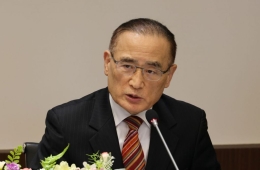
Kwon Dae-young, Director of the Financial Policy Bureau at the Financial Services Commission, held a briefing session for gathering opinions and communication with the financial sector regarding the New Start Fund on the afternoon of the 18th at the Korea Chamber of Commerce and Industry in Jung-gu, Seoul, and conducted a Q&A session with the press.
View original image[Asia Economy Reporter Song Hwajeong] The government has strengthened the debt adjustment criteria for small business owners affected by COVID-19, considering concerns over moral hazard. If assets exceed debts, principal reduction will not be granted, and if hidden assets are discovered later, the debt adjustment will be nullified. Additionally, reflecting the opinions of the financial sector, the debt purchase limit and interest rates have been adjusted, and consent-based debt adjustment will also be allowed.
On the 18th, the Financial Services Commission held a briefing session on the New Start Fund for the financial sector at the Korea Chamber of Commerce and Industry in Jung-gu, Seoul, together with the Korea Asset Management Corporation (KAMCO) and the Credit Recovery Committee (CRC), announcing these measures.
First, principal reduction will only be granted when debts exceed assets, reducing 60-80% of net debt. For borrowers overdue by more than 90 days (non-performing borrowers), 0-80% of total debt will be reduced, but vulnerable borrowers such as basic livelihood security recipients, low-income severely disabled persons, and low-income elderly aged 70 or older will receive up to a 90% reduction rate. Considering the impact of COVID-19, the maximum reduction rate was raised above the CRC’s maximum reduction rate (70%). Secured loans are excluded from principal reduction. Thorough screening will be conducted in connection with the National Tax Service and others, and debt adjustment will be nullified if hidden assets are found. Kwon Daeyoung, Director of the Financial Policy Bureau at the Financial Services Commission, explained, “Secured debts are not eligible for principal reduction support, and principal reduction is only applied to net debt (debt minus assets) for unsecured debts,” adding, “If hidden assets are discovered later through asset tracking linked with the National Tax Service, the adjustment will be invalidated.” To prevent moral hazard such as intentional delinquency for principal reduction, the use of debt adjustment will be registered for two years and reflected in credit evaluations for 1 to 5 years.
Interest rate reductions for borrowers at risk of default were disclosed only at the principle level, stating that rates will be adjusted proportionally to the repayment period. The installment repayment period is 10 to 20 years, similar to the Credit Welfare Committee’s debt adjustment period (8 to 20 years). Director Kwon said, “The interest rate details will be announced separately,” and added, “We will propose interest rates at a level that allows debt adjustment, considering the funding costs of the secondary financial sector.”
Also, considering concerns about asset reduction in financial companies, consent-based debt adjustment will be allowed to enable financial companies and guarantee institutions to conduct their own debt adjustments if they wish. In addition, reflecting concerns from regional credit guarantee funds about liquidity issues caused by early subrogation repayment, installment payments for early subrogation repayment amounts will be permitted. Regarding concerns about low-price purchases by the New Start Fund, the policy is to purchase at fair value based on market prices.
The debt purchase limit of the New Start Fund will be reduced. This appears to be in response to criticism that the debt purchase limit in the financial sector is somewhat high. Initially, the debt adjustment limit was KRW 2.5 billion for individual self-employed persons and KRW 3 billion for corporate small business owners. Director Kwon explained, “Currently, the CRC’s limit is KRW 1.5 billion, and the court increased it from KRW 1.5 billion to KRW 2.5 billion last year,” adding, “On average, 80-90% will fall within KRW 1.5 billion, but considering concerns that the limit is too high, we will announce a reduced limit.”
Hot Picks Today
 "Now Our Salaries Are 10 Million Won a Month" Record High... Semiconductor Boom Drives Performance Bonuses at Major Electronic Component Firms
- Experts Already Watching Closely..."Target Price Set at 970,000 Won" Only Upward Momentum Remains [Weekend Money]
- "Heading for 2 Million Won": The Company the Securities Industry Says Not to Doubt [Weekend Money]
- Did Samsung and SK hynix Rise Too Much?... Foreign Assets Grow Despite Selling [Weekend Money]
- "Chanel Open Run? I Get a Free Pass"... The World of the Top 0.1% That Money Alone Can't Enter [Luxury World]
The Financial Services Commission estimated that the New Start Fund will be able to handle 50-80% of the potential non-performing loans of small business owners, which are currently estimated at KRW 37 trillion to KRW 56 trillion.
© The Asia Business Daily(www.asiae.co.kr). All rights reserved.