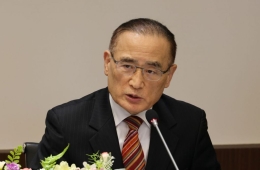
Jin-Tack Jeong, President of Korea University, "Revise Existing Curriculum Rather Than Establishing a Semiconductor Department"
Jin-Taeok Jeong, Chairman of the Private University Presidents' Council
Expresses Concern Over Talent Drain from Regional Universities
Proposes Utilizing Convergence Programs at Capital Area Universities as an Alternative
Flexible Graduate School Quotas Also Effective

Jung Jin-taek, president of Korea University and chairman of the Association of Private University Presidents, stated, "While the need to train semiconductor personnel required by the industry is acknowledged, it is more effective to revise the existing curriculum to enable students to acquire knowledge necessary for the semiconductor industry rather than creating new departments."
President Jung met with reporters at the Summer Presidents' Seminar hosted by the University Education Council held in Daegu on the 23rd and said, "There is a great concern that even the limited personnel secured by regional universities could be taken away, and it is desirable for universities in the metropolitan area to strengthen the curriculum or invite more professors in semiconductor-related majors such as the Department of Electrical and Electronic Engineering or the Department of Materials Science and Engineering to teach."
According to a survey conducted by the Ministry of Education's press corps among presidents attending the seminar, 58 out of 88 respondents (66%) opposed deregulation such as expanding the enrollment quota of metropolitan universities. Among them, 93% of presidents from non-metropolitan universities (56 universities) opposed it, while 86% of metropolitan university presidents were in favor. This result is interpreted as reflecting the perception that if enrollment quotas are increased primarily for metropolitan universities, non-metropolitan universities would suffer relatively.
Expanding the total university admission quota necessary for training semiconductor talent requires amendments to laws such as the Metropolitan Area Readjustment Planning Act. The Ministry of Education is considering a plan to increase about 8,000 students by utilizing the enrollment quotas that universities have previously reduced. Currently, the enrollment quota for departments specializing in semiconductor-related education is about 2,000, but by utilizing related majors, it can be expanded to about 24,000. Using convergence courses is considered a realistic alternative.
President Jung said, "At Korea University, majors are divided into first and second majors, and it is also an option to create related major curricula so that students in the Department of Electrical and Electronic Engineering or the Department of Materials Science and Engineering can take semiconductor as a second major. This allows students to freely attend classes." He added, "If graduate school quotas are made more flexible rather than undergraduate quotas, it would not significantly affect non-metropolitan universities."
For training semiconductor talent, the need for financial support to secure related faculty at regional universities is also being raised. There is a significant gap between metropolitan and non-metropolitan universities in operating semiconductor departments. Among eight regional universities operating semiconductor departments, three failed to fill their quotas in the 2022 regular admissions.
Hot Picks Today
 "Now Our Salaries Are 10 Million Won a Month" Record High... Semiconductor Boom Drives Performance Bonuses at Major Electronic Component Firms
- Is It Really Like an Illness? "I Can't Wait to Go Again"—Over 1 Million Visited in Q1, Now 'Busanbyeong' Takes Hold [K-Holic]
- Living the Homebody Dream? "I Was Shocked by My Spending" How to Cut Costs to 5,000 Won for Essentials [The Principles of Benefits]
- "Heading for 2 Million Won": The Company the Securities Industry Says Not to Doubt [Weekend Money]
- Experts Already Watching Closely..."Target Price Set at 970,000 Won" Only Upward Momentum Remains [Weekend Money]
President Jung said, "It is said that there are no professors to teach semiconductors at regional universities, but to attract related faculty to regional universities, exceptional treatment must be offered." He added, "If the government wants to help companies, it should provide administrative and financial support to secure necessary faculty at universities, and companies also need incentives such as scholarships, tuition reimbursement, and employment guarantees to encourage students to attend regional universities."
© The Asia Business Daily(www.asiae.co.kr). All rights reserved.