The Bank of Korea: "Monetary Policy Must Be Operated Proactively for Rapid Price Stability"
Bank of Korea Announces Monetary and Credit Policy Report

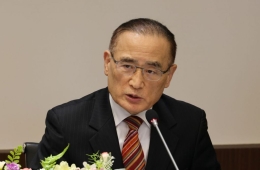
Lee Chang-yong, Governor of the Bank of Korea, is presiding over the Monetary Policy Committee plenary meeting held at the Bank of Korea in Jung-gu, Seoul on the 26th. Photo by Joint Press Corps
View original imageOn the 9th, the Bank of Korea stated, "The possibility of a prolonged spread of inflation cannot be ruled out," emphasizing that "the more actively the central bank pursues price stability through monetary policy, the smaller the losses become."
In the Monetary and Credit Policy Report released that day, the Bank of Korea explained, "The recent high inflation surge is the result of a combination of demand-side factors such as economic recovery after COVID-19 and supply-side factors including supply chain bottlenecks and rising international raw material and grain prices following the Ukraine crisis."
The Bank of Korea analyzed the responses of the United States and Germany during the 1970s oil crisis to examine how central banks should ideally respond to inflationary periods through monetary policy.
According to the Bank of Korea, the United States at that time perceived inflation as driven by cost-side factors such as rising oil prices, thus suppressing wage increases and operating monetary and fiscal policies expansively to stimulate the economy. In contrast, Germany viewed inflation as a monetary phenomenon and actively raised interest rates.

As a result, the United States experienced the second oil shock in 1978 due to monetary expansion and fiscal deficits, with the consumer price inflation rate soaring above 13% by the end of 1979. Meanwhile, Germany preemptively raised interest rates to curb inflationary anxiety early on.
The Bank of Korea stated, "The German central bank actively sought to stabilize inflation expectations through monetary policy, and the government operated fiscal spending expansively to respond to economic slowdown, resulting in both price and economic stability."
The Bank of Korea forecasted that if inflation expectations are stable and price persistence is low, prices can stabilize relatively quickly even when cost shocks occur, explaining that active central bank responses are necessary in this process.
Hot Picks Today
 "Now Our Salaries Are 10 Million Won a Month" Record High... Semiconductor Boom Drives Performance Bonuses at Major Electronic Component Firms
- Experts Already Watching Closely..."Target Price Set at 970,000 Won" Only Upward Momentum Remains [Weekend Money]
- Prime Minister Kim Minseok: "Samsung Electronics Strike Could Cost Up to 1 Trillion Won per Day, 100 Trillion Won Total... Tomorrow's Talks Are the Last Chance" (Comprehensive)
- Did Samsung and SK hynix Rise Too Much?... Foreign Assets Grow Despite Selling [Weekend Money]
- Is It Really Like an Illness? "I Can't Wait to Go Again"—Over 1 Million Visited in Q1, Now 'Busanbyeong' Takes Hold [K-Holic]
The Bank of Korea emphasized, "It was estimated that the loss function value decreases the more the central bank actively pursues price stability through monetary policy," adding, "Proactively operating monetary policy is desirable from the perspective of macroeconomic stabilization over the medium-term horizon."
© The Asia Business Daily(www.asiae.co.kr). All rights reserved.