'Returning Foreigners and Institutions' Push Kospi Beyond 2720... "Will It Falter? Nervous Individual Profit-Taking Underway"
![[Image source=Yonhap News]](http://www.asiae.co.kr/news/img_view.htm?img=2022041911080534781_1650334084.jpg)
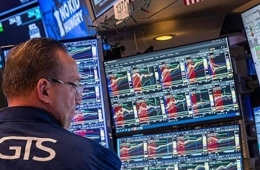
[Asia Economy Reporter Lee Seon-ae] On the 19th, the domestic stock market, which started higher, maintained an upward trend of about 1% throughout the morning due to simultaneous 'buying' by foreigners and institutions. Although existing negative factors such as the Ukraine crisis and tightening continue to drive market interest rates higher and strengthen the dollar, it is interpreted that the domestic stock market is developing resistance and attempting a rebound, as can be inferred from the previous trading day’s movements in the U.S. stock market.
On this day, the KOSPI opened at 2707.76, up 14.55 points (0.54%↑), and the KOSDAQ opened at 922.60, up 4.37 points (0.48%↑). The market expanded its gains during the session, showing a 1% rise. As of 11:05 a.m., the KOSPI was up 0.97%, and the KOSDAQ was up 1.13%, each attempting to break through the 2720 and 930 levels, respectively.
Despite issues related to interest rate hikes such as rising U.S. Treasury yields and a strong dollar, the ongoing earnings season has led to attention on individual stock issues, which positively affected the Korean stock market. In particular, the Philadelphia Semiconductor Index rose 1.88% due to positive outlooks related to the data center industry, which is favorably influencing the supply-demand environment of related sectors in the domestic market.
Moreover, foreigners, who had been selling off in the domestic stock market for consecutive days, have supported the index rebound with 'buying' from the early session, and institutions have joined in. At this time, foreigners are purchasing approximately 100.2 billion KRW and 82.3 billion KRW in the KOSPI and KOSDAQ markets, respectively. Institutions are also recording net purchases of about 91 billion KRW and 58.7 billion KRW, respectively. On the other hand, individuals, who had been buying at low prices for consecutive days, appear to be realizing profits today, with net sales of approximately 187.7 billion KRW and 135.4 billion KRW in the two markets, respectively.
Seo Sang-young, a researcher at Mirae Asset Securities, said, "Although concerns about prolonged high inflation due to the Ukraine war remain a burden, considering that this has already been reflected in the stock market, the impact is expected to be limited. Rather, with the earnings season underway, a stock market showing fluctuations depending on changes in individual stock groups is expected." He added, "Today, the Korean stock market is expected to be led by the semiconductor sector showing a solid performance."
Han Ji-young and Kim Se-heon, researchers at Kiwoom Securities, forecasted, "Despite persistent external uncertainties, the domestic stock market, which showed weakness in the previous trading day, is expected to show a rebound trend as market attention focuses on the intraday rebound effect of the U.S. stock market and individual earnings issues."
Hot Picks Today
!["Stock Set to Double: This Company Smiles Every Time a Data Center Is Built [Click e-Stock]"](https://cwcontent.asiae.co.kr/asiaresize/93/2026050416112750184_1777878687.jpg) "Stock Set to Double: This Company Smiles Every...
"Stock Set to Double: This Company Smiles Every...
- "Is Yours Just Gathering Dust at Home? Millennials & Gen Z Rediscover Digicams O...
- Chicago Fed President: "Rate Hikes Needed If Productivity Expectations Overheat"
- "High-Net-Worth Investors Managing 10 Trillion Won: 'Gangnam Wealthy Also Feel F...
- “She Shouted, ‘The Rope Isn’t Tied!’... Chinese Woman Falls from 168m Cliff ...
Meanwhile, on the previous day in the New York stock market, the three major indices closed slightly lower. The decline widened due to growing economic concerns following the World Bank’s downward revision of global growth forecasts, but financial and semiconductor stocks showed strength, leading to intraday rebounds. The Dow Jones Industrial Average closed at 34,411.69, down 39.54 points (0.11%) from the previous trading day. The Standard & Poor’s (S&P) 500 index closed at 4391.69, down 0.90 points (0.02%), and the Nasdaq index closed at 13,332.36, down 18.72 points (0.14%).
© The Asia Business Daily(www.asiae.co.kr). All rights reserved.