The Election Commission Allows Banners Including 'Law Card Sushi' and 'So Gajuk Power'
'Would You Entrust the Country to Forces That Skin Living Cows?'
'Who Ate the 10 Servings of Sushi and Beef Bought with the Corporate Card?'
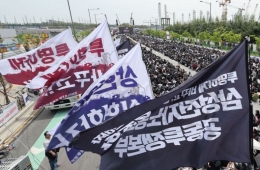
![On the 15th, when the official election campaign for the 2022 presidential election began, banners of each candidate were hung in Sillim-dong, Gwanak-gu, Seoul. <br>[Image source=Yonhap News]](http://www.asiae.co.kr/news/img_view.htm?img=2022022308032654718_1645571006.jpg)
On the 15th, when the official election campaign for the 2022 presidential election began, banners of each candidate were hung in Sillim-dong, Gwanak-gu, Seoul.
[Image source=Yonhap News]
[Asia Economy Intern Reporter Kim Jeong-wan] The National Election Commission (NEC) announced that it plans to allow expressions such as "Will you entrust the country to those who skin a living cow?" and "Who ate the 10 servings of sushi bought with the corporate card?" on banners and placards for the March 9 presidential election.
According to political circles on the 22nd, the NEC recently decided to permit the use of the phrase "skin of a living cow," requested by the Democratic Party of Korea, and the phrase "corporate card sushi," requested by the People Power Party, and notified each party accordingly.
"Corporate card sushi" targets allegations of misuse of the corporate card by candidate Lee Jae-myung's wife, Kim Hye-kyung, from the People Power Party, while "skin of a living cow" is a phrase used by the Democratic Party to criticize candidate Yoon Seok-youl of the People Power Party regarding shamanism controversies.
The opposition party's submitted banners and placards reportedly include numerous negative expressions targeting Democratic Party candidate Lee Jae-myung, such as "Who ate the 10 servings of sushi bought with the corporate card?" "No four-time convicts allowed," "Let's judge the double curse and infidelity," and "Will you elect the double curse scoundrel?"
Earlier, the NEC allowed the ruling party to use expressions such as "Will you entrust the country to those who skin a living cow?" "We cannot turn the Blue House into a shaman's altar," "Not only shamans but also Shincheonji, what nonsense is this?" and "Worker vs. Drunkard, who will you choose?"
The NEC reportedly established a policy to mostly allow expressions that do not include real names or photos, showing a stance completely different from last year's April 7 by-election, when expressions like "hypocrisy" and "incompetence" were prohibited.
At that time, the NEC banned expressions such as "hypocrisy" and "incompetence" based on Article 90 of the Election Act. From 180 days before the election, it prohibited content that explicitly or implicitly mentions the name of a political party or candidate, or their photos, to prevent influencing the election.
However, on the 19th, the NEC concluded that banners with phrases like "Demanding a thorough investigation of Governor Lee Jae-myung's Daejang-dong Gate - Whose is Hwacheon Daeyu?" or "Shaman republic, Shincheonji country, opposing the prosecutor government" cannot be posted by individuals but only by political parties.
Hot Picks Today
 "Samsung and Hynix Were Once for the Underachievers"... Hyundai Motor Employee's Lament
- "Buy on Black Monday"... Japan's Nomura Forecasts 590,000 for Samsung, 4 Million for SK hynix
- "Plunged During the War, Now Surging Again"... The Real Reason Behind the 6% One-Day Silver Market Rally [Weekend Money]
- Even After the 'Tax,' High Profits Remain... Korea Emerges as a Premium Market [ChwiYakGukga]②
- "That? It's Already Stashed" Nightlife Scene Crosses the Line [ChwiYak Nation] ③
Regarding this conclusion, the NEC stated, "(The above cases) can be seen as violating Article 90 of the Public Official Election Act because the candidate is specifically identified."
© The Asia Business Daily(www.asiae.co.kr). All rights reserved.