From Hanbok Controversy to Biased Judgments... 'Ban-Jung' Emerging as a Variable in the Presidential Election
China's Hanbok Controversy and Biased Judgments... Netizens Say "Eyes Wide Open, Nose Cut" Beijing Olympics
Opposition Criticizes "What Is the Price of Pro-China Policy?"
Experts Warn "If Controversies Continue During the Olympics, Anti-China Sentiment Will Intensify"

Amid controversy over biased judging at the 2022 Beijing Winter Olympics, a photo featuring the phrase "Nuntteugo Kobeijing 2022" is spreading online. Photo by Online Community Screen Capture.
View original image[Asia Economy Reporter Heo Midam] Following the appearance of a woman wearing hanbok at the 2022 Beijing Winter Olympics opening ceremony and the controversy over biased short track refereeing, public resentment toward China is growing. Presidential candidates from both ruling and opposition parties are also raising their voices in criticism of China's questionable judgments. As the presidential election is less than a month away, the political sphere is keenly watching how anti-China (反中) sentiment might influence voters' preferences. Especially since the 2030 generation, known for strong anti-China sentiment, is considered a casting vote in this election, both parties are continuously issuing messages criticizing China.
On the 9th, posts criticizing China flooded online communities and social networking services (SNS). On the 7th, during the men's 1000m short track semifinals held at the Beijing Capital Indoor Stadium, Korean athletes such as Hwang Daeheon and Lee Junseo were consecutively disqualified due to questionable rulings, sparking criticism against the host country, China. The controversy intensified as Chinese athletes, who were third in their heats due to the disqualifications of Korean players, advanced to the finals.
Earlier, on the 4th, at the Beijing Winter Olympics opening ceremony, a woman wearing hanbok appeared as a 'representative of ethnic minorities,' which also drew criticism.
At the beginning of the opening ceremony, a flag relay passing the Five-star Red Flag by hand took place. During this, a woman with a daenggi hairstyle wearing an outfit presumed to be hanbok was captured on camera passing the Five-star Red Flag. Some pointed out that Korea's traditional hanbok could be mistakenly perceived as part of China's ethnic minority culture.
![On the afternoon of the 4th, at the National Stadium in Beijing, China, a performer wearing a hanbok waved their hand during the opening ceremony of the 2022 Beijing Winter Olympics. [Image source=Yonhap News]](http://www.asiae.co.kr/news/img_view.htm?img=2022020518154532790_1644052546.jpg)
On the afternoon of the 4th, at the National Stadium in Beijing, China, a performer wearing a hanbok waved their hand during the opening ceremony of the 2022 Beijing Winter Olympics. [Image source=Yonhap News]
View original imageNetizens responded critically to China's actions, saying things like "The Olympic spirit is being damaged. We should boycott Chinese products," "Let's start a No China movement," and "At this point, it's not the Olympics but a Chinese sports event." Particularly, photos with the phrase 'Eyes Open, Nose Beijing 2022' spread widely on online communities.
Meanwhile, the People Power Party stated, "We must speak up to China," criticizing the Moon Jae-in administration's diplomacy and security policies as 'pro-China' and raising their voices of criticism.
Lee Yang-su, senior spokesperson for the People Power Party's presidential campaign headquarters, released a statement on the 8th, urging the government and ruling party to "reflect on the cost of the pro-China policy that has relied on and courted China for the past five years," adding, "The result of being uniquely pro-China, even at the expense of discord with traditional allies, is exactly this situation."
Hwang Gyu-hwan, spokesperson for the People Power Party's campaign headquarters, also stated in a commentary, "Our government was obsessed with the Chinese Dream and failed to properly protest China's Northeast Project and cultural encroachment, maintaining a submissive stance in various diplomatic matters," and added, "The government must clearly protest, demand an apology, and secure a promise to prevent recurrence."
![Yoon Seok-yeol, the presidential candidate of the People Power Party, is listening to questions at the policy forum titled "Science and Technology Change the Future of Korea," held on the 8th at the Korea Science and Technology Center in Yeoksam-dong, Gangnam-gu, Seoul. <br>[Image source=Yonhap News]](http://www.asiae.co.kr/news/img_view.htm?img=2022020910142637024_1644369266.jpg)
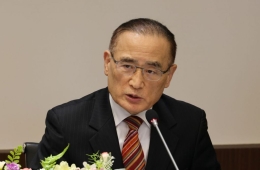
Yoon Seok-yeol, the presidential candidate of the People Power Party, is listening to questions at the policy forum titled "Science and Technology Change the Future of Korea," held on the 8th at the Korea Science and Technology Center in Yeoksam-dong, Gangnam-gu, Seoul.
[Image source=Yonhap News]
This is not the first time the opposition has voiced criticism related to China. In December last year, Yoon Seok-yeol, the People Power Party's presidential candidate, criticized the Moon Jae-in administration's pro-China policy, saying, "Most Korean citizens, especially the youth, dislike China." However, at that time, the Democratic Party fiercely attacked Yoon, saying, "One blunder a day is not enough; now you are making blunders across borders."
Given this situation, there is speculation that the People Power Party, which takes a tough stance on China, might have an advantage in the presidential election. The Democratic Party has shown relatively pro-China tendencies compared to the conservative opposition.
This difference is also evident in the views of the presidential candidates from both parties. On the 3rd, during the first four-party TV debate, Lee Jae-myung, the Democratic Party's presidential candidate, argued, "We must continue to develop a strategic cooperative partnership with China. Twenty-five percent of our trade depends on China, and we have an annual trade surplus exceeding 50 trillion won."
Lee particularly criticized Yoon, who pledged additional deployment of THAAD (Terminal High Altitude Area Defense), asking, "Why provoke China's backlash and ruin the economy?" Yoon responded, "Strengthening security maintains stock prices and reduces national risk."

Lee Jae-myung, the Democratic Party presidential candidate, is speaking at the emergency meeting of the national representatives of self-employed and small business organizations held on the 8th in the conference room of the Customer Support Center at Bangsin Traditional Market in Gangseo-gu, Seoul, titled "We will be the strength of the self-employed and small business owners." Photo by Yonhap News
View original imageHowever, as public anti-China sentiment intensifies, not only the opposition but also the ruling party is voicing criticism of China. Lee expressed on his Facebook, regarding the introduction of hanbok as one of China's ethnic minority costumes at the opening ceremony, "Do not covet culture. Oppose cultural engineering." He also pointed out the biased short track refereeing controversy, saying, "I cannot help but feel disappointment and anger at the biased refereeing in short track at the Beijing Winter Olympics."
Song Young-gil, leader of the Democratic Party, also posted on Facebook, "The disqualification rulings against men's short track athletes Hwang Daeheon and Lee Junseo at the Beijing Winter Olympics are truly absurd and infuriating," adding, "Where has the Olympic spirit gone, leaving only such biased rulings? Beyond favoring the host country, it seems like a monopoly by the host nation."
Hot Picks Today
 "Now Our Salaries Are 10 Million Won a Month" Record High... Semiconductor Boom Drives Performance Bonuses at Major Electronic Component Firms
- Living the Homebody Dream? "I Was Shocked by My Spending" How to Cut Costs to 5,000 Won for Essentials [The Principles of Benefits]
- Is It Really Like an Illness? "I Can't Wait to Go Again"—Over 1 Million Visited in Q1, Now 'Busanbyeong' Takes Hold [K-Holic]
- "Heading for 2 Million Won": The Company the Securities Industry Says Not to Doubt [Weekend Money]
- Experts Already Watching Closely..."Target Price Set at 970,000 Won" Only Upward Momentum Remains [Weekend Money]
Experts predict that if controversies such as biased refereeing continue at the Beijing Olympics, anti-China sentiment could become a variable in the presidential election. Political commentator Lee Jong-hoon analyzed, "If the government's response to various controversies at the Beijing Olympics is lukewarm, the People Power Party could have a slight advantage in the election," and added, "If controversies like biased rulings continue throughout the Olympics, public anti-China sentiment will intensify further."
© The Asia Business Daily(www.asiae.co.kr). All rights reserved.