Concerns Over Triple Cracks in Korea: Capital Outflow, Bubble Collapse, and Export Slowdown if US Tightening Accelerates
Fed Early Tightening Crisis Spreads
Pressure on Slowing Chinese Economy
If China’s Growth Rate Drops by 1%P, South Korea’s Falls by 0.5%P

[Sejong=Asia Economy Reporters Kim Hyunjung, Kwon Haeyoung, Son Seonhee, Hwang Junho] Due to the aggressive tightening signals from the U.S. Federal Reserve (Fed), concerns are mounting over a ‘perfect storm’ of a major crisis hitting the South Korean economy all at once. Capital is fleeing due to the sharp depreciation of the currency, asset market bubbles are rapidly deflating due to interest rate hikes, and even exports, which have supported South Korea’s economic growth, could collapse. The so-called ‘gray rhino’ is surfacing, raising concerns that cracks may soon appear in the South Korean economy that has endured the COVID-19 pandemic.
On the 18th (local time), U.S. Treasury yields surged in the New York bond market, reaching the highest level in two years, reflecting growing fears that the Fed may embark on more aggressive early tightening than expected. The U.S. 10-year Treasury yield recorded 1.87%, the highest since January 2020. Tensions are also rising in the domestic bond market. In the Seoul bond market, the 3-year government bond yield jumped 10.4 basis points to 2.148% on the 17th, marking the highest level in 3 years and 7 months, and slightly eased to 2.127% on the 18th. Kim Sungwook, Director of the International Finance Bureau at the Ministry of Strategy and Finance, assessed, "The tightening signals were expected, but the pace is faster than the market anticipated, causing market volatility."
◆Last Year’s ‘Record High’ Exports... Warning Signs?= If the perfect storm hits, the export market could be the first to be affected. Alongside the U.S., uncertainty over the Chinese economy is increasing, casting a red light on exports, which set a record high last year. China, accounting for 25% of South Korea’s total exports, saw its economic growth rate in Q4 last year slow sharply to 4% (year-on-year), down from 18.3% in Q1, 7.9% in Q2, and 4.9% in Q3. According to the Hyundai Research Institute, if China’s economic growth rate drops by 1 percentage point, South Korea’s economic growth rate falls by 0.5 percentage points.
On the same day in the Seoul foreign exchange market, the won-dollar exchange rate was trading at 1192.10 won at 9:30 a.m., up 2 won from the previous day’s close of 1192.7 won. Although won depreciation is expected due to accelerated U.S. tightening, it is difficult to view this as a positive signal for South Korean trade. The impact of exchange rates on export companies is more limited than in the past, and if the U.S. accelerates tapering (asset purchase reduction) and interest rate hikes, it is largely to respond to inflation rather than economic recovery. The rise in global raw material prices, especially energy, is also a burden. Since South Korea has many intermediate goods industries, prolonged increases in import costs lead to export price hikes, which in turn negatively affect exports with a time lag. Ultimately, concerns are growing that won depreciation could worsen the trade balance and deliver a greater shock to the South Korean economy.

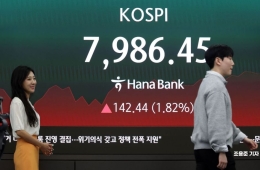
On the 19th, dealers were working in the dealing room of Hana Bank in Euljiro, Seoul. On that day, the KOSPI index opened at 2,840.34, down 23.90 points (0.83%) from the previous session. The won-dollar exchange rate started at 1,195.0 won, up 4.9 won. Photo by Moon Honam munonam@
View original imageConcerns Over Collapse of Asset Markets Including Real Estate
Larger Decline in Apartment Sale Prices in Gangnam
Significant Burden on Stock Market
◆Concerns Over Asset Market Collapse Due to Sharp Interest Rate Rise= With the Fed’s early interest rate hike announcement and the Bank of Korea’s additional base rate hike (on the 14th, from 1.00% to 1.25%), there are forecasts that the real estate market, which had recently stopped rising, may enter a downturn. Considering that real estate prices tend to change sharply during both upturns and downturns, the government’s supply policies combined with rapid interest rate hikes could lead to a ‘bubble burst’ scenario.
Mortgage loan interest rates have already risen to a maximum of 6% per annum, and jeonse (long-term deposit lease) loans and unsecured loans have also increased to around 5% per annum. The COFIX, which serves as the benchmark for variable mortgage loan rates in banks, hit 1.69% last month, the highest in 2 years and 6 months, and reflecting this, commercial banks began applying higher loan rates from the previous day.
According to monthly apartment transaction price trends provided by the Korea Real Estate Board, apartment sale prices in the four Gangnam districts fell 0.05% in November and further declined by 0.86% last month. Seoul (-0.48%), the metropolitan area (-1.09%), and nationwide (-0.91%) all showed downward trends. The auction market clearance rate for Seoul apartments in December, which gauges buyer sentiment, dropped sharply by 15.3 percentage points from 62.2% in November to 46.9%, marking the lowest level of the year.
◆Countdown to Capital Outflow? Concerns Over Stock Market Shock= The stock market has been weak since the first trading day of the year when it fell below 3,000 points, continuing to decline daily. This week, it dropped below 2,900 points and even slipped to the 2,830 range on the 19th. Kim Younghwan, a researcher at NH Investment & Securities, said, "Concerns over Fed monetary tightening, similar to the 2013 tightening shock, could negatively affect stock markets, especially emerging market stocks," adding, "If quantitative easing ends in March, quantitative tightening begins in the second half of the year, and four base rate hikes occur within 2022, it could place considerable pressure on the economy and stock market."
Hot Picks Today
 No Bacteria Detected in Arisu After 24 Hours of Repeated Drinking from a Tumbler
- "We Can't Just Let Them Be Damaged Inside"... Samsung Electronics Removes 360,000 Wafers in Preparation for Strike
- "Up to 100 Trillion Won in Losses Feared, It's Not About Second Place but Catastrophe"... Industry Minister: 'Emergency Mediation Unavoidable If Samsung Strike Occurs'
- Wife in $6.7 Million Debt Took Out $3 Million in Husband's Life Insurance, Poisoned Him... US Court: "She Can Never Be Released"
- "He's Handsome, It's Such a Pity?"... Lawyer Responds to Bizarre 'Appearance Evaluation' of High School Girl Murder Suspect
On the other hand, some argue that concerns over a ‘perfect storm’ crisis are excessive. Kim Sangbong, professor of economics at Hansung University, said, "We should be more worried about a long-term recession than a perfect storm," and added, "Financial institutions have better resilience than before, so they can respond to some extent." Director Kim also assessed, "Our fundamentals are good, and the bond market funds are mostly from high-quality investors, so the risk of outflows is not significant."
© The Asia Business Daily(www.asiae.co.kr). All rights reserved.