Only Saying "Received Well," Will North Korea Respond to "Defection by Crossing the Border"?
![[Image source=Yonhap News]](http://www.asiae.co.kr/news/img_view.htm?img=2022010413543886728_1641272078.jpg)
[Asia Economy Reporter Lee Ji-eun] Regarding the defection of Mr. A, a defector from North Korea, to the North on the 1st, our government sent a notification to the North, but the North has not yet given an official response. Experts analyze that North Korea is likely to remain silent rather than respond to this issue.
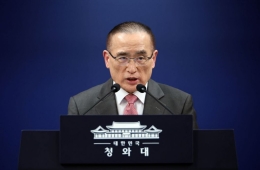
According to the Joint Chiefs of Staff and the Blue House on the 4th, the North only confirmed that they "received it well" regarding the notification sent by our government but has not responded so far. Ministry of National Defense spokesperson Boo Seung-chan said at a briefing that "we are currently waiting for North Korea's response."
Mr. A, who crossed the 22nd Division General Outpost (GOP) barbed wire fence and defected to the North on the 1st, is presumed to be a man in his 30s who defected in the same way in November 2020, and three North Korean soldiers contacted him in the DMZ and took him away. Our military sent two notifications to the North on the 2nd for personal protection reasons.
However, the North has remained silent even three days after the defection. This contrasts with the incident on July 19 last year when a "COVID-19 suspected" defector defected to Kaesong, and the Kaesong area was sealed off, and the Workers' Party Central Committee Political Bureau held an emergency expanded meeting to transition the national emergency quarantine system to the highest emergency level.
Experts believe that while the North will consider various humanitarian aspects, it is highly likely to remain silent going forward.
After the five-day plenary meeting, North Korea has not expressed any particular stance toward the U.S. or South Korea, and Kim Jong-un, General Secretary of the Workers' Party, also omitted the New Year's address, indicating that North Korea is deliberately distancing itself from inter-Korean relations.
Hot Picks Today
 Even with High Oil Price Relief Payment, Additional 300,000 Won Per Person to Be Provided... Applications Open from the 18th in This Region
- "Invested 95% in Hynix and Reached 10 Billion Won"... Japanese Investor's Proof Post Goes Viral
- "Why Is the Korean Stock Market Surging?"... Even Italy Is Astonished by the KOSPI Rally
- "You Don't Need to Go to the Gym": The Best Exercises for Lowering Hypertension
- "That Thing Wakes Up Every Night" ... Suspicious Object Covers Rural Village
The possibility that North Korea will politically exploit this incident is also low. Hong Min, a research fellow at the Korea Institute for National Unification, said, "In the past, when North Korea tried to use such issues, it was when inter-Korean relations were considerably strained, and there was a strong will to actively utilize them, but now is not such a phase," adding, "Since mid-last year, General Secretary Kim has also revealed a response strategy that deliberately does not worsen inter-Korean relations first."
© The Asia Business Daily(www.asiae.co.kr). All rights reserved.