[Interview] An Kyung-duk, Minister of Employment and Labor: "Punishment under the Serious Accident Punishment Act is not the ultimate solution, there should be no disadvantages"
Raising Awareness Among Employers Through Supervision
Guidebook Published Presenting Punishment Cases
Youth Employment in Companies Crucial for Industrial Development
Considering Labor Transition in Eco-Friendly Energy Policies
Application of Labor Standards Act to Workplaces with Fewer Than 5 Employees
Time to Begin Social Discussions Now

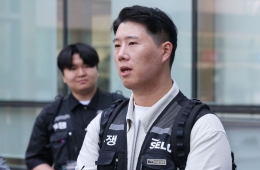
Minister of Employment and Labor An Kyung-duk being interviewed by Asia Economy at the Seoul Regional Employment and Labor Office on the 11th./Photo by Moon Ho-nam munonam@
View original image[Asia Economy Reporter Moon Chaeseok]
A legal commentary guidebook that allows labor and management to easily determine violations and punishments under the Serious Accidents Punishment Act will be released. Employment and Labor Minister An Kyung-duk said, "We will present cases to clarify investigations and punishments," adding, "Explaining the intent of the law and enforcement decree will help companies resolve uncertainties."
Minister An stated in an interview with Asia Economy at the Seoul Regional Employment and Labor Office on the 11th, "There are criticisms that the law and enforcement decree are not specific," explaining this plan. With the enforcement of the Serious Accidents Punishment Act, which punishes CEOs and others in case of safety accidents, just over two months away, concerns about ambiguity remain, prompting the decision to provide a detailed guidebook. The commentary is expected to include specific cases subject to punishment. Minister An said, "The purpose of the Serious Accidents Punishment Act is accident prevention, not punishment," but added, "It will specify what violations by CEOs lead to punishment."
Regarding the government's encouragement of youth employment by companies, Minister An said, "It is an important factor for industrial development that large companies train youth and deploy them in jobs." He also mentioned plans to increase the youth employment budget next year by 800 billion KRW to 4.36 trillion KRW compared to this year.
On whether the Labor Standards Act applies to workplaces with fewer than five employees, which were excluded from this year's temporary holidays and attracted attention, he said, "A field survey was recently completed," adding, "It is time to start a comprehensive social discussion on whether to apply it and, if so, what roadmap to follow."
Regarding the recently highlighted 'four-day workweek' discussion during the presidential election process, he said social discussion is necessary. On the proposed Construction Safety Special Act, which raised overlapping controversy with the Serious Accidents Punishment Act, he said, "It pertains to the design area and does not overlap with the Serious Accidents Punishment Act."
- With the enforcement of the Serious Accidents Punishment Act scheduled for January 27 next year, many on-site reactions remain confused.
▲ Following the guidebook publication in August, a detailed legal commentary explaining the law will be distributed soon. It will explain the purpose of the enforcement decree and specify which violations during investigations lead to punishment. It will include concrete content such as "If a case falls under this, the CEO will be subject to punishment." The Ministry of Employment and Labor is gathering opinions from labor and management on the draft.
To emphasize again, the purpose of the Serious Accidents Punishment Act is prevention, not punishment. Since taking office, I have visited inspection sites three times unexpectedly. The goal is not to punish through supervision but to raise awareness among business owners. We will support small business owners so they do not suffer disadvantages due to lack of understanding of safety and health management systems.
- You asked corporate executives to increase youth employment.
▲ Companies moving toward continuous recruitment means they want to use prepared personnel, and we cannot tell them not to do so. However, when meeting youth, unlike in the past, there is widespread anxiety that without immediate job experience, applying is futile. For example, in the software (SW) industry, it is important for industrial development that relatively capable large companies train youth and deploy them in jobs. The government believes providing job-related work experience and training is most important. We suggested companies use continuous recruitment but also utilize open recruitment where possible, not insisting on only open recruitment.
- Is the government forcing companies to hire even if they do not need to?
▲ For example, if a company announced hiring 25,000 personnel over several years, we do not think there will be surplus workers. In the youth employment support project, we emphasize workforce development, work experience, training of subcontractor workers, and feedback during recruitment with companies we met. Considering the corporate hiring culture that values work experience, these workers will be prepared for employment anywhere. It is natural for companies to hire needed personnel. The Ministry of Employment and Labor does not force companies to "hire many people."
- Labor transition issues are expected to grow due to eco-friendly energy policies.
▲ Labor transition for internal combustion engine vehicle and coal power plant workers is most urgent. At the end of July, the Presidential Committee on Economic, Social and Labor Affairs launched a climate change and industry-labor research group. The Korean Confederation of Trade Unions (KCTU) is not participating in the committee, but many internal combustion engine vehicle and coal power plant union members belong to KCTU, so this issue must be resolved. The 'Automobile Industry Labor-Management-Government Forum,' involving the Ministry of Trade, Industry and Energy, the Ministry of Employment and Labor, and the two major trade unions, is also holding discussions. Labor transition talks are ongoing in various ways but need to be more concrete. We must consider whether to expand existing bodies or create new ones.
- There are many opinions that to strengthen the financial soundness of the employment insurance fund, besides rate increases, transferring to the general account is necessary to expand projects.
▲ We are continuously increasing transfers to the general account. This year alone, 1.06 trillion KRW was transferred from the general account, and 211.5 billion KRW of expenditures were converted from the employment fund to the general account. Employment retention support fund expenditures, which accounted for a large part of the employment fund spending, will decrease from 1.4 trillion KRW this year to 600 billion KRW next year due to expected unemployment reduction from economic recovery. Transfers to the general account will be discussed with financial authorities. For example, the transfer of maternity protection benefits to the general account is under negotiation but is not easy.
- What is your view on applying the Labor Standards Act to workplaces with fewer than five employees?
▲ We conducted a field survey targeting workplaces with fewer than five employees until last month and are finalizing some necessary supplements. Although working hours, leave, dismissal, and workplace harassment are excluded from application by law, we asked whether these are properly observed and which parts are burdensome. Considering the business owners' perspectives of workplaces with fewer than five employees, it is difficult to say to apply it immediately. However, it is time to discuss whether to apply it. It is time to start social discussions on whether to apply it and, if so, what roadmap to follow.
- Do you think the four-day workweek, raised by some, is feasible?
▲ The current 52-hour workweek system consists of a statutory 40-hour workweek plus up to 12 hours overtime. It is a system where one works 8 hours a day for 5 days. It is unclear whether implementing a four-day workweek means working 32 hours per week or maintaining 40 hours. If it is 32 hours, wage-related discussions may arise, and it would be difficult to legislate. Social discussion is essential. At this point, the important thing is to reduce Korea's annual average working hours of 1,952 hours to below 52 hours per week.
Hot Picks Today
!["Heading for 2 Million Won": The Company the Securities Industry Says Not to Doubt [Weekend Money]](https://cwcontent.asiae.co.kr/asiaresize/93/2025061015355092669_1749537351.jpg) "Heading for 2 Million Won": The Company the Securities Industry Says Not to Doubt [Weekend Money]
"Heading for 2 Million Won": The Company the Securities Industry Says Not to Doubt [Weekend Money]
- "Anyone Who Visited the Room Salon, Come Forward"… Gangnam Police Station Launches Full Staff Investigation After New Scandal
- "Can't Even Turn On a Fan? How Will They Endure the Heat?"... Massive Blackout Hits the Philippines Amid Scorching Heat
- "Drink Three Cups of Coffee and Stay Up All Night Before the Test"... Manual of Insurance Planner Who Collected 1 Billion Won in Payouts
- Did Samsung and SK hynix Rise Too Much?... Foreign Assets Grow Despite Selling [Weekend Money]
Interview by Choi Il-gwon, Head of Economic Department
Compiled by Reporter Moon Chaeseok
© The Asia Business Daily(www.asiae.co.kr). All rights reserved.