Research Begins on 'Core Technologies' for Next-Generation Space Launch Vehicle Following Nuriho
Ruling Party and Government Agree in Party-Government Meeting on the 10th
to Include in Next Year's Budget Proposal
![[Image source=Yonhap News]](http://www.asiae.co.kr/news/img_view.htm?img=2021102120482277300_1634816903.jpg)
[Asia Economy Reporter Kim Bong-su] The government will begin full-scale development next year of next-generation high-power, reusable, and advanced rockets equipped with engines of 100 tons or more, surpassing the performance of Nuriho.
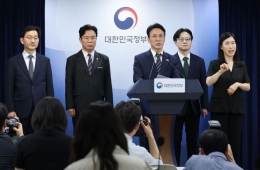
On the morning of the 10th, Jo Seung-rae, the ruling party's secretary of the National Assembly's Science, Technology, Information and Broadcasting Committee, held a party-government consultation on space development and introduced the details of next year's budget plan. According to Representative Jo, the government plans to allocate a total budget of 12 billion KRW, including 4.5 billion KRW next year and 7.5 billion KRW in 2023, for the 'Space Challenge' project, which includes these initiatives. Specifically, the plan is to develop an advanced rocket by improving the 75-ton liquid engine used in Nuriho to have 100 tons of thrust, with capabilities for reignition and thrust control, allowing multiple uses.
Globally, reusable rockets such as SpaceX's Falcon 9 and China's Long March 4 have already become the mainstream. Minimizing the cost, which is at least 200 billion KRW per launch, is essential to reduce the expenses of launching large numbers of satellites for 6G, satellite internet, and satellite navigation system construction, thereby enhancing economic feasibility.
This decision by the government and ruling party is interpreted as an intention to establish a 'preliminary research' budget for core technologies ahead of the full-scale Nuriho upgrade project. The government has been promoting the Nuriho upgrade project worth about 2.5 trillion KRW since last year and conducted a preliminary feasibility study, but it was deferred at the end of August. At that time, the plan was to develop a rocket equipped with a reusable staged combustion cycle engine by increasing the current 75-ton liquid engine to 82 tons, but it was rejected on the grounds that "the outlook in the space launch vehicle market is bleak and lacks competitiveness."
Instead, a plan to launch Nuriho four more times from October next year to verify reliability (about 600 billion KRW) was approved and is included in the government's budget plan for next year.
Hot Picks Today
 "Now Our Salaries Are 10 Million Won a Month" Record High... Semiconductor Boom Drives Performance Bonuses at Major Electronic Component Firms
- Wallets Open Wide on Big News...300 Trillion Won Heads to the U.S., "Tax Breaks" Fail to Keep Funds at Home
- "Realizing How Fast Money Disappears: Should You Try Only the Essentials for 5,000 Won? [The Basics of Benefits]"
- "Heading for 2 Million Won": The Company the Securities Industry Says Not to Doubt [Weekend Money]
- Experts Already Watching Closely..."Target Price Set at 970,000 Won" Only Upward Momentum Remains [Weekend Money]
The Korean Positioning System (KPS) project will also be intensified. It aims to reduce dependence on the U.S. GPS to restore sovereignty and enhance stability, while providing more precise time, location, and position information to meet demands in advanced 4th industrial revolution fields such as autonomous vehicles and urban air mobility. The government and ruling party are also considering legislation to systematically manage and operate this system. The government plans to invest 3.75 trillion KRW from next year through 2025 to launch seven satellites and provide KPS services targeting the Korean Peninsula and nearby regions. Additionally, a preliminary feasibility study for the 6G communication satellite project will be reinitiated next year.
© The Asia Business Daily(www.asiae.co.kr). All rights reserved.