KOSPI Trading Volume Hits 'Lowest' in 10 Months... Growing Caution Prevails

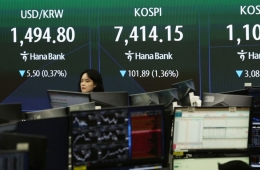
On the 26th, the KOSPI opened at 3,151.30, up 4.49 points (0.14%) from the previous trading day, at the Hana Bank dealing room in Jung-gu, Seoul. On the same day, the won-dollar exchange rate opened at 1,165.0 won, down 3.1 won from the previous trading day. Photo by Kim Hyun-min kimhyun81@
View original image[Asia Economy Reporter Junho Hwang] Recently, as the stock market has stalled, the KOSPI trading volume has dropped to its lowest level in 10 months. In addition, various factors such as the Bank of Korea's interest rate hikes and the increased possibility of tapering in the United States are expected to affect this week's stock market trading volume.
According to the Korea Exchange on the 29th, the daily trading volume on the KOSPI market on the 27th was recorded at 502.67 million shares. This is the lowest since October 29 last year (509.77 million shares).
The average daily trading volume this month was 659.83 million shares, less than half of February's (1.66831 billion shares), when stock trading was active. Last month barely exceeded 1 billion shares, and this month it has sharply decreased. During the first half of this year, the average daily trading volume each month was maintained at 1.2 billion to 1.6 billion shares, except for May (990 million shares).
The KOSDAQ's average daily trading volume this month was also 1.29431 billion shares, which is about half compared to February (2.91179 billion shares), dropping to half in half a year. Analysts say that as the stock market continues to weaken recently, caution has expanded in the stock market.
Hot Picks Today
!["Rather Than Endure a 1.5 Million KRW Stipend, I'd Rather Earn 500 Million in the U.S." Top Talent from SNU and KAIST Are Leaving [Scientists Are Disappearing] ①](https://cwcontent.asiae.co.kr/asiaresize/93/2026051414165763158_1778735817.jpg) "Rather Than Endure a 1.5 Million KRW Stipend, I'd Rather Earn 500 Million in the U.S." Top Talent from SNU and KAIST Are Leaving [Scientists Are Disappearing] ①
"Rather Than Endure a 1.5 Million KRW Stipend, I'd Rather Earn 500 Million in the U.S." Top Talent from SNU and KAIST Are Leaving [Scientists Are Disappearing] ①
- [Breaking] Two Days Before Strike... Central Labor Relations Commission Chair Park Soogeun Says "Differences Narrowing... Possibility of Agreement"
- "If That's the Case, Why Not Just Buy Stocks?" ETFs in Name Only, Now 'Semiconductor-Heavy' and a Playground for Short-Term Traders
- Individual Investors Absorb Foreign Sell-Off... Concerns Over Becoming "Cannon Fodder" Emerge
- "No Cure Available, Spread Accelerates... Already 105 Dead, American Infected"
Lee Kyung-min, a researcher at Daishin Securities, said, "The worsening COVID-19 situation, China regulatory risks, uncertainties in US/Korea monetary policies, combined with semiconductor industry conditions and earnings concerns, have created a vicious cycle where uncertainty factors, foreign selling, and won depreciation negatively feed back on each other," adding, "Flexibility is required in short-term outlook and response." He added, "Untangling this complicated knot is not easy," and "Time is needed."
© The Asia Business Daily(www.asiae.co.kr). All rights reserved.