Market Analysis
Samsung Group Stocks Reshuffled: Electro-Mechanics and SDI Surge While Biologics Falls
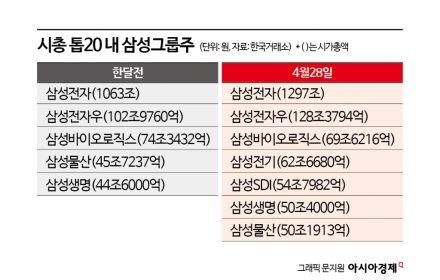
As the KOSPI continues its record-breaking rally, surpassing the 6,700 mark during intraday trading, shifts are also occurring in the market capitalization landscape of Samsung Group stocks. While Samsung Electro-Mechanics and Samsung SDI have seen significant increases in their stock prices and thus in their market capitalization over the past month, Samsung Biologics, whose stock has struggled due to labor union issues, has dropped in the rankings. Stocks benefiting from artificial intelligence (AI) are coming into the spotlight. According to the Korea Exchange on April 29, Samsung Electro-Mechanics closed at 839,000 won on the previous day, up 5.67%. The price reached as high as 845,000 won during the session, marking a new all-time high. Thanks to this rise, Samsung Electro-Mechanics surpassed Kia to secure the 11th spot in market capitalization. Samsung SDI also hit a 52-week high, climbing to 690,000 won during intraday trading and closing at 680,000 won, up 7.09%. Samsung SDI's
-
Surpassing 4 Million Won in a Week... Which ETF Saw Massive Buying Despite Weak Q1 Earnings?
-
"Mom, Did You Buy Stocks in My Name Too?"... 3 Trillion Won Accumulated in Children's Accounts

-
Why Are Department Stores Thriving as DRAM Sales Soar? [Weekend Money]
![Why Are Department Stores Thriving as DRAM Sales Soar? [Weekend Money]](https://cwcontent.asiae.co.kr/asiaresize/44/2026042315394238114_1776926383.png)
-
"They Said It Was Safe, Even Seniors Invested... But ETFs Can Also Be Delisted [Investment Barometer]"
!["They Said It Was Safe, Even Seniors Invested... But ETFs Can Also Be Delisted [Investment Barometer]"](https://cwcontent.asiae.co.kr/asiaresize/44/2026042309294237256_1776904182.png)
-
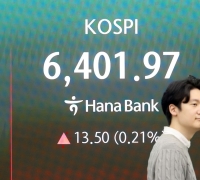
Robust Earnings, Foreign Investor Comeback, and Strong ETFs: The Power Behind KOSPI Surpassing 6,400 Points
-
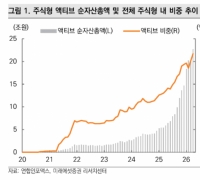
ETFs Go 'Active'... 'Money Moves' Since the Second Half of Last Year
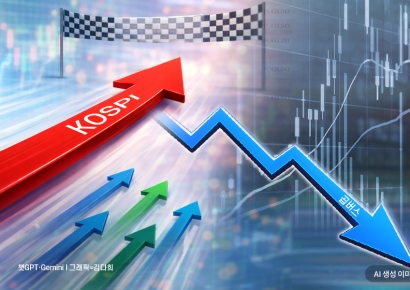
Individual Investors Net Buy 140.3 Billion Won in a Month... KOSPI Surges While Double Inverse ETFs Hit Rock Bottom
As the KOSPI rebounds from the shock of war and approaches its previous high, the prices of “geared inverse” (2x inverse) exchange-traded funds (ETFs) betting on a KOSPI decline have dropped to their lowest levels so far this year. Despite persistent geopolitical uncertainties stemming from the Middle East, expectations of continued upward momentum in the KOSPI?which has developed resilience?are leading to forecasts of further declines in the returns of geared inverse ETFs. According to the Korea Exchange on April 21, geared inverse ETFs ranked lowest in ETF performance last week. KIWOOM 200 Futures Inverse 2X fell by 13.90%, recording the sharpest drop. TIGER 200 Futures Inverse 2X declined 12.07%, KODEX 200 Futures Inverse 2X fell 11.87%, PLUS 200 Futures Inverse 2X dropped 11.67%, and RISE 200 Futures Inverse 2X was down 11.66%, placing all top five decliners among the geared inverse ETFs. These products generate double the return when the index falls, but conversely, incur double
![[PE Now] Where Is Indecisive Lotte Rental Headed?](https://cwcontent.asiae.co.kr/asiaresize/93/2026041614305828939_1776317459.png)
[PE Now] Where Is Indecisive Lotte Rental Headed?
The sale of Lotte Rental is currently stalled. After the Korea Fair Trade Commission rejected the merger between SK Rent-a-Car, owned by private equity fund (PEF) manager Affinity Equity Partners, and Lotte Rental, various scenarios have been discussed without a clear solution. Ultimately, it appears that Lotte Group is putting Lotte Rental back on the market. However, Lotte is unlikely to receive its desired price from potential buyers, while Affinity now faces the challenge of restoring the value of SK Rent-a-Car. According to the investment banking (IB) industry on April 20, Affinity abandoned its appeal of the Fair Trade Commission's decision to block the merger and has instead been negotiating with Lotte Group over the acquisition of Lotte Rental, including potential price reductions. During this process, Affinity explored multiple options to acquire Lotte Rental, including putting SK Rent-a-Car, which it acquired in 2024, up for sale. However, it is reported that Lotte Group bega
![Electric Vehicle Demand Surges as Oil Prices Rise [Weekend Money]](https://cwcontent.asiae.co.kr/asiaresize/93/2025060515173288276_1749104252.png)
Electric Vehicle Demand Surges as Oil Prices Rise [Weekend Money]
There are projections that rising oil prices could translate into benefits for the electric vehicle industry. Jiwoong Yoo, a researcher at Daol Investment & Securities, stated in a recent report titled "Identifying Beneficiaries of Rising Oil Prices" that, as the era of high oil prices is likely to be prolonged over the mid- to long-term, electric vehicle consumption has surged. Yoo explained that since oil prices began rising in February this year, demand for electric vehicles has increased, which in turn has raised the burden on finished vehicle supply chains, creating a cycle that further boosts electric vehicle demand. As of last month, electric vehicle demand in France and Germany increased by 69% and 66%, respectively, compared to the same period last year. In the United States, a rebound trend was observed. Although electric vehicle demand in March dropped by 15% year-on-year, prices of imported internal combustion engine vehicles rose due to a 15% import tariff, leading the U.S
![Can Investor Sentiment in Bio Stocks Revive in Q2 After Samchundang's Impact? [Weekend Money]](https://cwcontent.asiae.co.kr/asiaresize/93/2026041615225529091_1776320575.png)
Can Investor Sentiment in Bio Stocks Revive in Q2 After Samchundang's Impact? [Weekend Money]
Although bio stocks showed weak performance in the first quarter of this year, there is momentum building for a recovery in the second quarter, raising attention on whether stock prices will rebound. According to NH Investment & Securities on April 18, the share prices of the healthcare sector underperformed the index in the first quarter. While the KOSPI rose 39%, KOSPI pharmaceutical stocks fell by 3%. During the same period, the KOSDAQ gained 20%, but KOSDAQ pharmaceutical stocks increased by only 2%. This sluggishness is attributed to credibility issues involving leading KOSDAQ stocks. Researcher Han Seung-yeon at NH Investment & Securities explained, "In the KOSDAQ biotech space, whenever a leading stock steps back, it is common for a new stock with momentum to take its place. For example, when Celltrion Healthcare, the leading KOSDAQ stock from 2020 to 2023, was merged and dissolved, Alteogen took the top spot in 2024 after announcing a revised contract with MSD (Merck). When Alt

“KOSPI Rebounds Rapidly, but Variables Remain: ‘I Haven’t Bought Yet and Prices Already Surged’”
With the KOSPI recouping its losses from the war and nearing its previous highs, the electricity, securities, and semiconductor sectors have recovered from the shock of the war and are now trading at levels seen before the conflict. KB Securities identified Hyosung Heavy Industries, LS ELECTRIC, Mirae Asset Securities, Samsung Electronics, SK hynix, Leeno Industrial, Wonik IPS, Yes T, Doosan Fuel Cell, and PNT as stocks that initially fell due to the war but have since rebounded. Kim Minkyu, a researcher at KB Securities, explained, "Although there was a shock from the war, it was short-lived and did not alter the overall trend," adding, "Most of these stocks are also expected to see profit growth." Meanwhile, sectors that continued to rise steadily despite the war include defense, IT hardware, and battery materials. Representative stocks in these sectors are HD Hyundai Energy Solutions, OCI Holdings, Seojin System, Hanwha Aerospace, APR, Daeduck Electronics, RFHIC, Daejoo Electronic M
!["Interest on Interest"... Why Individual Investors Are Flocking to Safe, High-Yield Government Bonds [Finance Barometer]](https://cwcontent.asiae.co.kr/asiaresize/93/2026041515482627403_1776235706.jpg)
"Interest on Interest"... Why Individual Investors Are Flocking to Safe, High-Yield Government Bonds [Finance Barometer]
This year, retail government bonds have continued to sell out completely. Demand for retail government bonds is surging due to the stability guaranteed by the state and higher yields compared to bank deposits. According to the retail government bond subscription status on Mirae Asset Securities’ mobile trading system (MTS), M-STOCK, as of April 16, the subscription was oversubscribed again this month, maintaining the sell-out streak. In the April subscription, which closed the previous day, the competition rate for the 3-year coupon bond was 1.03:1, the 3-year compound interest bond was 1.46:1, the 5-year compound interest bond was 2.44:1, the 10-year compound interest bond was 1.67:1, and the 20-year compound interest bond was 1.89:1. Mirae Asset Securities conducted the April subscription for retail government bonds from April 9 to April 15. Notably, a new 3-year bond was launched this month. With the addition of the 3-year coupon bond and the 3-year compound interest bond, in additi
![[ETF 400 Trillion Era] ETF Market Quadruples in Three Years, Transforming Korea's Investment Landscape](https://cwcontent.asiae.co.kr/asiaresize/93/2026041515034227289_1776233021.jpg)
[ETF 400 Trillion Era] ETF Market Quadruples in Three Years, Transforming Korea's Investment Landscape
The Exchange-Traded Fund (ETF) market has continued its rapid growth, ushering in the era of 400 trillion won in assets. This milestone was reached just three months after surpassing the 300 trillion won mark at the beginning of this year. Accelerated by an unprecedented bull run in the stock market, the ETF market's growth has gained momentum, fundamentally reshaping the investment landscape. According to the Korea Exchange on April 15, the total market capitalization of ETFs exceeded 400 trillion won during intraday trading for the second consecutive day. As of the previous day's market close, the total net assets of ETFs stood at 398.1367 trillion won, signaling that the 400 trillion won milestone is imminent. This surge comes just over three months after the 300 trillion won threshold was passed on January 5. Initially, with ETF assets climbing to the 387 trillion won range at the end of February, it was expected that the 400 trillion won mark would be reached in early March. Howe
![[Bitcoin Now] Upbit and Bithumb Plunge Sharply](https://cwcontent.asiae.co.kr/asiaresize/93/2026041310222523289_1776043345.jpg)
[Bitcoin Now] Upbit and Bithumb Plunge Sharply
As the cold spell in the digital asset market continues, the overall profitability of virtual asset exchanges has also deteriorated. Given that transaction fees account for over 90% of their earnings under the current structure, trading volume has a significant impact, making it urgent for these exchanges to diversify their sources of revenue. According to the Financial Supervisory Service's electronic disclosure system on April 14, Dunamu, which operates the virtual asset exchange Upbit, posted a consolidated net profit of 708.9 billion won last year. This figure represents a 27.9% decrease compared to the same period in the previous year. During the same period, Dunamu's revenue was 1.5578 trillion won and operating profit was 869.3 billion won, down 10% and 26.7%, respectively, from the previous year. A Dunamu official explained, "The decrease in performance is analyzed to be a result of declining trading volumes in the digital asset market due to the global economic slowdown." Bith
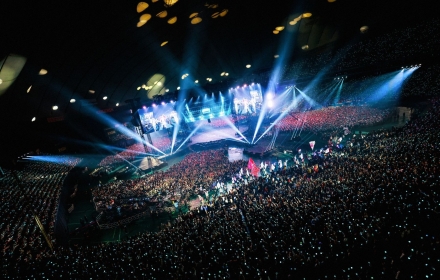
![[Why Did K-pop Leave Korea] Overseas Revenue Grows, But Less Returns Home... The Paradox of K-pop Globalization](https://cwcontent.asiae.co.kr/asiaresize/303/2026042415521039824_1777013531.jpg)
![[Why Did K-pop Leave Korea] The Era of Selling Only Songs Is Over... K-pop Competes with Four Key Survival Strategies](https://cwcontent.asiae.co.kr/asiaresize/303/2024050815595964978_1715151598.jpg)
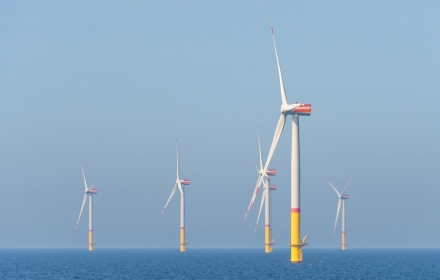
![Japan's Reliance on Foreign Turbines... Even the "Wind" Has Stopped [Seeking the Path to Wind Power Independence] ③](https://cwcontent.asiae.co.kr/asiaresize/303/2026042812050143494_1777345501.jpg)
![Monitoring 24,000 Wind Data Points... AI Prevents Wind Turbine Failures in Advance [In Search of Wind Power Independence] ②](https://cwcontent.asiae.co.kr/asiaresize/303/2026042623012840732_1777212087.jpg)
In the News

- Trump: "Iran Is Out of Its Mind... Must Get a Grip on the Situation Quickly"
- The Era of 100 Large Business Groups Begins... 11 New Entrants Including Toss, Orion, Kolmar Korea, and Korea Teachers’ Credit Union
- "Why Is Genesis Faster?" Surprised Ferrari... Promising First Results
- You Can Change Your Name, But Not Your Memories
- 'Prince of Sleeping Han River' This Year, Beat the Mosquitoes
- Our Baby Tilts Their Head... Without Care, It Could Last a Lifetime