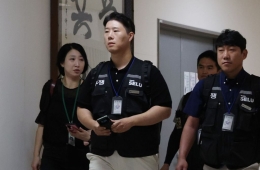
Supreme Court: "Apgujeong Hyundai Apartment, Supervising 'Break Time', to Pay 700 Million Won to Security Guards"

[Asia Economy Reporter Kim Daehyun] The Supreme Court has ruled that if workers wear uniforms and wait at a specific location under supervision during the rest periods specified in their employment contracts, this time should be considered working hours. This ruling came from a wage claim lawsuit filed by security guards of Apgujeong Hyundai Apartment against the residents.
On the 10th, the Supreme Court's 2nd Division (Presiding Justice Lee Dongwon) announced that it upheld the appellate court's partial ruling in favor of the plaintiffs in the wage claim lawsuit filed by about 30 former security guards of Apgujeong Hyundai Apartment against the Residents' Representative Meeting.
Previously, A and others who worked as security guards at Apgujeong Hyundai Apartment in Gangnam-gu, Seoul, filed a lawsuit demanding payment for the rest periods totaling six hours guaranteed under the collective agreement from 2015 to 2017, claiming they were unable to properly rest and had to work during that time.
They also claimed that the two hours of industrial safety and health training they received monthly should be counted as working hours and compensated accordingly.
The first trial court ruled against the plaintiffs, stating that "the submitted evidence is insufficient to consider the rest periods as actual working hours." It recognized only 20 minutes of the two-hour monthly industrial safety and health training as working hours.
On the other hand, the appellate court ruled in favor of the security guards, judging that they had to wear uniforms and stay at the security post during rest periods to respond to residents' complaints. It also considered the entire duration of the industrial safety and health training as working hours.
The Supreme Court agreed with this judgment. The court stated, "Rest periods refer to time during working hours when workers are freed from the employer's supervision and can use the time freely. However, if workers are effectively under the employer's supervision during rest periods, that time is included in working hours."
Furthermore, the court added, "The appellate court did not err in distinguishing between working hours and rest periods or in calculating working hours for training time, and there is no mistake affecting the judgment."
Hot Picks Today
 "Samsung and Hynix Were Once for the Underachievers"... Hyundai Motor Employee's Lament
- "Was This Delicious Treat Enjoyed Only by Koreans?"... The K-Dessert Captivating Japan
- Despite Captivating the Nation for Over a Month... "Timmy" the Whale Ultimately Found Dead
- "Record Heat Expected"...Warning of the Strongest 'Super El Nino' Since 1877
- "That? It's Already Stashed" Nightlife Scene Crosses the Line [ChwiYak Nation] ③
However, the Supreme Court overturned the part of the appellate court's ruling that applied a 20% annual delay interest rate on unpaid wages, deciding that until the judgment date, a 5% annual rate should apply, and after that, a 20% rate should be applied. This is based on the judgment that if the existence of delayed wages is appropriately disputed in court, the delay interest rate stipulated by the Labor Standards Act cannot be applied during the period the dispute persists.
© The Asia Business Daily(www.asiae.co.kr). All rights reserved.