Democratic Party Primary Postponement, But Only for Ten Days? Conflict Likely to Continue

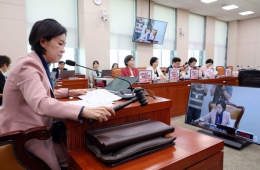
Yoon Ho-jung, the floor leader of the Democratic Party of Korea, is attending the policy coordination meeting held at the National Assembly on the 15th and delivering opening remarks. Photo by Yoon Dong-ju doso7@
View original image[Asia Economy Reporter Park Cheol-eung] The Democratic Party of Korea is effectively leaning towards adjusting the presidential primary schedule, but a plan to delay it by only about one to two weeks is being considered. Taking into account the severity of the fourth wave of COVID-19, the delay would be implemented but the process must be completed before Chuseok and the National Assembly audit. This could serve as a compromise with the camp of Gyeonggi Province Governor Lee Jae-myung, who has opposed postponement. However, other candidates’ camps, which have insisted on delaying the schedule by about two months, are expected to strongly oppose this.
On the 15th, a key official from the Democratic Party’s Election Commission told Asia Economy in a phone interview, “Although nothing is decided yet, it is true that consensus on postponing the primary has grown,” adding, “There is an opinion that the schedule should be completed before the National Assembly audit and the earlier Chuseok holiday so that it can become a topic at the holiday dinner table.” However, the official added, “Since this would not differ significantly from the original schedule, it is uncertain whether an agreement can be reached with those in favor of postponement.”
Governor Lee’s camp has expressed a stance of “We will follow the party’s decision,” reportedly viewing the National Assembly audit as the deadline. Typically, the audit is held around Chuseok, and last year it began on October 7, two days after the Chuseok holiday. The Democratic Party’s presidential candidate confirmation date is September 5, and the runoff vote, held if no candidate receives a majority, is on the 10th. Since the Chuseok holiday falls on September 20?22, postponing until just before that would only delay the runoff vote by about ten days.
As the COVID-19 situation worsened and even former Minister of Justice Choo Mi-ae and Representative Park Yong-jin, who had opposed postponement, began leaning towards delay, Governor Lee’s side found it difficult to oppose it outright. Nevertheless, they seem to be emphasizing minimizing the length of the postponement. A Democratic Party Election Commission official said, “When we contact people from Lee Jae-myung’s camp, they still express a preference to proceed according to the original schedule if possible.”
Those strongly advocating for postponement, including former Democratic Party leader Lee Nak-yeon and former Prime Minister Chung Sye-kyun, argue that with some level of herd immunity established and considering the People Power Party’s primary schedule, delaying by about two months from early September is necessary to increase public interest. Since there are differing expectations regarding the ‘postponement,’ conflicts are likely to continue.
Hot Picks Today
 "Now Our Salaries Are 10 Million Won a Month" Record High... Semiconductor Boom Drives Performance Bonuses at Major Electronic Component Firms
- Experts Already Watching Closely..."Target Price Set at 970,000 Won" Only Upward Momentum Remains [Weekend Money]
- "Heading for 2 Million Won": The Company the Securities Industry Says Not to Doubt [Weekend Money]
- Did Samsung and SK hynix Rise Too Much?... Foreign Assets Grow Despite Selling [Weekend Money]
- "Chanel Open Run? I Get a Free Pass"... The World of the Top 0.1% That Money Alone Can't Enter [Luxury World]
The key issue is the COVID-19 situation. With concerns that daily confirmed cases could rise to the 2,000 range, the Democratic Party leadership and Election Commission are deeply deliberating on what scenarios to prepare for.
© The Asia Business Daily(www.asiae.co.kr). All rights reserved.