Government: "We Will Promote North Korea-US Dialogue and Restore Inter-Korean Dialogue System"

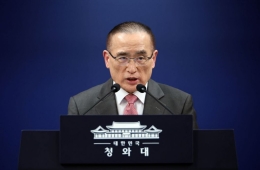
Minister of Unification Lee In-young is delivering a greeting at the 4.27 Panmunjom Declaration 3rd Anniversary Commemoration Event "Cooperation for Peace, Let's Start Again" held on the 27th in front of the DMZ gate at the northern end of the Inter-Korean Joint Security Area Office in Paju, Gyeonggi Province. 2021.4.27 Photo by Joint Press Corps
View original image[Asia Economy Reporter Lee Ji-eun] The government announced that it will promote dialogue between North Korea and the United States this year and restore the disrupted inter-Korean dialogue system.
On the 28th, the government established the "2021 Inter-Korean Relations Development Implementation Plan" containing these details, and reported it to the National Assembly after deliberation by the Inter-Korean Relations Development Committee.
This implementation plan is the fourth-year execution plan of the "3rd Basic Plan for Inter-Korean Relations Development" (2018?2022) prepared in 2018, with policy goals including ▲ resolving the North Korean nuclear issue and establishing permanent peace ▲ sustainable development of inter-Korean relations ▲ realization of a new economic community on the Korean Peninsula.
First, the government stated that it will adhere to the three principles for resolving Korean Peninsula issues?non-war, mutual security assurance, and joint prosperity?and strive to promote North Korea-U.S. dialogue. To this end, it plans to closely cooperate with the new U.S. administration to restart and lay the groundwork for progress in the Korean Peninsula peace process.
Additionally, it will expand the scope of inter-Korean relations to create conditions for resolving the North Korean nuclear issue and strengthen international cooperation to drive substantial progress in the Korean Peninsula peace process.
To improve inter-Korean relations, the government will also work to restore the inter-Korean dialogue system. Starting with consultations on sectoral issues such as COVID-19 quarantine, inter-Korean military talks, and restoration of inter-Korean communication channels, it will resume high-level talks and expand communication with the public through academic forums and commemorative projects.
Regarding the Inter-Korean Joint Liaison Office, which North Korea blew up last year, the government stated, "Based on the experience of operating the office, we will gradually promote the establishment of a developmental liaison consultation body, with the ultimate goal of establishing resident representative offices in Seoul and Pyongyang."
Concerning the "Law Prohibiting Leaflets to North Korea (Amendment to the Act on the Development of Inter-Korean Relations)," which has sparked controversy over "freedom of expression infringement" in some parts of the international community, the government said, "We will clarify the interpretation of the scope of legal application through the enactment of enforcement regulations."
This year, exchanges and cooperation between the government and the private sector will also be expanded in various fields. Joint inter-Korean events involving both public and private sectors will be held on occasions such as June 15 and October 4, while supporting inter-Korean exchanges by religious and social organizations, including visits to religious holy sites, and resuming inter-Korean exchanges through international events or third countries.
In the sports sector, the government will foster an atmosphere of inter-Korean sports exchanges through international competitions and cooperate on the joint bid for the 2032 Summer Olympics.
In the economic cooperation (Gyeonghyeop) sector, cooperation between the North and South authorities will be expanded step-by-step. After inter-Korean consultations on railway and road connections and modernization, the process will proceed in the order of additional and detailed surveys → basic plan → design → construction. In the aviation and maritime sectors, restoration of existing air routes between the North and South, establishment of new international air routes in the East and West Seas, and restoration of inter-Korean maritime routes will be pursued.
Considering the COVID-19 situation, individual tourism and small-scale trade with North Korea will also be promoted. Regarding Kumgangsan tourism, in response to the North's independent development plans, the government will emphasize the necessity of cooperative development through dialogue and seek effective reopening measures for the Kaesong Industrial Complex.
Based on the draft of the "National Unification Agreement," the government will also promote public discourse on unification policy.
Hot Picks Today
 Even with High Oil Price Relief Payment, Additional 300,000 Won Per Person to Be Provided... Applications Open from the 18th in This Region
- "Invested 95% in Hynix and Reached 10 Billion Won"... Japanese Investor's Proof Post Goes Viral
- "Why Is the Korean Stock Market Surging?"... Even Italy Is Astonished by the KOSPI Rally
- "You Don't Need to Go to the Gym": The Best Exercises for Lowering Hypertension
- "That Thing Wakes Up Every Night" ... Suspicious Object Covers Rural Village
Regarding the limitations of inter-Korean cooperation projects last year, the government stated, "Since the Hanoi North Korea-U.S. summit, inter-Korean relations have remained strained, and sanctions against North Korea and COVID-19 were also limiting factors." It added, "The North's destruction of the Inter-Korean Joint Liaison Office and the shooting death of our citizens in the West Sea worsened public perception toward North Korea."
© The Asia Business Daily(www.asiae.co.kr). All rights reserved.