Minister Choi Ki-young of MSIT Apologizes for Delay in Heavy Ion Accelerator Project... Will Accelerate Efforts
![[Image source=Yonhap News]](http://www.asiae.co.kr/news/img_view.htm?img=2021021715421481222_1613544134.jpg)
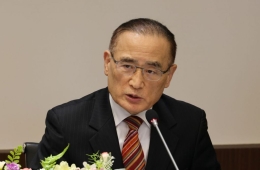
[Asia Economy Reporter Kim Bong-su] Choi Ki-young, Minister of Science and ICT, apologized for the delay in the large-scale basic science research project, the 'Heavy Ion Accelerator' project.
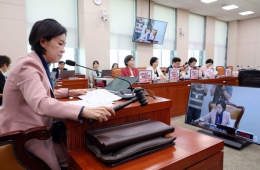
On the 17th, at the National Assembly Science, Technology, Information and Broadcasting and Communications Committee (STIBC), Minister Choi said, "Management has been insufficient," in response to Democratic Party lawmaker Yoon Young-chan's questioning about the schedule delay of the Heavy Ion Accelerator project. Lawmaker Yoon pointed out, "The project schedule has been postponed three times," and added, "It is becoming increasingly difficult to convince the public that the delay is due to technical difficulties."
Yoon also urged, "The Ministry of Science and ICT should not just leave the project to IBS but accurately identify the problems and clearly define the strategy for moving forward," and emphasized, "An internal audit should be conducted to investigate the causes and changes should be made to the project."
In response, Minister Choi said, "Because the project was pushed forward without sufficient research and development, unforeseen situations have arisen causing delays," and promised, "I will take responsibility and manage the project going forward." He also added, "By the end of this year, we plan to achieve at least minimal results in the low-energy section and proceed with R&D in the high-energy section, and we will accelerate progress by introducing a PM (Project Manager) system."
Hot Picks Today
 "Now Our Salaries Are 10 Million Won a Month" Record High... Semiconductor Boom Drives Performance Bonuses at Major Electronic Component Firms
- Is It Really Like an Illness? "I Can't Wait to Go Again"—Over 1 Million Visited in Q1, Now 'Busanbyeong' Takes Hold [K-Holic]
- "Realizing How Fast Money Disappears: Should You Try Only the Essentials for 5,000 Won? [The Basics of Benefits]"
- "Heading for 2 Million Won": The Company the Securities Industry Says Not to Doubt [Weekend Money]
- Experts Already Watching Closely..."Target Price Set at 970,000 Won" Only Upward Momentum Remains [Weekend Money]
Meanwhile, the government is building the Heavy Ion Accelerator in the Shindong district of Daejeon with an investment of 1.5 trillion won. It is the largest basic science project since the founding of Korea and has been underway for 10 years. The accelerator can accelerate various heavy ions from protons to uranium to generate rare isotopes that can be used in various basic science fields. The government plans to complete the construction of the low-energy accelerator within this year and begin test operations. However, for the high-energy accelerator, difficulties in developing the superconducting accelerator tubes (SSR1, SSR2) have made it difficult to specify the completion date for the entire facility.
© The Asia Business Daily(www.asiae.co.kr). All rights reserved.