The Election Commission: "Only One Unification Debate? That Was 19 Years Ago... We Will Respond If Asked"
Ahn Cheol-soo and Geum Tae-seop's Provided Interpretation Reflects Roh Moo-hyun and Chung Mong-joon's Case
At That Time, Interpretation Allowed Access to Other Candidates or Multiple Debates if Host Was Not a Broadcaster
[Asia Economy Reporter Naju-seok] It has been confirmed that the response from the 'National Election Commission,' which was mentioned as an obstacle to the unification debate between Ahn Cheol-soo, the People's Party candidate for Seoul mayor, and Geum Tae-seop, the independent candidate for Seoul mayor, is merely 'reference' rather than a 'recommendation.'
On the 15th, a National Election Commission official stated, "(The interpretation regarding the unification debate between candidate Ahn and candidate Geum) was guidance based on past precedents and not an official interpretation," adding, "If questions arise regarding the debate, we will provide answers." The precedent provided was for 'reference' purposes only.

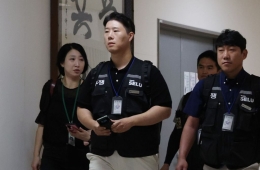
Eighty days ahead of the Seoul mayoral by-election, on the 18th, officials at the Seoul Jongno District Election Commission are putting up promotional materials with the phrase "Beautiful Election, Happy Republic of Korea" at the entrance. Photo by Mun Ho-nam munonam@
View original imagePreviously, it was reported that the National Election Commission conveyed an interpretation from 19 years ago regarding the unification of candidates Ahn and Geum. In this context, Ahn's side argued that there is only one opportunity for a unification debate. Therefore, they claimed that the originally agreed two debates with candidate Geum would be difficult, and that if a debate with candidate Geum takes place, it would also be difficult to hold a unification debate with the final candidate from the People Power Party afterward.
However, the precedent provided by the National Election Commission for 'reference' purposes was a unification debate from 19 years ago in 2002 on KBS broadcasting between Roh Moo-hyun, then the Democratic Party candidate, and Chung Mong-joon, then the candidate of the National Unity 21. The issue was whether the broadcaster could hold a debate related to unification.
At that time, the National Election Commission stated, "Debate broadcasts can be aired only once in the form of relay broadcasting," but added a proviso, "If broadcasting more than once is desired, it is only possible if other candidates selected by reasonable criteria are given the opportunity to participate." This clause implies that if other candidates are also guaranteed the opportunity to participate in related debates, more than one debate is possible.
Moreover, regarding cases where an external organization hosts a two-party debate for the public and a broadcasting station reports it, the Commission responded that "this is a matter under the autonomy of the broadcasting station." This means that if the debate is not hosted by the broadcaster, the restriction on the number of relay-broadcasted debates may be lifted, as included in the response.
Furthermore, since the situation and media environment have changed over the past 19 years, it is uncertain whether the same restrictions on the number of debates will apply.
Hot Picks Today
 "Samsung and Hynix Were Once for the Underachievers"... Hyundai Motor Employee's Lament
- "Was This Delicious Treat Enjoyed Only by Koreans?"... The K-Dessert Captivating Japan
- Despite Captivating the Nation for Over a Month... "Timmy" the Whale Ultimately Found Dead
- "Record Heat Expected"...Warning of the Strongest 'Super El Nino' Since 1877
- "That? It's Already Stashed" Nightlife Scene Crosses the Line [ChwiYak Nation] ③
A National Election Commission official explained, "The situation may not be the same, and there may not have been specific inquiries about the debate format, so we will respond accordingly." However, it is known that neither side has yet made inquiries regarding the debate.
© The Asia Business Daily(www.asiae.co.kr). All rights reserved.