Serious Accident Punishment Act, Government Trying to Lower Severity... "Is This a 'Protection' Law for Companies?"
Controversy Over Application Delay Based on Company Size
Employer Responsibility and Punishment Severity Also Key

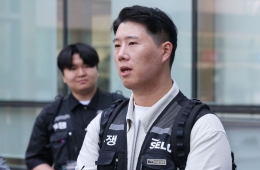
Baek Hye-ryun, Chairperson of the Legislation and Judiciary Committee's First Subcommittee on Bill Review, attended the First Subcommittee on Bill Review of the Legislation and Judiciary Committee held at the National Assembly on the 29th and spoke with Lee Yong-gwan, father of the late PD Lee Han-bit, Kim Mi-sook, mother of the late Kim Yong-gyun and director of the Kim Yong-gyun Foundation, and Kang Eun-mi, floor leader of the Justice Party, urging the enactment of the Serious Accidents Punishment Act. Photo by Yoon Dong-ju doso7@
View original image[Asia Economy Reporter Park Cheol-eung] Initially, the government held the opinion that strengthening the existing Industrial Safety and Health Act (San-an Act) was preferable to enacting the Serious Accidents Punishment Act. They believed that within the framework of the San-an Act, the employer's safety management obligations could be specifically reinforced and responsibilities more strictly enforced to achieve the goal of accident prevention. Nevertheless, as the Democratic Party of Korea pushed for the enactment of the Serious Accidents Act, the government proposed a more lenient version.
The most controversial point is the grace period condition. The Democratic Party's bill proposes a four-year grace period only for workplaces with fewer than 50 employees, which has drawn strong opposition from the Justice Party and labor groups. The government went a step further by suggesting an additional two-year grace period for workplaces with 50 to fewer than 100 employees.
On the 29th, Kim Jong-chul, leader of the Justice Party, pointed out on Facebook that 85% of serious accidents occur in workplaces with fewer than 50 employees, stating, "The primary contractor's responsibility is weakened, punishments are relaxed, and punitive damages are also reduced. What was supposed to be a Serious Accidents 'Punishment' Act has turned into a Serious Accidents 'Protection' Act. I think I understand why industrial accidents have not decreased even under the Moon Jae-in administration," criticizing the bill.
Because the law's name includes 'punishment,' constitutional issues and criticisms of excessive legislation have been raised due to conflicts with criminal law. The bill proposed by Democratic Party lawmaker Park Ju-min stipulates that if an employer or management officer violates safety obligations resulting in a fatal accident, they shall be sentenced to imprisonment of two years or more or fined at least 500 million KRW. In terms of punishment severity, the bill by Im I-ja of the People Power Party is the strictest, prescribing imprisonment for five years or more or a fine up to 1 billion KRW.
Although criminal liability can be imposed under criminal law for professional negligence, the Serious Accidents Act is designed to take precedence and allow criminal punishment. Heo Byung-jo, a specialist at the National Assembly's Legislation and Judiciary Committee, noted in a review report on Justice Party lawmaker Kang Eun-mi's bill that "consideration is needed as the penalty is relatively severe compared to similar types of negligence or safety obligation violations."
Accordingly, the government proposed maintaining the punishment clause but setting the maximum fine at 'up to 1 billion KRW.' At a subcommittee meeting of the Judiciary Committee held on the 24th, it was discussed and a provision allowing imprisonment and fines to be imposed concurrently was also suggested.
The 'presumption of causation' clause included in Park Ju-min's bill is likely to be removed. This clause defines employers or management officers who have violated safety obligations three or more times within five years as the cause providers of serious accidents. This is a representative provision with potential constitutional issues; it was omitted from the bill proposed by Democratic Party lawmaker Park Beom-gye, and the government also proposed deleting it.
Regarding punitive damages, the government proposed a limit of 'up to five times' the damage amount. This is significantly lower than Park Ju-min's bill's 'five times or more' and Justice Party lawmaker Kang Eun-mi's 'three to ten times.' Specialist Heo stated, "It is necessary to consider that punitive damages can be an exception to the principle of liability, which is the fundamental principle of tort law." He also noted that since other laws generally set the upper limit of punitive damages at 'three times the damage amount,' the proposed amount might be excessive and requires discussion. The government appears to have taken this into account.
There have also been ongoing criticisms that the employer's obligation provisions are unclear. Heo Byung-jo, the Judiciary Committee specialist, said, "Since criminal punishment can be imposed, the provisions should be as clear as possible," adding, "The current wording, such as 'to prevent harm to the life, body safety, or health hygiene of workers or users,' is broad and abstract, making it difficult for those subject to the law to predict the scope of their obligations." He further noted, "This not only violates the principle of liability but could also lead to a contraction of corporate activities."
Hot Picks Today
!["Heading for 2 Million Won": The Company the Securities Industry Says Not to Doubt [Weekend Money]](https://cwcontent.asiae.co.kr/asiaresize/93/2025061015355092669_1749537351.jpg) "Heading for 2 Million Won": The Company the Securities Industry Says Not to Doubt [Weekend Money]
"Heading for 2 Million Won": The Company the Securities Industry Says Not to Doubt [Weekend Money]
- "Anyone Who Visited the Room Salon, Come Forward"… Gangnam Police Station Launches Full Staff Investigation After New Scandal
- "Envious of Korean Daily Life"...Foreign Tourists Line Up in Central Myeongdong from Early Morning [Reportage]
- "Can't Even Turn On a Fan? How Will They Endure the Heat?"... Massive Blackout Hits the Philippines Amid Scorching Heat
- Did Samsung and SK hynix Rise Too Much?... Foreign Assets Grow Despite Selling [Weekend Money]
In response, the government proposed specifying the obligations more concretely, such as 'risks caused by hazardous or dangerous machinery, equipment, or facilities,' 'risks caused by substances that can cause serious health damage,' and 'risks associated with work at locations with high risk of falls or collapses.' Since more detailed obligation provisions increase the law's effectiveness, the government's proposal is likely to be adopted. Regarding special provisions on punishment for related public officials, the government narrowed the scope to 'public officials with licensing or supervisory authority.'
© The Asia Business Daily(www.asiae.co.kr). All rights reserved.