[Q&A] Fair Trade Commission Chairman: "Maintenance of Exclusive Prosecution System Reflects Consideration of Small and Medium Enterprises' Opposition... Respecting National Assembly's Decision"
Joint Briefing on the Fair Economy 3 Acts

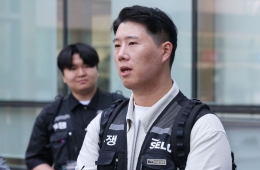
Josungwook, Chairman of the Fair Trade Commission, is holding a 'Joint Briefing on the Three Fair Economy Acts' at the Government Seoul Office Building on the 16th.
View original image[Sejong=Asia Economy Reporters Joo Sang-don and Moon Chae-seok] Cho Sung-wook, Chairman of the Korea Fair Trade Commission (KFTC), stated on the 16th, "The maintenance of the exclusive prosecution system is a matter that has been deliberated and resolved by the National Assembly, and the Fair Trade Commission respects the decision of the National Assembly." This was an indirect way of saying that they will not re-push for the abolition of the exclusive prosecution system.
On the same day, Chairman Cho said at a joint briefing on the 'Fair Economy 3 Acts (Fair Trade Act, Commercial Act, and Act on the Supervision of Financial Conglomerates)' held at the Government Complex Seoul with the Ministry of Justice and the Financial Services Commission, "The National Assembly considered the fact that small and medium-sized enterprises were the most opposed to the abolition of the exclusive prosecution system from the beginning."
The comprehensive amendment to the Fair Trade Act, passed by the National Assembly on the 9th, excluded the KFTC's proposal to abolish the exclusive prosecution right, which was originally included in the government’s plan. However, there are still ongoing claims that the exclusive prosecution right should be abolished. Regarding this, Chairman Cho emphasized, "Although the KFTC holds the exclusive prosecution right, when the prosecution or Public Procurement Service believes that 'the KFTC's prosecution is insufficient,' they can use the mandatory prosecution request system," adding, "Such complementary measures like the mandatory prosecution request system are actually being activated quite a lot."
Below are the main points from the Q&A session between Chairman Cho and the press corps.
▲The Fair Trade Act has been revised for the first time in 40 years. What is the biggest change in the KFTC’s law enforcement?
= I believe that the passage of the Fair Economy 3 Acts, including this revision of the Fair Trade Act, is a significant step toward strengthening our economic system and achieving innovative growth. With the expansion of civil enforcement measures, companies have greater incentives to change themselves, and victim relief will be activated. The introduction of the data submission order system and the expansion of the scope for dispute mediation applications are examples. These private civil enforcement measures complement the previously existing public enforcement. When civil enforcement is activated, I believe it will enable victims to receive prompt relief.
We will enforce public enforcement more strictly. The regulation of private interests has addressed regulatory blind spots. The upper limit of fines for unfair practices has been doubled. We will faithfully enforce the law to ensure effective sanctions.
Lastly, considerations were made to support innovation in new industries during law enforcement. We will promote the venture ecosystem so that Corporate Venture Capital (CVC) and venture holding companies can be activated, and strengthen law enforcement in areas that hinder innovation. From the perspective of law enforcement, victim relief will be faster in the future. The KFTC will enforce the law strictly and faithfully while ensuring innovation in new industries.
▲There are many evaluations that the comprehensive amendment to the Fair Trade Act represents a 'regression in chaebol reform policies.' Do you think this amendment is sufficient to prevent the chaebols’ illicit practices?
= The essence of your question seems to be whether it can completely prevent the chaebols’ illicit practices. I think it is not perfect. However, it is much more progressive than the chaebol reform policies the KFTC had in the past. It is a step forward in the legislation.
Hot Picks Today
!["Heading for 2 Million Won": The Company the Securities Industry Says Not to Doubt [Weekend Money]](https://cwcontent.asiae.co.kr/asiaresize/93/2025061015355092669_1749537351.jpg) "Heading for 2 Million Won": The Company the Securities Industry Says Not to Doubt [Weekend Money]
"Heading for 2 Million Won": The Company the Securities Industry Says Not to Doubt [Weekend Money]
- "Anyone Who Visited the Room Salon, Come Forward"… Gangnam Police Station Launches Full Staff Investigation After New Scandal
- "Can't Even Turn On a Fan? How Will They Endure the Heat?"... Massive Blackout Hits the Philippines Amid Scorching Heat
- "Drink Three Cups of Coffee and Stay Up All Night Before the Test"... Manual of Insurance Planner Who Collected 1 Billion Won in Payouts
- Did Samsung and SK hynix Rise Too Much?... Foreign Assets Grow Despite Selling [Weekend Money]
Compared to the past, I believe illicit practices will decrease going forward. We already have various laws and systems that can activate market surveillance functions. Through these, existing companies will voluntarily improve their governance and law enforcement will be carried out to prevent illicit practices.
© The Asia Business Daily(www.asiae.co.kr). All rights reserved.